


While the capture of Venezuelan President Nicolas Maduro following US airstrikes marked a seismic geopolitical development, early signals suggested that the global oil market would largely take the move in its stride.
Venezuela’s oil infrastructure was not affected after a series of US attacks in Caracas and other states, people with knowledge of the matter said.
Key facilities such as the Port of Jose, the Amuay refinery and oil areas in the Orinoco Belt are still operational, the people said.
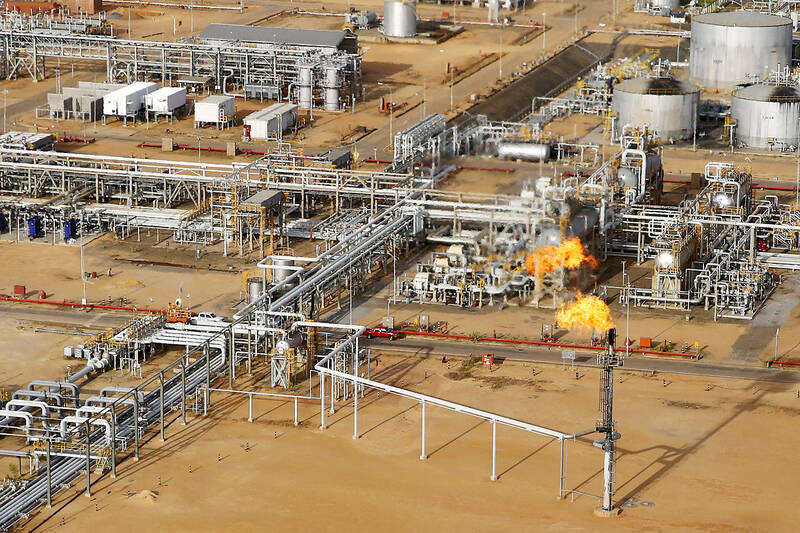
Photo: Reuters
While Venezuela was once an oil-producing powerhouse, its output has declined precipitously over the past two decades and now represents less than 1 percent of global supplies. US pressure on Maduro’s regime, including the seizure of tankers carrying Venezuelan crude, forced the country to start shutting some oil wells.
US President Donald Trump on Saturday said that sanctions on Venezuela’s oil industry would remain in place and US oil companies would help rebuild infrastructure and revive output.
Such a reconstruction would be highly ambitious and most likely a distant prospect. In the meantime, worldwide oil supplies are expected to exceed demand by 3.8 million barrels a day this year, which would mark a record glut, the International Energy Agency said.
Crude prices have slumped in recent weeks to about US$60 a barrel.
“I assess that Brent crude prices will rise only marginally at the open on Sunday evening, by US$1-US$2 or even less,” A/S Global Risk Management Ltd chief analyst Arne Lohman Rasmussen said. “Even under normal conditions, a disruption of this magnitude is manageable for the market. In particular, all forecasts point to a significant oversupply in the first quarter, driven by seasonally weak demand and OPEC+ production increases.”
Despite the volatility of the past month, US oil producer Chevron Corp has continued to operate in the country under a sanctions waiver issued by the Trump administration.
“Chevron remains focused on the safety and wellbeing of our employees, as well as the integrity of our assets,” the company said. “We continue to operate in full compliance with all relevant laws and regulations.”
Maduro’s capture raised speculation over the fate of the Venezuelan oil industry in the longer term.
Trump said that US companies would spend billions of dollars to rebuild the Venezuelan oil sector and sell a “large amount” of oil to global buyers, including current customers and new ones.
It was not immediately clear which oil companies he was referring to and he did not specify how soon they would be able to begin production. It was also unclear how willing oil giants such as Exxon Mobil Corp, Chevron, ConocoPhillips and others are to pour substantial sums of money into a country run by a temporary US-backed government without established legal and fiscal rules.
“History shows that forced regime change rarely stabilizes oil supply quickly, with Libya and Iraq offering clear and sobering precedents,” Rystad Energy AS geopolitical analyst Jorge Leon said.

HORMUZ ISSUE: The US president said he expected crude prices to drop at the end of the war, which he called a ‘minor excursion’ that could continue ‘for a little while’ The United Arab Emirates (UAE) and Kuwait started reducing oil production, as the near-closure of the crucial Strait of Hormuz ripples through energy markets and affects global supply. Abu Dhabi National Oil Co (ADNOC) is “managing offshore production levels to address storage requirements,” the company said in a statement, without giving details. Kuwait Petroleum Corp said it was lowering production at its oil fields and refineries after “Iranian threats against safe passage of ships through the Strait of Hormuz.” The war in the Middle East has all but closed Hormuz, the narrow waterway linking the Persian Gulf to the open seas,

RATIONING: The proposal would give the Trump administration ample leverage to negotiate investments in the US as it decides how many chips to give each country US officials are debating a new regulatory framework for exporting artificial intelligence (AI) chips and are considering requiring foreign nations to invest in US AI data centers or security guarantees as a condition for granting exports of 200,000 chips or more, according to a document seen by Reuters. The rules are not yet final and could change. They would be the first attempt to regulate the flow of AI chips to US allies and partners since US President Donald Trump’s administration said it rescinded its predecessor’s so-called AI diffusion rules. Those rules sought to keep a significant amount of AI

Apple Inc increased iPhone production in India by about 53 percent last year and now makes a quarter of its marquee devices there, reflecting the US company’s efforts to avoid tariffs on China. The company assembled about 55 million iPhones in India last year, up from 36 million a year earlier, people familiar with the matter said, asking not to be named because the numbers aren’t public. Apple makes about 220 million to 230 million iPhones a year globally, with India’s share of the total increasing rapidly. Apple has accelerated its expansion in the world’s most populous country in recent years, bolstered

A new worry has been rippling across the stock market lately: Entire businesses, not just their employees, might be thrown out of work. While most economists say fears of an artificial intelligence (AI) job apocalypse are overblown, seismic shifts have happened in the past after big tech breakthroughs. The IT revolution of the 1990s led to a surge in productivity that sped up the US economy for several years. It also rendered companies or even industries largely redundant — from travel agents and stockbrokers to classified advertising and newspapers, or video rental stores. Economists expect AI would deliver higher productivity,


 RSS
RSS