


Fourteen-year-old Estella spends her weekdays studying Spanish, rock climbing or learning acupuncture in her living room as part of her homeschooling since she left China’s grueling public school system.
Her parents withdrew her from her Shanghai school three years ago, worried she was struggling to keep up with a demanding curriculum they believe would soon be outdated in the era of artificial intelligence (AI).
They are among a small number of parents in China who are rethinking the country’s rigorous education system, in which school days can last 10 hours, with students often working late into the evening on extra tutoring and homework.
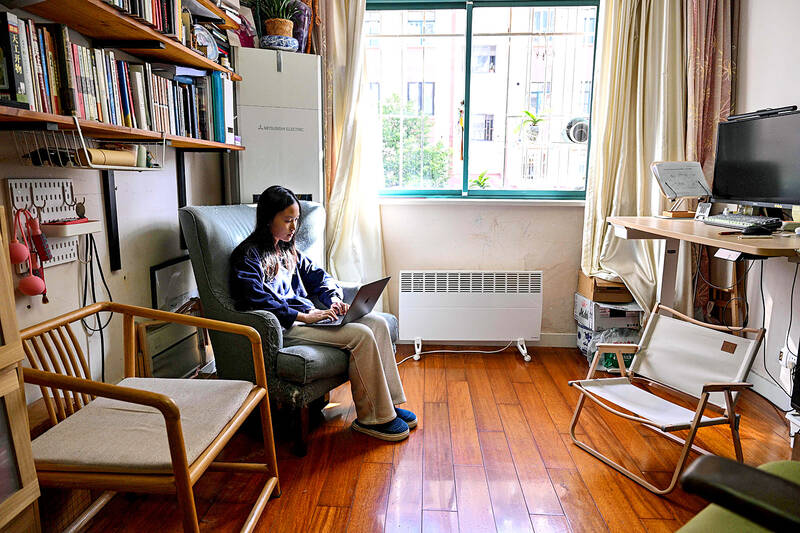
Photo: AFP
“In the future, education models and jobs will face huge changes due to AI,” said Estella’s mother, Xu Zoe, using a pseudonym.
“We wanted to get used to the uncertainty early,” she said.
Homeschooling is banned in China, although authorities overlook rare individual cases.
Just 6,000 Chinese children were homeschooled in 2017, according to the non-profit 21st Century Education Research Institute. By comparison, China had about 145 million primary and middle-school students that year.
However, that number of homeschoolers had increased annually by about 30 percent from 2013, the institute said.
Supporters say looser schedules centered around practical projects, and outdoor activities help nourish creativity that is squashed by the national curriculum.
In Shanghai, Estella’s school day ended at 5pm, and she often spent around four hours a night on homework.
“Instead of just doing a stressful exam in school, I will do the things I was interested [in],” said Estella, who, unlike many students her age, would not be cramming for high-school entrance exams she would have taken next year.
Her parents have hired tutors in science, maths, Spanish and gym, and together with Estella decide her schedule.
On a Tuesday afternoon, she was the youngest at a nearby climbing gym, hoisting herself up the wall after a day of online Spanish studies from her living room and an acupuncture lesson taught by her mother.
Xu, 40, said her daughter has grown more confident since leaving the highly competitive public school system.
“We don’t use societal standards to evaluate ourselves but rather, what kind of person we want to be,” she said.
Experts say Chinese people are increasingly questioning the value of traditionally prized degrees from elite universities in an oversaturated market.
In 2023, fewer than one in five undergraduates from Shanghai’s prestigious Fudan University found jobs immediately after graduation.
The country’s unemployment rate for 16 to 24-year-olds reached a two-year high of 18.9 percent in August last year, according to the Chinese National Bureau of Statistics.
“[China] has out-produced. Too many PhDs [doctorates], too many master’s, too many undergraduates. The jobs they are trying to get are disappearing,” said Yong Zhao, an author on China’s education system.
Chinese authorities have tried to counter the competitive learning culture by cracking down on cram schools in the past few years — but tutoring, paid under the table, remains in demand.
While homeschooling is technically illegal, Zhao said families can generally “get away with it without causing too much attention.”
One mother in Zhejiang Province, who wished to remain unidentified for fear of repercussions, said she used an AI chatbot to create a lesson plan on recycling for her nine-year-old homeschooled son.
“The development of AI has allowed me to say that what you learn in a classroom, you don’t need anymore,” she said.
Her son studies Chinese and maths using coursework from his former public school in the mornings and spends afternoons working on projects or outdoor activities.
However, his mother, a former teacher, plans to re-enrol her son when he reaches middle school.
“There’s no way to meet his social needs at home,” she said.
Time with children her age was one of the biggest losses for 24-year-old Gong Yimei, whose father pulled her out of school when she was 8 to focus on art.
She studied on her own with few teachers, and most of the people she called friends were twice her age.
However, Gong said that at home, she had more free time to consider her future.
“You ask yourself: ‘What do I like? What do I want? What is the meaning of the things I do?’” said Gong, who hopes to launch an education start-up.
“It helped me more quickly find myself,” she added.
Back in Shanghai, college is an uncertainty for Estella, whose family plans to spend time in Europe or South America to improve her Spanish.
Her mother, Xu, is hopeful that homeschooling could become more mainstream in China.
She said she would encourage other parents considering it to take the leap.
“You don’t need to be afraid,” she said.

Cairo’s new monorail slices across the city skyline, running above the familiar chaos of blaring horns and aging buses’ exhaust fumes that mark rush hour below. The US$4.5 billion monorail, opened this month, is among Egypt’s most prominent new transport projects, part of a debt-funded infrastructure drive criticized for sapping state finances while bringing limited benefits to most of the country’s 109 million people. “It feels like you’re in a different country,” said Ramy Sayed, a restaurant manager, aboard a driverless Innovia 300 train. “No noise, no traffic, we’re not used to this.” The eastern line runs 56km from the bustling middle-class

Taiwanese firms have increased investment in the Philippines in recent years as Manila’s ties with Washington deepen and global supply chains continue to shift away from China, an expert at the Chung-Hua Institution for Economic Research (CIER, 中華經濟研究院) said yesterday. The Philippines had not been among Taiwanese investors’ top choices in Southeast Asia, CIER Taiwan ASEAN Studies Center director Kristy Hsu (徐遵慈) said at a seminar in Taipei. However, Taiwan’s investment in the country has grown significantly since the COVID-19 pandemic, reaching US $257 million last year, a high in recent years, she said. Although Taiwan’s total investment in the Philippines still lags
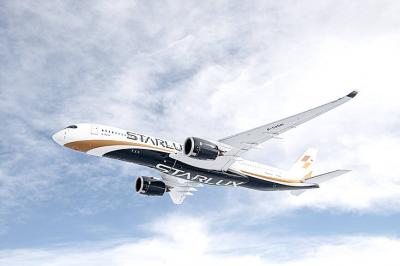
Starlux Airlines Co (星宇航空) today unveiled a long-haul network expansion plan at a shareholders’ meeting in Taipei, including direct flights to Barcelona, Spain, and Zurich, Switzerland, as well as a service connecting Taipei, Sydney and New Zealand. Starlux is to become the first Taiwanese carrier to offer non-stop services to the two European cities, while the inaugural oceanic route is expected to expand transit opportunities within the Australia-New Zealand market, Starlux said. Flight services to Chicago, Dallas, Washington and New York are under evaluation, the airline added. Prior to the shareholders’ meeting, the airline earlier this year announced that it would be

Intel Corp regards Taiwan Semiconductor Manufacturing Co (TSMC, 台積電) as a longstanding partner, as the US chipmaker would continue outsourcing production of advanced chips to TSMC, Intel chief executive officer Lip-Bu Tan (陳立武) said yesterday. “I don’t look at people as competitors. I look at the collaboration... Nvidia is also, you know, a good friend,” Tan told a news conference following his keynote speech at the Computex trade show in Taipei. “It’s a very trusted partnership for us... We are a big, top customer for them, and we’re going to continue doing that,” he said, referring to TSMC, the world’s largest foundry


 RSS
RSS