


BYD Co (比亞迪) last year met its full-year sales target and likely surpassed Tesla Inc to become the world’s largest maker of electric vehicles (EVs) — a milestone overshadowed by a challenging outlook for the Chinese auto market in the year ahead.
The Chinese EV giant’s Hong Kong-listed shares rose on the first day of trading for the new year, gaining as much as 2.3 percent yesterday.
The Shenzhen-based automaker delivered 4.6 million vehicles last year, up 7.7 percent from 2024. That is in line with a lowered full-year goal the company gave in September.
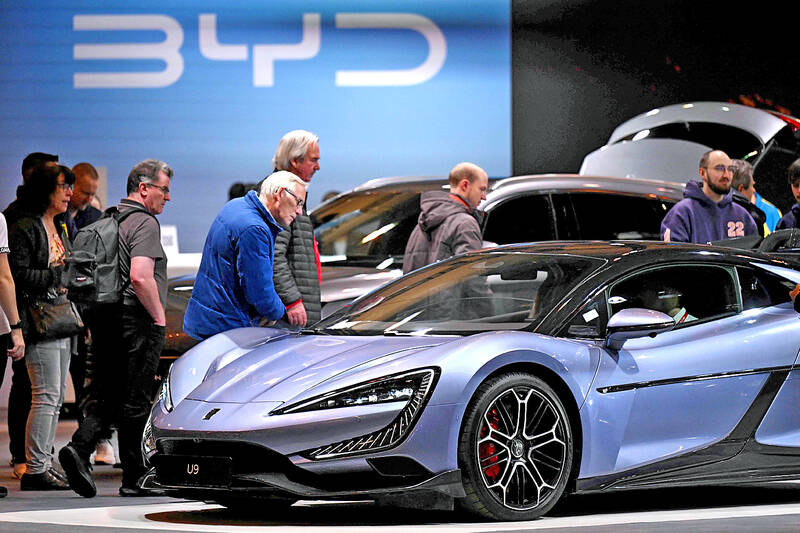
Photo: AFP
Among the mix, it sold almost as many fully electric vehicles as it did plug-in hybrids.
Tesla yesterday was expected to report that it delivered about 440,900 vehicles in the fourth quarter, down 11 percent from a year earlier, data compiled by Bloomberg showed.
That would mean annual sales of about 1.6 million — the second consecutive annual drop.
BYD and its rivals face growing pressure in the coming year as China scales back some incentives supporting EV purchases. An influx of new models is also making domestic competition even fiercer, while trade barriers pose challenges for BYD’s ambitions to expand overseas.
China’s best-selling automaker has faced stiffer competition in the past year from Geely Automobile Holdings Ltd (吉利汽車) and Xiaomi Corp (小米), whose new models and rapid innovations are winning over consumers.
BYD’s shares gained 7 percent last year, but gave up gains from an early rally that saw its shares jump as much as 74 percent by late May as tougher competition and increased regulatory scrutiny became more prominent.
BYD chief executive officer Wang Chuanfu (王傳福) at an investors’ meeting early last month said that the technological head start the company had maintained over the past few years had diminished and affected domestic sales.
He hinted at new technology breakthroughs to come, with the company’s 120,000-strong engineering team giving him confidence about its ability to regain advantages, Chinese media reported.
A bright spot for BYD has been surging overseas sales. Deliveries outside China hit 1.05 million last year, exceeding the high-end estimate of 1 million sales, enabling it to offset the company’s decline in its core market, where its passenger EV and hybrid sales fell for the eighth consecutive month, slumping 37.7 percent last month.
Morgan Stanley in a note said that it forecasts a more meaningful domestic recovery after BYD launches several major facelifts to its lineup this year.
The company has set a goal to expand overseas sales to between 1.5 million and 1.6 million units this year, according to a Citigroup Inc report in November that cited a meeting with BYD management.
Pressure is mounting on BYD after it posted back-to-back declines in quarterly profit and found itself at the center of China’s efforts to rein in aggressive discounting. The growing scrutiny is likely to accelerate consolidation and shake up the hierarchy of the sector.
So far, analysts are confident that BYD can weather the challenges better than others. The company’s total sales could grow to 5.3 million units next year, analyst estimates compiled by Bloomberg showed.
Analysts at Deutsche Bank expect new product launches and the unveiling of a technology platform to boost the company’s competitiveness. That could enable BYD to stretch its lead over Tesla.

SECOND-RATE: Models distilled from US products do not perform the same as the original and undo measures that ensure the systems are neutral, the US’ cable said The US Department of State has ordered a global push to bring attention to what it said are widespread efforts by Chinese companies, including artificial intelligence (AI) start-up DeepSeek (深度求索), to steal intellectual property from US AI labs, according to a diplomatic cable. The cable, dated Friday and sent to diplomatic and consular posts around the world, instructs diplomatic staff to speak to their foreign counterparts about “concerns over adversaries’ extraction and distillation of US AI models.” Distillation is the process of training smaller AI models using output from larger, more expensive ones to lower the costs of training a powerful new
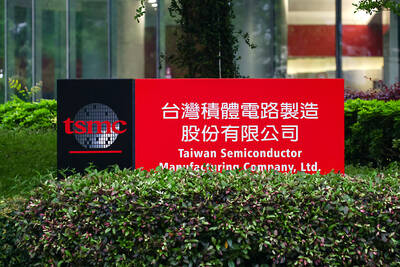
Shares of Taiwan Semiconductor Manufacturing Co (TSMC, 台積電) have repeatedly hit new highs, but an equity analyst said the stock’s valuation remains within a reasonable range and any pullback would likely be technical. The contract chipmaker’s historical price-to-earnings (P/E) ratio has ranged between 20 and 30, Cathay Futures Consultant Co (國泰證期) analyst Tsai Ming-han (蔡明翰) told Central News Agency. With market consensus projecting that TSMC would post earnings per share of about NT$100 (US$3.17) this year, supported by strong global demand for artificial intelligence (AI) applications, and the stock currently trading at a P/E ratio of below 25, Tsai said the valuation
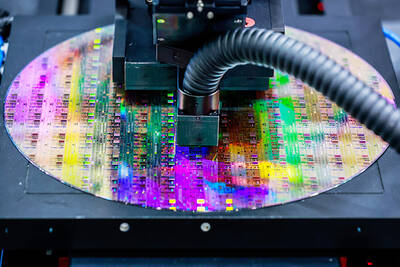
The artificial intelligence (AI) boom has triggered a seismic reshuffling of global equity markets, with Taiwan and South Korea muscling past European nations one by one. With its stock market now valued at nearly US$4.3 trillion, Taiwan surpassed the UK, Europe’s biggest market, earlier this month, data compiled by Bloomberg showed. South Korea is about US$140 billion away from doing the same. The tech-heavy Asian markets have shot past Germany and France in the past seven months. The shift is largely down to massive gains in shares of three companies that provide essential hardware for AI: Taiwan Semiconductor Manufacturing Co (TSMC, 台積電),
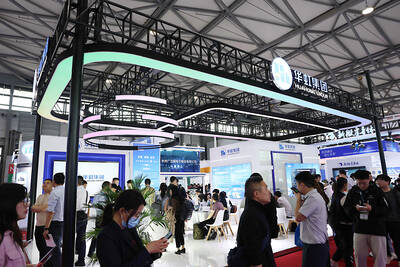
The US Department of Commerce last week ordered multiple chip equipment companies to halt shipments of certain tools to China’s second-largest chipmaker, Hua Hong Semiconductor Ltd (華虹半導體), its latest action to slow the country’s development of advanced chips, two people familiar with the matter said. The department sent letters to at least a handful of companies informing them of restrictions on tools and other materials destined for two Hua Hong facilities US officials believe make China’s most sophisticated chips, the people said. Top US chip equipment companies Lam Research Corp, Applied Materials Inc and KLA Corp, each of which has significant


 RSS
RSS