


Gold and silver advanced as trading began in the new year, building on their best annual performances since 1979.
Bullion rose to US$4,375 an ounce, while silver gained more than 2 percent.
While traders have flagged that the metals could do well this year on further US interest rate cuts and US dollar weakness, there is near-term concern that broad index rebalancing could pressure prices.
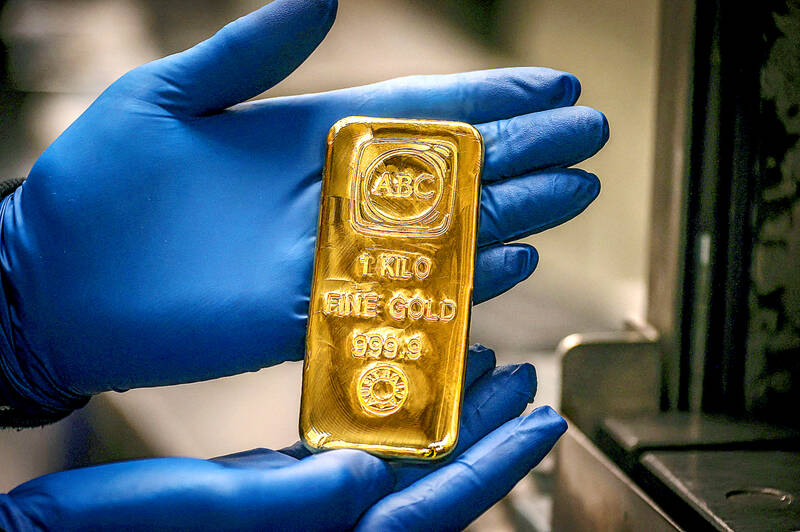
Photo: AFP
Given that the metals have rallied, passive tracking funds could sell some contracts to match new weightings as they are confirmed.
“We expect a massive 13 percent of aggregate open interest in Comex silver markets will be sold over the coming two weeks, to result in a dramatic repricing lower,” TD Securities senior commodity strategist Daniel Ghali wrote in a note.
Lower post-holiday liquidity could amplify price moves, Ghali said.
Precious metals posted a ferocious run higher last year, although there was significant volatility late last month as some investors booked profits and trading metrics pointed to overbought conditions.
Gold notched a series of records last year, aided by central bank buying, easing US Federal Reserve policy and a weaker US dollar.
Demand for haven assets driven by geopolitical tensions and US-led trade frictions was also supportive.
Silver rallied even harder than gold last year, hitting records and blowing through levels that until recently had seemed unthinkable to all but the most enthusiastic of market watchers.
In addition to the factors that aided gold, silver has also been a beneficiary of sustained concerns that the US administration could eventually impose import tariffs on the refined metal.
Among leading banks, there is support for further rises in gold this year, especially with the Fed expected to deliver additional rate reductions and US President Donald Trump reshaping the central bank’s leadership.
Goldman Sachs Group Inc last month said that its base case was for a rally to US$4,900 an ounce, with risks to the upside.
Gold gained 1.3 percent to US$4,375.15 an ounce at 12:01pm in Singapore. The Bloomberg Dollar Spot Index was 0.1 percent lower.
Silver advanced 2.5 percent to US$73.4459. Palladium and platinum also surged.

HORMUZ ISSUE: The US president said he expected crude prices to drop at the end of the war, which he called a ‘minor excursion’ that could continue ‘for a little while’ The United Arab Emirates (UAE) and Kuwait started reducing oil production, as the near-closure of the crucial Strait of Hormuz ripples through energy markets and affects global supply. Abu Dhabi National Oil Co (ADNOC) is “managing offshore production levels to address storage requirements,” the company said in a statement, without giving details. Kuwait Petroleum Corp said it was lowering production at its oil fields and refineries after “Iranian threats against safe passage of ships through the Strait of Hormuz.” The war in the Middle East has all but closed Hormuz, the narrow waterway linking the Persian Gulf to the open seas,

RATIONING: The proposal would give the Trump administration ample leverage to negotiate investments in the US as it decides how many chips to give each country US officials are debating a new regulatory framework for exporting artificial intelligence (AI) chips and are considering requiring foreign nations to invest in US AI data centers or security guarantees as a condition for granting exports of 200,000 chips or more, according to a document seen by Reuters. The rules are not yet final and could change. They would be the first attempt to regulate the flow of AI chips to US allies and partners since US President Donald Trump’s administration said it rescinded its predecessor’s so-called AI diffusion rules. Those rules sought to keep a significant amount of AI

Apple Inc increased iPhone production in India by about 53 percent last year and now makes a quarter of its marquee devices there, reflecting the US company’s efforts to avoid tariffs on China. The company assembled about 55 million iPhones in India last year, up from 36 million a year earlier, people familiar with the matter said, asking not to be named because the numbers aren’t public. Apple makes about 220 million to 230 million iPhones a year globally, with India’s share of the total increasing rapidly. Apple has accelerated its expansion in the world’s most populous country in recent years, bolstered

A new worry has been rippling across the stock market lately: Entire businesses, not just their employees, might be thrown out of work. While most economists say fears of an artificial intelligence (AI) job apocalypse are overblown, seismic shifts have happened in the past after big tech breakthroughs. The IT revolution of the 1990s led to a surge in productivity that sped up the US economy for several years. It also rendered companies or even industries largely redundant — from travel agents and stockbrokers to classified advertising and newspapers, or video rental stores. Economists expect AI would deliver higher productivity,


 RSS
RSS