


Ta Tun Electric Wire and Cable Co (TEWC, 大東電業) yesterday said it is targeting double-digit revenue growth next year, supported by Taiwan Power Co’s (Taipower, 台電) orders that aim to enhance power grid resilience.
Taipower is expected to invest up to NT$564.5 billion (US$17.9 billion) over a decade to upgrade the power grid, with projects covering distributed infrastructure, grid hardening, and infrastructure resilience and protection, TEWC chairman Jimmy Lin (林志明) said.
That is expected to boost demand for the company’s extra-high-voltage (EHV) cable products, including 161 kilovolt (kV) and 345kV lines, and lift the company’s revenue over the next three years, Lin said.
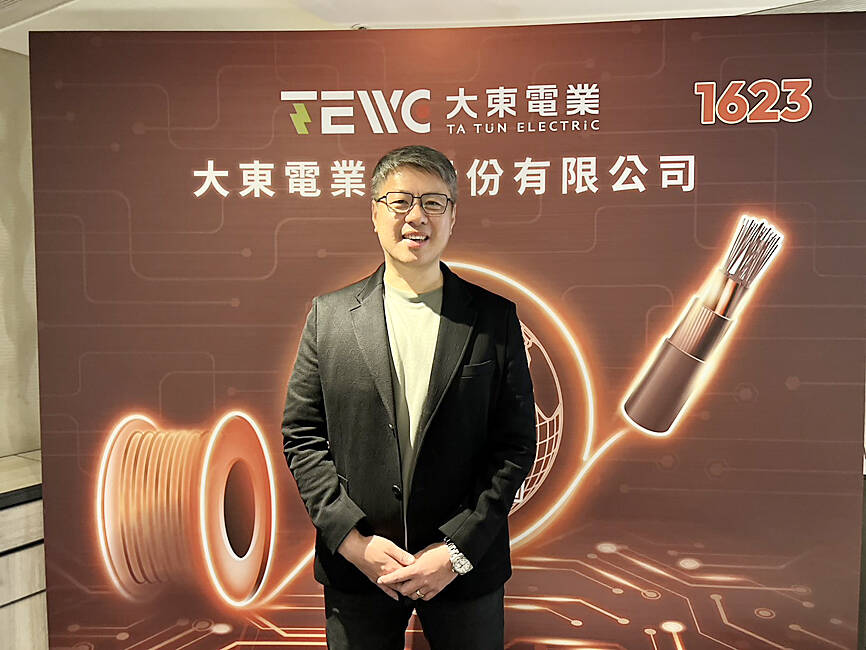
Photo: Lin Jin-hua, Taipei Times
From 2023 to October, the company has secured Taipower orders worth a combined NT$15.4 billion, ranking first among the state-run utility’s four certified suppliers of 345kV cables, he said.
The company has unfulfilled orders totaling NT$12 billion, most of which are from Taipower, with order visibility extending through 2028, Lin said, adding that EHV cables accounted for more than 60 percent of orders.
TEWC produces power cables, electric wires and specialty cables used in power transmission and distribution, infrastructure projects and industrial applications.
Revenue in the first three quarters rose 23.54 percent year-on-year to NT$4.8 billion, with EHV cables accounting for 34.79 percent, followed by medium-voltage cables at 24.12 percent, low-voltage cables at 16.75 percent, rubber cables at 7.71 percent and other products at 16.63 percent.
As the fourth quarter is typically the peak season for its EHV cable business, company revenue this year is expected to reach a new record high, Lin said.
Net income in the first three quarters was NT$565.38 million, down 3.55 percent from NT$586.22 million for the same period last year, with earnings per share decreasing to NT$9.42 from NT$10.16 and gross margin falling to 17.7 percent from 19.2 percent over the same period.
The company attributed the decline in gross margin to higher sales of medium and low-voltage cables last quarter to align with some clients’ construction schedules, delaying shipments of EHV products more than expected.
As shipments of higher-margin products — mainly 345kV cables — are expected to normalize this quarter, gross margin is expected to improve, it said.
The company is developing cables for 800 volt high voltage direct current or ±400 volt direct-current architectures used in artificial intelligence data centers, and is discussing new power distribution and cooling distribution products with connector makers, TEWC president Yang Po-wen (楊博文) said, adding that he expects their revenue contribution to emerge in the second half of next year.
TEWC is also considering entering the US market by working with contractors of electromechanical systems for major technology firms, to supply cables for plant construction projects that meet US standards, he said.

HORMUZ ISSUE: The US president said he expected crude prices to drop at the end of the war, which he called a ‘minor excursion’ that could continue ‘for a little while’ The United Arab Emirates (UAE) and Kuwait started reducing oil production, as the near-closure of the crucial Strait of Hormuz ripples through energy markets and affects global supply. Abu Dhabi National Oil Co (ADNOC) is “managing offshore production levels to address storage requirements,” the company said in a statement, without giving details. Kuwait Petroleum Corp said it was lowering production at its oil fields and refineries after “Iranian threats against safe passage of ships through the Strait of Hormuz.” The war in the Middle East has all but closed Hormuz, the narrow waterway linking the Persian Gulf to the open seas,

RATIONING: The proposal would give the Trump administration ample leverage to negotiate investments in the US as it decides how many chips to give each country US officials are debating a new regulatory framework for exporting artificial intelligence (AI) chips and are considering requiring foreign nations to invest in US AI data centers or security guarantees as a condition for granting exports of 200,000 chips or more, according to a document seen by Reuters. The rules are not yet final and could change. They would be the first attempt to regulate the flow of AI chips to US allies and partners since US President Donald Trump’s administration said it rescinded its predecessor’s so-called AI diffusion rules. Those rules sought to keep a significant amount of AI

Apple Inc increased iPhone production in India by about 53 percent last year and now makes a quarter of its marquee devices there, reflecting the US company’s efforts to avoid tariffs on China. The company assembled about 55 million iPhones in India last year, up from 36 million a year earlier, people familiar with the matter said, asking not to be named because the numbers aren’t public. Apple makes about 220 million to 230 million iPhones a year globally, with India’s share of the total increasing rapidly. Apple has accelerated its expansion in the world’s most populous country in recent years, bolstered

A new worry has been rippling across the stock market lately: Entire businesses, not just their employees, might be thrown out of work. While most economists say fears of an artificial intelligence (AI) job apocalypse are overblown, seismic shifts have happened in the past after big tech breakthroughs. The IT revolution of the 1990s led to a surge in productivity that sped up the US economy for several years. It also rendered companies or even industries largely redundant — from travel agents and stockbrokers to classified advertising and newspapers, or video rental stores. Economists expect AI would deliver higher productivity,


 RSS
RSS