


A widespread power outage in San Francisco that led to Waymo robotaxis blocking traffic earlier this month has raised concerns about the readiness of autonomous vehicle operators to handle major emergencies such as earthquakes and floods.
Driverless taxis from Waymo, a ubiquitous feature on the city’s streets, were stuck at intersections with their hazard lights turned on as traffic lights stopped working following a fire at a PG&E Corp substation that knocked out power to roughly one-third of the city on Dec. 20, videos posted on social media showed. Waymo, a subsidiary of Google parent company Alphabet Inc, halted operations, resuming a day later.
The incident has renewed calls for stricter regulation of the nascent but fast-growing industry as other companies, including Tesla Inc and Amazon.com Inc’s Zoox, race to expand robotaxi services in several cities.
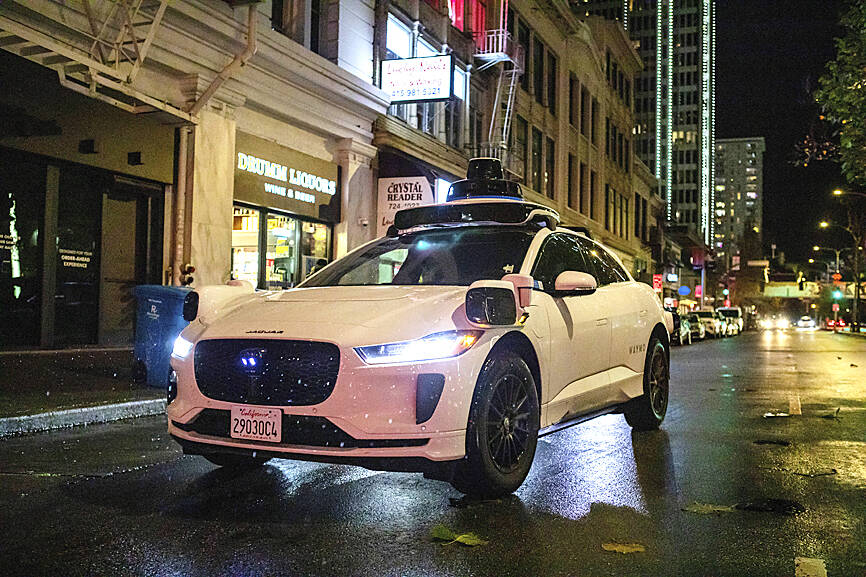
“If you get a response to a blackout wrong, regulators are derelict if they do not respond to that by requiring some sort of proof that the earthquake scenario will be handled properly,” Carnegie Mellon University computer-engineering professor and autonomous-technology expert Philip Koopman said.
Robotaxi operators across the globe use remote access by humans — known in the industry as “teleoperation” — in varying degrees to monitor and control vehicles. Waymo, for example, has a team of human “fleet response” agents who respond to questions from the Waymo Driver, the bot driving the vehicle, when it encounters a particular situation.
Such remote assistance has its limitations, and the Waymo outage highlights the need to regulate how robotaxi operators use the technology, said Missy Cummings, director of the George Mason University Autonomy and Robotics Center and former adviser to the US road safety regulator.
“The whole point of having remote operations is for humans to be there when the system is not responsive in the way it should be,” she said.
“The federal government needs to regulate remote operations,” Cummings said. “They need to make sure that there’s backup remote operations when there’s some kind of catastrophic failure.”
California’s Department of Motor Vehicles (DMV) and the California Public Utilities Commission, which regulate and issue permits for the testing and commercial deployment of robotaxis, have said they are looking into the incident.
The DMV said it was talking to Waymo and other autonomous vehicle makers about actions related to emergency situations. It also said it was formulating regulations to ensure remote drivers “meet high standards for safety, accountability and responsiveness.”
Robotaxis have returned to the spotlight as Tesla began service in Austin, Texas earlier this year as CEO Elon Musk promises rapid expansion. Waymo, which has grown slowly and steadily over the years since its launch as Google’s self-driving project in 2009, has accelerated expansion.
Cummings and Koopman said robotaxi operators should face additional permitting requirements once their fleets grow beyond a certain size to ensure that they have adequate capabilities to deal with large-scale failures.
“If this had been an earthquake, it would have been a problem,” Koopman said. “This is just a shot across the bow.”

South Korea’s equity benchmark yesterday crossed a new milestone just a month after surpassing the once-unthinkable 5,000 mark as surging global memory demand powers the country’s biggest chipmakers. The KOSPI advanced as much as 2.6 percent to a record 6,123, with Samsung Electronics Co and SK Hynix Inc each gaining more than 2 percent. With the benchmark now up 45 percent this year, South Korea’s stock market capitalization has also moved past France’s, following last month’s overtaking of Germany’s. Long overlooked by foreign funds, despite being undervalued, South Korean stocks have now emerged as clear winners in the global market. The so-called “artificial intelligence
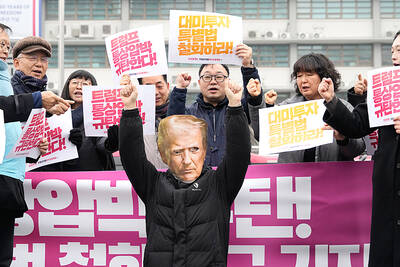
CONFUSION: Taiwan, Japan and other big exporters are cautiously monitoring the situation, while analysts said more Trump responses ate likely after his loss in court US trading partners in Asia started weighing fresh uncertainties yesterday after President Donald Trump vowed to impose a new tariff on imports, hours after the Supreme Court struck down many of the sweeping levies he used to launch a global trade war. The court’s ruling invalidated a number of tariffs that the Trump administration had imposed on Asian export powerhouses from China and South Korea to Japan and Taiwan, the world’s largest chip maker and a key player in tech supply chains. Within hours, Trump said he would impose a new 10 percent duty on US imports from all countries starting on

STRATEGIC ALLIANCE: The initiative is aimed at protecting semiconductor supply chain resilience to reduce dependence on China-dominated manufacturing hubs India yesterday joined a US-led initiative to strengthen technology cooperation among strategic allies in a move that underscores the nations’ warming ties after a brief strain over New Delhi’s unabated purchase of discounted Russian oil. The decision aligns India closely with Washington’s efforts to build secure supply chains for semiconductors, advanced manufacturing and critical technologies at a time when geopolitical competition with China is intensifying. It also signals a reset in relations following friction over energy trade and tariffs. Nations that have joined the Pax Silica framework include Japan, South Korea, the UK and Israel. “Pax Silica will be a group of nations
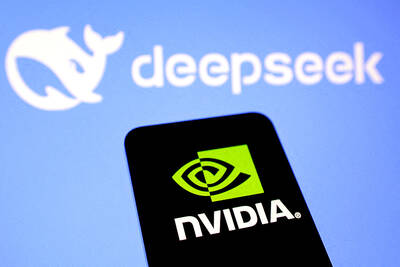
Chinese artificial intelligence (AI) start-up DeepSeek’s (深度求索) latest AI model, set to be released as soon as next week, was trained on Nvidia Corp’s most advanced AI chip, the Blackwell, a senior official of US President Donald Trump’s administration said on Monday, in what could represent a violation of US export controls. The US believes DeepSeek will remove the technical indicators that might reveal its use of American AI chips, the official said, adding that the Blackwells are likely clustered at its data center in Inner Mongolia, an autonomous region of China. The person declined to say how the US government received


 RSS
RSS