


Nvidia Corp has told Chinese customers it aims to start shipping its second-most powerful artificial intelligence (AI) chips to China before the Lunar New Year holiday in the middle of February, three people familiar with the matter said.
The US chipmaker plans to fulfill initial orders from existing stock, with shipments expected to total 5,000 to 10,000 chip modules — equivalent to about 40,000 to 80,000 H200 AI chips, the first and second sources said.
Nvidia has also told Chinese customers that it plans to add new production capacity for the chips, with orders for that capacity opening in the second quarter of next year, the third source said.
Photo: Reuters
Significant uncertainty remains, as Beijing has yet to approve any H200 purchases and the timeline could shift depending on government decisions, the sources said.
“The whole plan is contingent on government approval,” the third source said. “Nothing is certain until we get the official go-ahead.”
The Chinese Ministry of Industry and Information Technology did not immediately respond to a request for comment.
The H200 graphics processing units, part of Nvidia’s previous-generation Hopper line, remains widely used in AI despite being superseded by the firm’s newer Blackwell chips.
Nvidia has focused production on Blackwell and its upcoming Rubin line, making H200 supply scarce.
“We continuously manage our supply chain. Licensed sales of the H200 to authorized customers in China will have no impact on our ability to supply customers in the United States,” Nvidia said in a statement.
The planned shipments would mark the first deliveries of H200s to China after US President Donald Trump this month said that Washington would allow such sales with a 25 percent fee.
Trump’s decision comes as China pushes to develop its domestic AI chip industry. Local firms have yet to match the H200’s performance, raising concerns that allowing imports could slow domestic progress.
Chinese officials held emergency meetings earlier this month to discuss the matter and are weighing whether to allow shipments, Reuters reported this month.
One proposal would require each H200 purchase to be bundled with a set ratio of domestic chips, the report said
For Chinese technology giants such as Alibaba Group Holding Ltd (阿里巴巴) and ByteDance Ltd (字節跳動), which have expressed interest in buying H200 chips, the potential shipments would provide access to processors about six times more powerful than the H20, a downgraded chip Nvidia designed for China.

Cairo’s new monorail slices across the city skyline, running above the familiar chaos of blaring horns and aging buses’ exhaust fumes that mark rush hour below. The US$4.5 billion monorail, opened this month, is among Egypt’s most prominent new transport projects, part of a debt-funded infrastructure drive criticized for sapping state finances while bringing limited benefits to most of the country’s 109 million people. “It feels like you’re in a different country,” said Ramy Sayed, a restaurant manager, aboard a driverless Innovia 300 train. “No noise, no traffic, we’re not used to this.” The eastern line runs 56km from the bustling middle-class
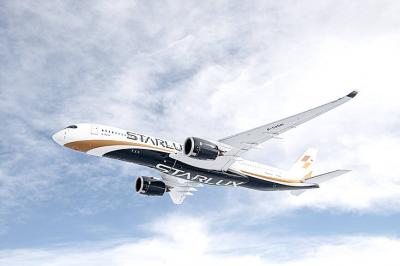
Starlux Airlines Co (星宇航空) today unveiled a long-haul network expansion plan at a shareholders’ meeting in Taipei, including direct flights to Barcelona, Spain, and Zurich, Switzerland, as well as a service connecting Taipei, Sydney and New Zealand. Starlux is to become the first Taiwanese carrier to offer non-stop services to the two European cities, while the inaugural oceanic route is expected to expand transit opportunities within the Australia-New Zealand market, Starlux said. Flight services to Chicago, Dallas, Washington and New York are under evaluation, the airline added. Prior to the shareholders’ meeting, the airline earlier this year announced that it would be
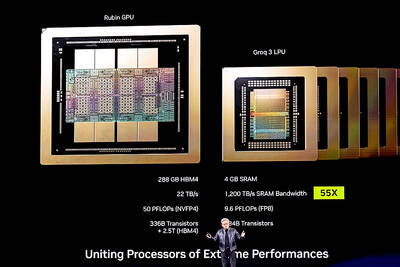
Taiwanese prosecutors suspect that three people successfully smuggled at least one shipment of Nvidia Corp artificial intelligence (AI) chips to China after first exporting them to Japan, people familiar with the matter said. The trio was detained last week by the Keelung District Prosecutors’ Office for allegedly falsifying documents related to exports of Super Micro Computer Inc servers containing advanced Nvidia chips, which the US has barred from sale to China without a license from Washington. The move marked Taiwan’s first public crackdown on AI chip diversion after years of pressure from the US to take a more active role in curtailing
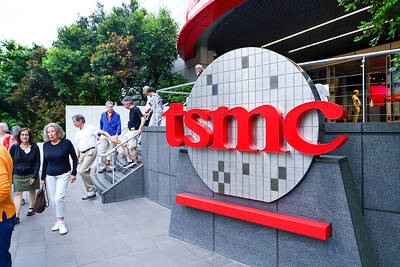
Taiwan Semiconductor Manufacturing Co (TSMC, 台積電) employee bonuses are likely to grow more than 30 percent this year, in line with the past few years as the company’s profits continue to set new records, an anonymous source cited TSMC chairman C.C. Wei (魏哲家) as saying yesterday. TSMC, the world’s largest contract chipmaker, is committed to taking care of its workers, the source said, citing Wei’s meeting with employees yesterday morning. Wei also expressed gratitude to employees for their contribution to the company’s improving bottom line, the source added. Since 2023, TSMC’s employee bonuses have grown at an annual rate of


 RSS
RSS