


The economy is set for its fastest expansion in 15 years, prompting Academia Sinica to sharply raise its growth forecast yesterday, as exports powered by surging global demand for artificial intelligence (AI) hardware proved far stronger than expected.
The research institute expects GDP growth to hit 7.41 percent this year, more than double the 2.93 percent projection it made in July.
The upgrade reflects stronger-than-anticipated overseas demand, particularly for AI-related applications, even as uncertainties surrounding US trade policy persist.
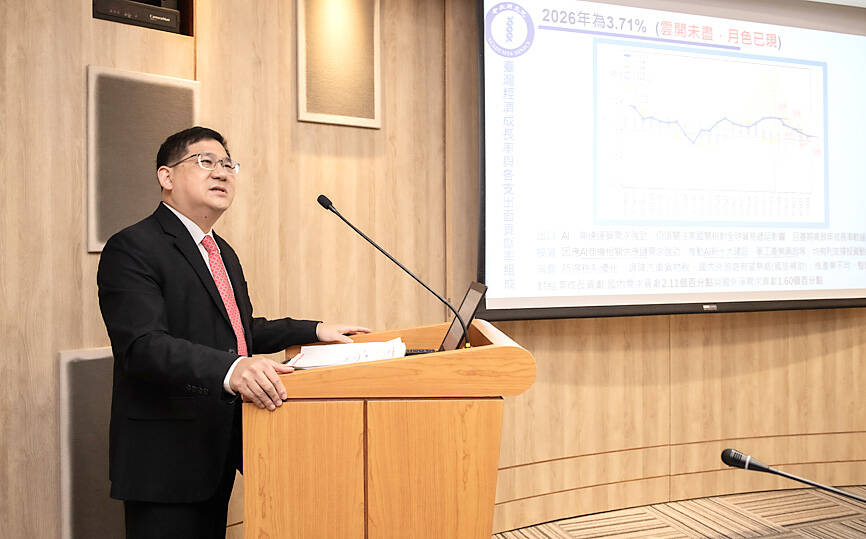
Photo courtesy of Academia Sinica
“Although clouds have not fully cleared, moonlight is already visible,” Academia Sinica Institute of Economics research fellow Lin Chang-ching (林常青) said, adding that robust external demand offsets lingering risks tied to US tariffs.
Exports are forecast to soar 32.09 percent this year, while imports are projected to rise 29.79 percent, underscoring the trade-led nature of the expansion.
Growth figures mask deep structural imbalances, Academia Sinica vice president Peng Shin-kun (彭信坤) said.
Expansion is driven overwhelmingly by exports and trade, with technology firms tied to the AI supply chain significantly outperforming the rest of the economy, Peng said, adding that traditional industries remain sluggish.
Such an imbalance helps explain why many households feel disconnected from the strong macroeconomic data, he said.
While industrial polarization is unlikely to have an immediate impact on GDP, it could weaken economic resilience and social stability over time, Lin said.
With non-tariff trade barriers expected to increase amid shifting global political and economic conditions, he urged the government to step up support for small and medium-sized enterprises.
Measures should include assistance with industrial transformation, compliance with international regulations and greater access to resources needed to compete globally, he said.
Academia Sinica forecasts consumer inflation of 1.67 percent this year and 1.6 percent next year, citing easing global energy prices and appreciation of the New Taiwan dollar.
The institute expects the local currency to strengthen versus the US dollar as the US Federal Reserve moves toward interest rate cuts and Taiwan’s widening trade surplus add upward pressure.
Academia Sinica projects economic growth of 3.71 percent next year, the most optimistic forecast among domestic research institutions.
Investment by US cloud-service providers would continue to support Taiwan’s exports next year, although growth momentum is likely to moderate as high base effects and the delayed impact of US tariffs take hold, it said.
Export and import growth rates are expected to slow next year to 8.41 percent and 8.2 percent respectively, it said.
The institute identified major sources of uncertainty including US monetary and trade policy, the uneven recovery of China’s economy, geopolitical tensions and ongoing supply-chain restructuring, and inefficiencies in domestic labor and capital allocation.
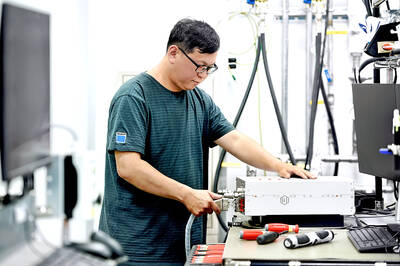
SEMICONDUCTORS: The German laser and plasma generator company will expand its local services as its specialized offerings support Taiwan’s semiconductor industries Trumpf SE + Co KG, a global leader in supplying laser technology and plasma generators used in chip production, is expanding its investments in Taiwan in an effort to deeply integrate into the global semiconductor supply chain in the pursuit of growth. The company, headquartered in Ditzingen, Germany, has invested significantly in a newly inaugurated regional technical center for plasma generators in Taoyuan, its latest expansion in Taiwan after being engaged in various industries for more than 25 years. The center, the first of its kind Trumpf built outside Germany, aims to serve customers from Taiwan, Japan, Southeast Asia and South Korea,
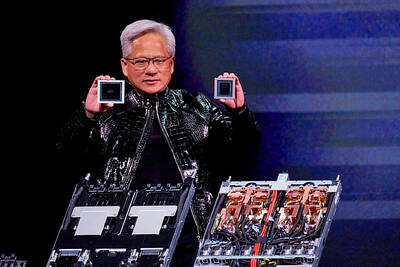
Nvidia Corp chief executive officer Jensen Huang (黃仁勳) on Monday introduced the company’s latest supercomputer platform, featuring six new chips made by Taiwan Semiconductor Manufacturing Co (TSMC, 台積電), saying that it is now “in full production.” “If Vera Rubin is going to be in time for this year, it must be in production by now, and so, today I can tell you that Vera Rubin is in full production,” Huang said during his keynote speech at CES in Las Vegas. The rollout of six concurrent chips for Vera Rubin — the company’s next-generation artificial intelligence (AI) computing platform — marks a strategic

Gasoline and diesel prices at domestic fuel stations are to fall NT$0.2 per liter this week, down for a second consecutive week, CPC Corp, Taiwan (台灣中油) and Formosa Petrochemical Corp (台塑石化) announced yesterday. Effective today, gasoline prices at CPC and Formosa stations are to drop to NT$26.4, NT$27.9 and NT$29.9 per liter for 92, 95 and 98-octane unleaded gasoline respectively, the companies said in separate statements. The price of premium diesel is to fall to NT$24.8 per liter at CPC stations and NT$24.6 at Formosa pumps, they said. The price adjustments came even as international crude oil prices rose last week, as traders
Taiwan Semiconductor Manufacturing Co (TSMC, 台積電), which supplies advanced chips to Nvidia Corp and Apple Inc, yesterday reported NT$1.046 trillion (US$33.1 billion) in revenue for last quarter, driven by constantly strong demand for artificial intelligence (AI) chips, falling in the upper end of its forecast. Based on TSMC’s financial guidance, revenue would expand about 22 percent sequentially to the range from US$32.2 billion to US$33.4 billion during the final quarter of 2024, it told investors in October last year. Last year in total, revenue jumped 31.61 percent to NT$3.81 trillion, compared with NT$2.89 trillion generated in the year before, according to


 RSS
RSS