


The land under Taipei 101 has once again topped the list as the most valuable plot in Taiwan, extending its reign as the nation’s “land king” to 13 consecutive years, land value data released yesterday by the Taipei City Government showed.
The Taipei Land Administration Department said that the plot that the skyscraper is built on is valued at NT$6.98 million (US$221,405) per ping (3.3 m2), reflecting its position as Taiwan’s tallest building and an internationally recognized landmark, as well as being a beneficiary of resilient office market demand.
Cathay Landmark Plaza (國泰置地廣場) ranked second, retaining its title as Taipei’s ”land queen” for a third consecutive year, at NT$6.7 million per ping, the data showed.
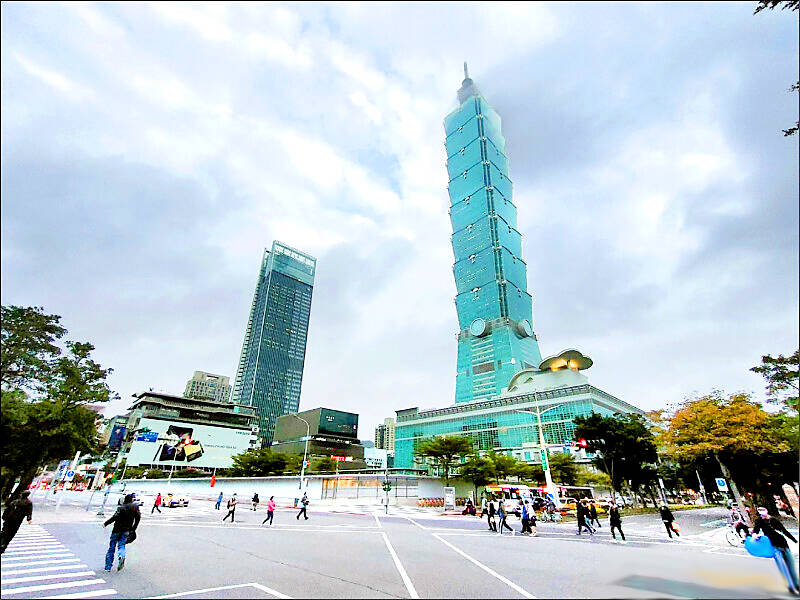
Photo: Gan Meng-lin, Taipei Times
Shin Kong Life Tower (新光摩天大樓) near Taipei Railway Station placed third at NT$6.61 million per ping, supported by its relatively high development intensity, the data showed.
The department’s land valuation committee approved a modest 0.31 percent decline in overall land value, with residential zones falling 0.58 percent, while commercial and industrial zones rose 0.46 percent.
“Real estate-related taxes would not change significantly following the land value adjustments, as the property market has entered a consolidation phase after the introduction of sweeping lending measures in September last year,” said Tseng Chin-der (曾敬德), head researcher at Sinyi Realty Inc (信義房屋), Taiwan’s only listed broker.
Holding costs in the form of land value tax could increase modestly, Tseng said.
The land value data — which are published annually to calculate the land value increment tax on property sales — would fall by 0.31 percent on average next year, the department said.
In contrast, the officially assessed land price, revised every two years and forming the basis for the land value tax, is to rise 3.9 percent compared with last year.
Land values in four administrative areas in Taipei would rise, while the other eight would decline, the department said.
Nangang District (南港) led the increases with a 0.39 percent gain, driven by infrastructure projects, improving living conditions, and large-scale developments that have attracted major shopping complexes and technology firms, a city official said.
Wenshan District (文山) was second with a 0.25 percent rise, aided by its livable environment and an improving transportation outlook linked to an MRT line under construction, the official said.
Beitou District (北投) would have a 0.12 percent increase, benefiting from the development of the Beitou-Shilin Technology Park, which has boosted local industry clustering and appeal, they said.
US chip giant Nvidia Corp is to build a new office complex in Beitou after Shin Kong Life Insurance Co (新光人壽) agreed to relinquish development rights.


Taiwanese firms have increased investment in the Philippines in recent years as Manila’s ties with Washington deepen and global supply chains continue to shift away from China, an expert at the Chung-Hua Institution for Economic Research (CIER, 中華經濟研究院) said yesterday. The Philippines had not been among Taiwanese investors’ top choices in Southeast Asia, CIER Taiwan ASEAN Studies Center director Kristy Hsu (徐遵慈) said at a seminar in Taipei. However, Taiwan’s investment in the country has grown significantly since the COVID-19 pandemic, reaching US $257 million last year, a high in recent years, she said. Although Taiwan’s total investment in the Philippines still lags

Intel Corp regards Taiwan Semiconductor Manufacturing Co (TSMC, 台積電) as a longstanding partner, as the US chipmaker would continue outsourcing production of advanced chips to TSMC, Intel chief executive officer Lip-Bu Tan (陳立武) said yesterday. “I don’t look at people as competitors. I look at the collaboration... Nvidia is also, you know, a good friend,” Tan told a news conference following his keynote speech at the Computex trade show in Taipei. “It’s a very trusted partnership for us... We are a big, top customer for them, and we’re going to continue doing that,” he said, referring to TSMC, the world’s largest foundry

Hon Hai Precision Industry Co (鴻海精密) yesterday said it would work with US chipmaker Intel Corp to jointly develop and deploy next-generation artificial intelligence (AI) infrastructure and intelligent computing platforms in a move to capture booming demand for AI computing systems. Hon Hai, also known as Foxconn Technology Group (富士康), said in a statement that the partnership would combine its global manufacturing scale, system integration expertise and AI data center deployment capabilities with Intel’s strengths in processor architecture, silicon technologies and software ecosystem. The companies said they plan to work on equipment used in AI data centers, including server racks powered by

Artificial intelligence (AI) agents would supplant smartphones as the center of people’s digital lives, fundamentally reshaping personal devices and driving a major computing upgrade cycle, Qualcomm Inc CEO Cristiano Amon said yesterday. In his keynote speech for this year’s Computex trade show in Taipei, Amon said that the rise of "agentic AI" — AI systems capable of reasoning, planning and carrying out tasks autonomously — would transform how people interact with technology across phones, PCs, vehicles and wearable devices. Describing the technology as the next major evolution in computing, Amon said that "2026 is the year of agents.” For decades, smartphones have sat


 RSS
RSS