


The Bank of Japan (BOJ) yesterday raised its benchmark interest rate to the highest in 30 years and said more increases are in the pipeline if conditions allow, in a sign of growing conviction that it can attain the stable inflation target it has pursued for more than a decade.
Bank of Japan Governor Kazuo Ueda’s policy board increased the rate by 0.2 percentage points to 0.75 percent, in a unanimous decision, the bank said in a statement.
The central bank cited the rising likelihood of its economic outlook being realized.
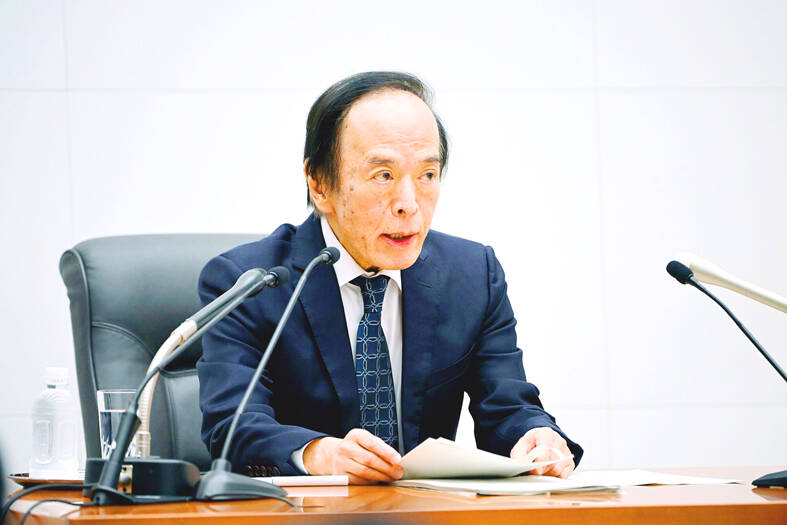
Photo: Bloomberg
The rate change was expected by all 50 economists surveyed by Bloomberg.
The central bank made it clear that the hiking cycle would continue, saying that it intends to keep raising borrowing costs if its economic outlook is realized and the chances of that happening are increasing.
It also said that underlying inflation is continuing to rise moderately.
“We’ll keep making appropriate decisions at each policy meeting,” Ueda told a news conference. “The pace at which we adjust our rate will depend on the state of the economy and prices.”
While market participants were closely watching whether Ueda would give further clarity on where he sees the neutral rate — the level at which the policy rate is neither stimulative nor restrictive — the governor continued to say that it is difficult to judge where that rate might precisely be.
The central bank sees the rate as roughly somewhere between 1 percent and 2.5 percent.
“Of course it would be great if we can have a better idea of where the neutral rate is, but it’s not easy,” Ueda said, adding that the current rate was still below the lower end of the estimated range.
“The decision statement describes rates as “at significantly low levels,” even as they edge toward the bank’s 1 percent estimate for the lower bound of neutral,” Bloomberg analyst Taro Kimura said.
“That suggests the bank now sees neutral as higher, giving it room to tighten further,” Kimura said.
The yen weakened past ¥156.80 against the US dollar after Ueda spoke, suggesting that traders were looking for stronger messaging around further hikes ahead.
Japanese government bond yields rose after the decision, with the yield on the benchmark 10-year bond climbing above 2 percent and hitting the highest level since 1999.
The Nikkei 225 Stock Average had earlier closed 1 percent higher.
The policy change underscored Ueda’s determination to keep raising rates as inflation gradually embeds itself into the economy in a major shift from decades of weak prices following the early 1990s bursting of an asset bubble.
Earlier yesterday, data showed that a key gauge of consumer prices rose 3 percent last month, extending the streak of months at or above the central bank’s 2 percent inflation target to 44.
“I think the BOJ will continue raising rates at a pace of around once every six months or so,” Kazuo Momma, a former executive director at the central bank, said on Bloomberg TV shortly after the decision, a comment largely in line with market consensus.
“Maybe two rate hikes in 2026 and one more in 2027, reaching the level of 1.5 percent,” Momma added.
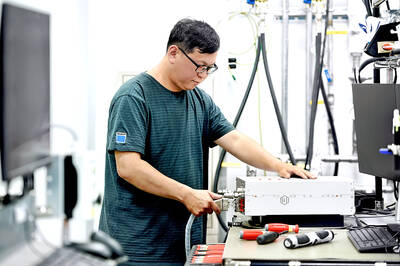
SEMICONDUCTORS: The German laser and plasma generator company will expand its local services as its specialized offerings support Taiwan’s semiconductor industries Trumpf SE + Co KG, a global leader in supplying laser technology and plasma generators used in chip production, is expanding its investments in Taiwan in an effort to deeply integrate into the global semiconductor supply chain in the pursuit of growth. The company, headquartered in Ditzingen, Germany, has invested significantly in a newly inaugurated regional technical center for plasma generators in Taoyuan, its latest expansion in Taiwan after being engaged in various industries for more than 25 years. The center, the first of its kind Trumpf built outside Germany, aims to serve customers from Taiwan, Japan, Southeast Asia and South Korea,

Gasoline and diesel prices at domestic fuel stations are to fall NT$0.2 per liter this week, down for a second consecutive week, CPC Corp, Taiwan (台灣中油) and Formosa Petrochemical Corp (台塑石化) announced yesterday. Effective today, gasoline prices at CPC and Formosa stations are to drop to NT$26.4, NT$27.9 and NT$29.9 per liter for 92, 95 and 98-octane unleaded gasoline respectively, the companies said in separate statements. The price of premium diesel is to fall to NT$24.8 per liter at CPC stations and NT$24.6 at Formosa pumps, they said. The price adjustments came even as international crude oil prices rose last week, as traders
SIZE MATTERS: TSMC started phasing out 8-inch wafer production last year, while Samsung is more aggressively retiring 8-inch capacity, TrendForce said Chipmakers are expected to raise prices of 8-inch wafers by up to 20 percent this year on concern over supply constraints as major contract chipmakers Taiwan Semiconductor Manufacturing Co (TSMC, 台積電) and Samsung Electronics Co gradually retire less advanced wafer capacity, TrendForce Corp (集邦科技) said yesterday. It is the first significant across-the-board price hike since a global semiconductor correction in 2023, the Taipei-based market researcher said in a report. Global 8-inch wafer capacity slid 0.3 percent year-on-year last year, although 8-inch wafer prices still hovered at relatively stable levels throughout the year, TrendForce said. The downward trend is expected to continue this year,
Taiwan Semiconductor Manufacturing Co (TSMC, 台積電), which supplies advanced chips to Nvidia Corp and Apple Inc, yesterday reported NT$1.046 trillion (US$33.1 billion) in revenue for last quarter, driven by constantly strong demand for artificial intelligence (AI) chips, falling in the upper end of its forecast. Based on TSMC’s financial guidance, revenue would expand about 22 percent sequentially to the range from US$32.2 billion to US$33.4 billion during the final quarter of 2024, it told investors in October last year. Last year in total, revenue jumped 31.61 percent to NT$3.81 trillion, compared with NT$2.89 trillion generated in the year before, according to


 RSS
RSS