


The central bank yesterday kept its benchmark discount rate at 2 percent for the seventh consecutive quarter and maintained its selective credit controls on the property market, citing low inflation and the need to oversee real-estate lending.
The decision comes as the economy posts unexpectedly strong growth, fueled by global demand for artificial intelligence (AI) hardware, which has propelled the technology sector even as traditional industries remain subdued.
The central bank steeply raised its GDP growth forecast for this year to 7.31 percent, the fastest pace in 15 years, up from earlier estimates of 4.55 percent. It projects 3.67 percent growth for next year, compared with prior estimates of 2.68 percent.
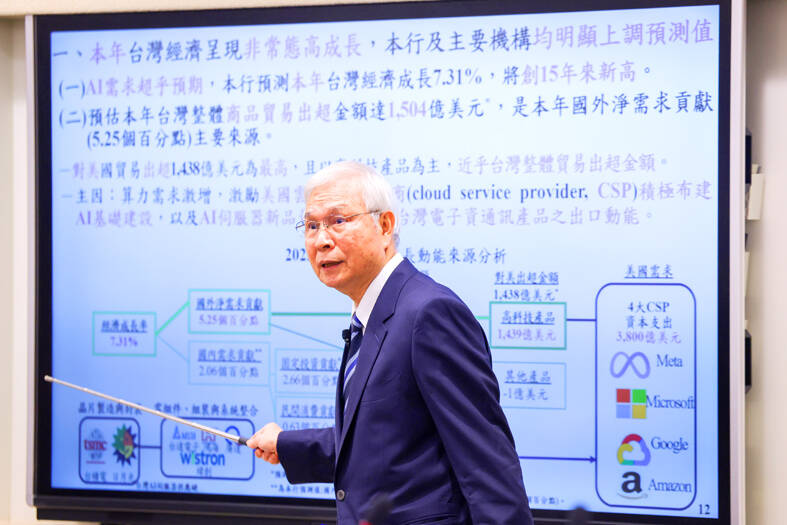
Photo: CNA
“Taiwan’s GDP growth has been widely underestimated by both domestic and international institutions, as global demand for AI hardware has outpaced expectations and is set to continue driving expansion next year,” central bank Governor Yang Chin-long (楊金龍) said following the bank’s policy meeting.
The unexpected strength in the technology sector has offset slower growth in traditional industries. Yang also noted that potential risks from the ongoing US semiconductor probe have not materialized and warned that any tariffs on chips would ultimately harm the US, which relies on Taiwan’s components to deploy AI technologies.
Meanwhile, the central bank maintained its selective property lending measures, noting that housing prices showed little change even as transactions slowed and loan-to-value ratios declined.
Real-estate loans accounted for 36.7 percent of total lending last month, down from 37.61 percent in June last year. Most banks have met the central bank’s lending targets and property loan indicators have stabilized, Yang said.
Starting next year, the central bank would modestly relax its oversight of property exposure, allowing banks to manage real-estate lending internally without further reduction measures, he said.
Financial institutions would be required to submit monthly reports on property loans, while the central bank would conduct targeted inspections to ensure compliance.
The governor said that some lenders previously categorized property loans as working capital, underscoring the need for continued oversight.
The measures aim to help channel credit to first-time buyers, government-backed urban renewal and social housing projects, and productive capital investment, he said.
The government’s preferential lending terms are scheduled to expire in July next year, prompting the Cabinet to plan a revised program aimed at supporting buyers with genuine housing needs.
Yang said that such programs carry both benefits and risks, cautioning that excessively loose credit could reignite property speculation and threaten the nation’s financial stability.
He urged lenders to uphold prudent credit assessments, saying that the cost of curbing previous housing market overheating had been “high.”
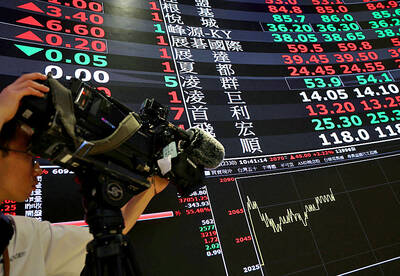
After several years flying high as Asia’s best Nvidia Corp proxy, Taiwan Semiconductor Manufacturing Co (TSMC, 台積電) is increasingly vying with other artificial intelligence (AI) stocks for investor attention. Stock traders are chasing a wider array of beneficiaries as mainstream usage of AI creates demand for hardware beyond the most-advanced chips TSMC makes for Nvidia. Subthemes from the deepening memory crunch to advances in robotics are also luring bids. At the same time, investment caps on single stocks are pushing funds to diversify, while retail investors long familiar with TSMC through its US depositary receipts are being offered a broader set of
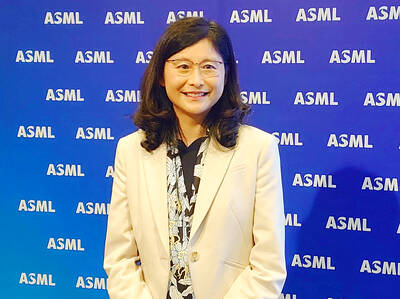
Netherlands-based semiconductor equipment supplier ASML Holding NV yesterday said that it is planning to hire an additional 1,000 people in Taiwan this year in response to growing demand from clients. ASML had previously planned to recruit 600 people this year, but that the plan has been adjusted upward, ASML vice president and ASML Taiwan general manager Grace Wang (汪佳慧) told reporters. ASML has a workforce of more than 4,500 in Taiwan, accounting for about 10 percent of its global total, Wang said. This year’s recruitment campaign would focus on adding people in the customer support, manufacturing and supply chain domains to assist ASML
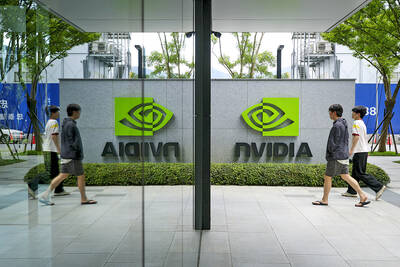
UNDER MICROSCOPE: Taiwan detained three people who allegedly conspired to buy servers in Taiwan and export them using fraudulent documentation, prosecutors said Nvidia Corp chief executive officer Jensen Huang (黃仁勳) on Saturday urged Super Micro Computer Inc to tighten up on compliance after Taiwan detained three people this week for allegedly making fraudulent declarations about artificial intelligence (AI) servers made by its US partner. The development marked the nation’s first crackdown on semiconductor smuggling, which grew after the US slapped restrictions on exports of high-end chips such as Nvidia AI accelerators to China. Nvidia is “rigorous” in explaining regulations to all of its partners, Huang told reporters after arriving in Taipei. “Ultimately Super Micro has to run their own company,” he said in response to

Nvidia Corp yesterday announced that CEO Jensen Huang (黃仁勳) would attend an employee meeting in Taipei tomorrow to celebrate the launch of the company’s Taiwan headquarters project. Huang would attend a gathering at the site of Nvidia’s planned headquarters in Beitou Shilin Technology Park (北投士林科技園區), the company said in a statement. After arriving in Taiwan on Saturday last week, Huang told reporters that he plans to meet with Quanta Computer Inc (廣達) chairman Barry Lam (林百里) and Taiwan Semiconductor Manufacturing Co (TSMC, 台積電) chairman C.C. Wei (魏哲家), and would attend the groundbreaking ceremony for Nvidia’s Taiwan headquarters tomorrow. Nvidia has not yet applied


 RSS
RSS