


A financial technology expert has called for the issuance of a New Taiwan dollar stablecoin, saying it is vital for safeguarding the nation’s monetary sovereignty and reinforcing the country’s industrial competitiveness.
Driven by strong policy momentum in the US, this year has been widely seen as the “first year of stablecoins” — cryptocurrencies designed to maintain a stable value, typically pegged 1:1 to a fiat currency, and widely used as settlement currencies for digital assets and tokenized real-world assets (RWAs).
As US dollar-pegged stablecoins such as USDT and USDC account for about 99 percent of the global market, Taiwan risks being sidelined in the emerging digital-finance infrastructure if it does not act soon, Taiwan FinTech Association board member Jeff Wen (溫宏駿) said.
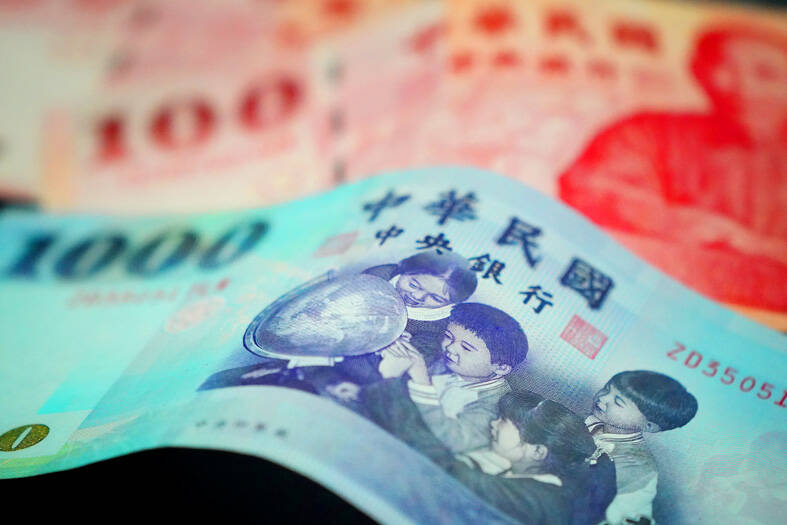
Photo: CNA
The issue goes beyond payment convenience and instead centers on competition over monetary sovereignty and control of financial ledgers, Wen said on Friday.
An NT dollar stablecoin could serve as a medium of exchange and unit of account for RWA transactions, allowing on-chain financial products to be priced in NT dollars, he said.
Without it, Taiwan’s financial products could struggle to circulate globally, he added.
As countries develop new accounting systems alongside traditional banking ledgers, Japan and South Korea are positioning their own currency-backed stablecoins, Wen said, adding that Taiwan could miss a strategic opportunity if it procrastinates.
Nearly 5 percent of domestic firms and more than 10 percent of Taiwanese companies operating overseas are already experimenting with stablecoins for cross-border payments, the Taiwan External Trade Development Council said.
Export-oriented technology firms might already be receiving US dollar stablecoins, and without an NT dollar stablecoin, converting those funds into the local currency could reduce efficiency and erode competitiveness, Wen said.
Taiwan could leverage its semiconductor strength to issue specialized US dollar stablecoins to lower transaction costs globally, while also using NT dollar stablecoins for payments within the domestic semiconductor and artificial intelligence supply chains, he suggested.
Financial Supervisory Commission Chairman Peng Jin-lung (彭金隆) earlier this month said that if virtual-asset legislation and related regulations are adopted soon, a Taiwan-issued stablecoin could debut as early as the second half of next year.
However, some critics have said there is little need for an NT dollar stablecoin, given that Taiwan has highly efficient domestic payment systems.
In response, Peng said that the growing use of RWAs and potential domestic applications highlights the merits of a local-currency stablecoin.
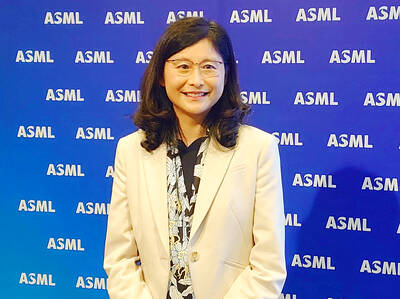
Netherlands-based semiconductor equipment supplier ASML Holding NV yesterday said that it is planning to hire an additional 1,000 people in Taiwan this year in response to growing demand from clients. ASML had previously planned to recruit 600 people this year, but that the plan has been adjusted upward, ASML vice president and ASML Taiwan general manager Grace Wang (汪佳慧) told reporters. ASML has a workforce of more than 4,500 in Taiwan, accounting for about 10 percent of its global total, Wang said. This year’s recruitment campaign would focus on adding people in the customer support, manufacturing and supply chain domains to assist ASML

UNDER MICROSCOPE: Taiwan detained three people who allegedly conspired to buy servers in Taiwan and export them using fraudulent documentation, prosecutors said Nvidia Corp chief executive officer Jensen Huang (黃仁勳) on Saturday urged Super Micro Computer Inc to tighten up on compliance after Taiwan detained three people this week for allegedly making fraudulent declarations about artificial intelligence (AI) servers made by its US partner. The development marked the nation’s first crackdown on semiconductor smuggling, which grew after the US slapped restrictions on exports of high-end chips such as Nvidia AI accelerators to China. Nvidia is “rigorous” in explaining regulations to all of its partners, Huang told reporters after arriving in Taipei. “Ultimately Super Micro has to run their own company,” he said in response to

Nvidia Corp yesterday announced that CEO Jensen Huang (黃仁勳) would attend an employee meeting in Taipei tomorrow to celebrate the launch of the company’s Taiwan headquarters project. Huang would attend a gathering at the site of Nvidia’s planned headquarters in Beitou Shilin Technology Park (北投士林科技園區), the company said in a statement. After arriving in Taiwan on Saturday last week, Huang told reporters that he plans to meet with Quanta Computer Inc (廣達) chairman Barry Lam (林百里) and Taiwan Semiconductor Manufacturing Co (TSMC, 台積電) chairman C.C. Wei (魏哲家), and would attend the groundbreaking ceremony for Nvidia’s Taiwan headquarters tomorrow. Nvidia has not yet applied
Huawei Technologies Co (華為) said it has come up with a new pathway to shorten its gap with industry leader Taiwan Semiconductor Manufacturing Co (TSMC, 台積電), potentially achieving a breakthrough in making advanced semiconductors without cutting-edge equipment. Right now there is about a five-year gap between what TSMC is capable of and what Huawei, together with its manufacturing partner Semiconductor Manufacturing International Corp (中芯), can produce. Huawei is to start making 1.4-nanometer chips by 2031 with its own “LogicFolding” technology, Huawei semiconductor chief He Tingbo (何庭波) said in a rare public appearance during a chip conference yesterday, while TSMC has


 RSS
RSS