


Women who have fought their way to the top of the male-dominated wine sommelier world say that their profession is becoming less sexist and more open — even if men continue to win all of the prizes.
Now an established figure as resident wine adviser at Chambers restaurant in New York, Pascaline Lepeltier told reporters that when she first started out, “a certain male clientele of a certain age didn’t trust me” — or would ask to see the real sommelier.
Argentina’s Paz Levinson, who is in charge of wine at renowned French chef Anne-Sophie Pic’s eateries, said she faced similar experiences in France.
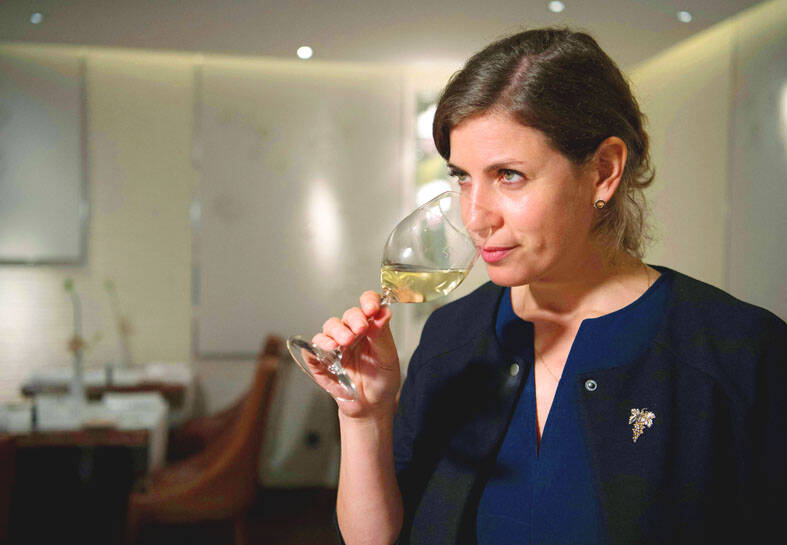
Photo: AF
“When I arrived in France, there were clients who tended to prefer a male sommelier and a French one,” the 47-year-old said.
However, now, more than 20 years into their professional careers, both say the landscape has become more welcoming for women like them.
“Things have evolved in terms of gender balance. It’s not parity, but we’re getting there,” said Lepeltier, 44.
She remains the only woman to have been named Best Sommelier of France and she came fourth at the World’s Best Sommelier competition in 2023.
However, fewer than 10 percent of candidates at the latter competition were women, echoing the way men still pick up the vast majority of gastronomic awards such as Michelin stars or the top positions in “best of” lists.
Some women have broken through in the World’s Best Sommelier, with Canadian Veronique Rivest finishing second in 2013, Denmark’s Nina Jensen ending runner up in 2019 and 2023, and Frenchwoman Julie Dupouy clinching third in 2016, but none has yet won the title, which is to be handed out in October in Lisbon.
“We still have the top spot to claim as the world’s best sommeliers. We’re keeping a lot of hope,” Levinson. said
If the 1970s and the 1980s saw a few pioneering female sommeliers emerge, the real opening of the profession came “about 20 years ago,” according to Fabrice Sommier, president of the French Sommeliers Union.
Today, women account for nearly half of those in training in France and a new generation of female sommeliers is rising in top restaurants, spurred by sweeping societal changes that have broken down gender barriers.
“I’ve always behaved as if being a man or a woman didn’t matter. It’s passion that brings us together,” said Agnese Morandi, sommelier at the two-star Table in Paris.
The 28-year-old Italian trained with Levinson, who “opened her mind” to non-alcoholic pairings — a field she had never explored with her male supervisors.
It is an approach that still inspires her today, notably through the tea list she offers at Table.
There remains the question of whether gender differences lead men and women to perform the role differently.
For Alexandre Lesieur, a teacher at the Ecole de Paris des Metiers de la Table, an elite catering school, the answer is yes.
Women “venture more into regions or products that are more niche” and suggest pairings that are “a bit gentler,” Lesieur said.
“I wouldn’t say we have a different approach,” said Pauline Monclus, one of his apprentices, 25. “Everyone truly has their own personality, men and women alike.”
After finishing fourth two years ago, Lepeltier is hoping she can do better at the World’s Best Sommelier competition next year.
“Equality isn’t here yet and there are still unacceptable behaviors, but we’re also much more supported and surrounded today than 20 years ago,” she said, choosing to see the glass as half full.

Netherlands-based semiconductor equipment supplier ASML Holding NV yesterday said that it is planning to hire an additional 1,000 people in Taiwan this year in response to growing demand from clients. ASML had previously planned to recruit 600 people this year, but that the plan has been adjusted upward, ASML vice president and ASML Taiwan general manager Grace Wang (汪佳慧) told reporters. ASML has a workforce of more than 4,500 in Taiwan, accounting for about 10 percent of its global total, Wang said. This year’s recruitment campaign would focus on adding people in the customer support, manufacturing and supply chain domains to assist ASML

UNDER MICROSCOPE: Taiwan detained three people who allegedly conspired to buy servers in Taiwan and export them using fraudulent documentation, prosecutors said Nvidia Corp chief executive officer Jensen Huang (黃仁勳) on Saturday urged Super Micro Computer Inc to tighten up on compliance after Taiwan detained three people this week for allegedly making fraudulent declarations about artificial intelligence (AI) servers made by its US partner. The development marked the nation’s first crackdown on semiconductor smuggling, which grew after the US slapped restrictions on exports of high-end chips such as Nvidia AI accelerators to China. Nvidia is “rigorous” in explaining regulations to all of its partners, Huang told reporters after arriving in Taipei. “Ultimately Super Micro has to run their own company,” he said in response to
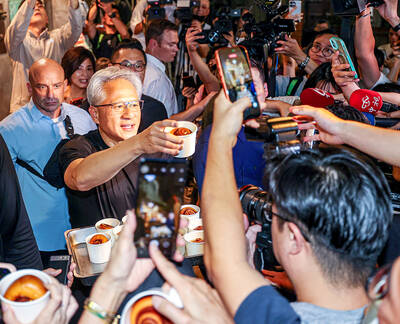
Nvidia Corp yesterday announced that CEO Jensen Huang (黃仁勳) would attend an employee meeting in Taipei tomorrow to celebrate the launch of the company’s Taiwan headquarters project. Huang would attend a gathering at the site of Nvidia’s planned headquarters in Beitou Shilin Technology Park (北投士林科技園區), the company said in a statement. After arriving in Taiwan on Saturday last week, Huang told reporters that he plans to meet with Quanta Computer Inc (廣達) chairman Barry Lam (林百里) and Taiwan Semiconductor Manufacturing Co (TSMC, 台積電) chairman C.C. Wei (魏哲家), and would attend the groundbreaking ceremony for Nvidia’s Taiwan headquarters tomorrow. Nvidia has not yet applied

Huawei Technologies Co (華為) said it has come up with a new pathway to shorten its gap with industry leader Taiwan Semiconductor Manufacturing Co (TSMC, 台積電), potentially achieving a breakthrough in making advanced semiconductors without cutting-edge equipment. Right now there is about a five-year gap between what TSMC is capable of and what Huawei, together with its manufacturing partner Semiconductor Manufacturing International Corp (中芯), can produce. Huawei is to start making 1.4-nanometer chips by 2031 with its own “LogicFolding” technology, Huawei semiconductor chief He Tingbo (何庭波) said in a rare public appearance during a chip conference yesterday, while TSMC has


 RSS
RSS