


Broadcom Inc, a chip company seeking to compete with Nvidia Corp in the artificial intelligence (AI) market, gave a strong revenue forecast for the current quarter, signaling that demand for AI data center equipment is fueling growth.
Sales would be about US$19.1 billion in the fiscal first quarter, which ends Feb. 1, the company said in a statement on Thursday.
Analysts had estimated US$18.5 billion on average, according to data compiled by Bloomberg.
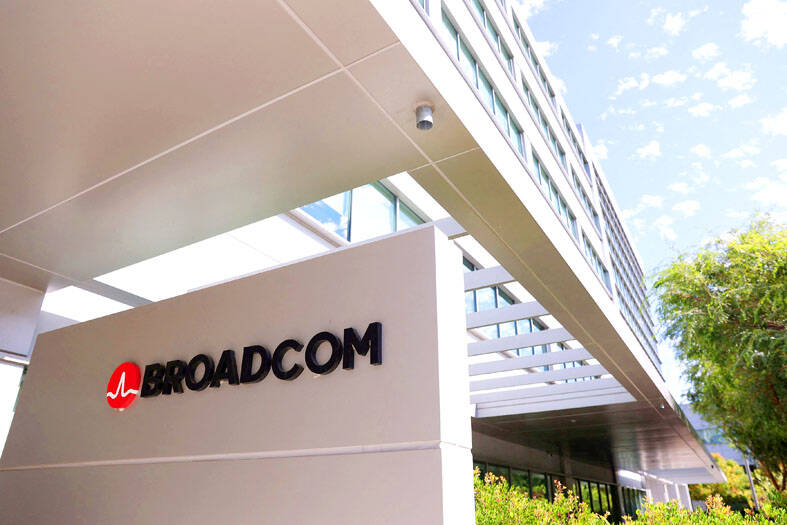
Photo: REUTERS
The company also boosted its quarterly dividend 10 percent to US$0.65 a share.
Broadcom has benefited from demand for its custom chips as part of a massive data center build-out, giving it a growing piece of an industry dominated by Nvidia.
“We see the momentum continuing in Q1 and expect AI semiconductor revenue to double year-over-year to US$8.2 billion,” CEO Hock Tan (陳福陽) said in the statement.
Much of the recent buzz around Broadcom stems from its ties to some of the biggest AI model providers. ChatGPT maker OpenAI signed a pact with Broadcom for its own AI chip designs, while Anthropic agreed to use tens of billions of dollars’ worth of computing services based on Alphabet Inc’s Google Cloud tensor processing units. The latter components also rely on Broadcom designs, helping fuel investor enthusiasm about the chipmaker’s AI prospects.
Broadcom shares rose about 3 percent in extended trading after the results were posted. The shares had earlier closed at US$406.37 in New York, leaving them up 75 percent this year.
The Palo Alto, California-based company has a wide-ranging lineup that spans communications chips, networking components and software.
As part of its bid to generate greater revenue from AI, Broadcom has been updating its networking equipment to move data more quickly inside and between data centers. With AI models getting more complex, the ability to connect chips, racks of servers and whole buildings is growing more critical.
In the fiscal fourth quarter, which ended Tuesday last week, Broadcom posted sales of US$18 billion. Earnings rose to US$1.95 a share, excluding some items. Analysts had estimated revenue of US$17.5 billion and profit of US$1.87 a share.
As part of Broadcom’s OpenAI deal, announced in October, the ChatGPT maker would use custom chips and networking components to help power its AI services.
The deal would bring in additional revenue to Broadcom’s custom chip unit and provide deeper access to the booming AI market. Although the company has already seen its revenue from AI computing climb, Broadcom has remained in the shadow of Nvidia, the top seller of AI processors.
Tan stands to benefit handsomely if that business meets long-term financial goals. The executive is due to get 610,521 shares of Broadcom if AI revenue hits US$90 billion by fiscal 2030. If the sales reach US$120 billion, Tan is poised for 300 percent of the payout.
Taiwan Semiconductor Manufacturing Co (TSMC, 台積電) has approved a capital budget of US$31.28 billion for production expansion to meet long-term development needs during the artificial intelligence (AI) boom. The company’s board meeting yesterday approved the capital appropriation plan for purposes such as the installation of advanced technology capacity and fab construction, the world’s largest contract chipmaker said in a statement. At an earnings conference last month, TSMC forecast that its capital expenditure for this year would be at the higher end of the US$52 billion to US$56 billion range it forecast in January in response to robust demand for 5G, AI and
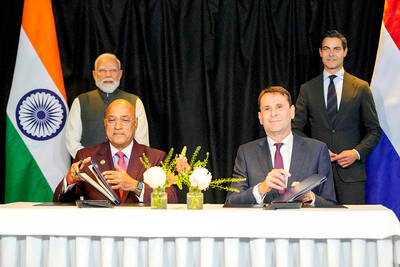
NEW MARKET: The partnership opens up India to the Dutch company, which already has a strong hold in the semiconductor market of South Korea, Taiwan and China ASML Holding NV entered into a partnership agreement with Tata Electronics Pvt Ltd aimed at ramping up India’s goal to develop domestic chip-manufacturing capabilities. The Dutch company’s technology would help power Tata Electronics’ planned 300 millimeter (mm) semiconductor foundry in Gujarat, according to a joint statement from the two companies on Saturday. The signing of a memorandum of understanding coincides with a visit by Indian Prime Minister Narendra Modi to the Netherlands, which is looking to deepen bilateral relations with New Delhi. ASML, whose top customers include Taiwan Semiconductor Manufacturing Co (台積電) and Samsung Electronics Co, makes lithography machines that can print
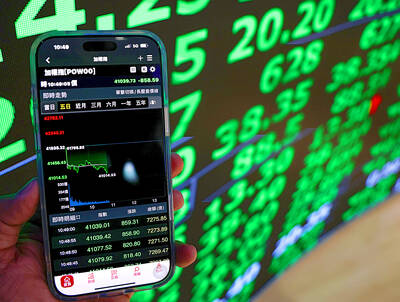
PORTFOLIO REBALANCING: The adjustments in three global equity indices reflect rising investor appetite for semiconductor and artificial intelligence-related stocks Taiwan’s weighting in major global equity indices compiled by MSCI Inc is to rise modestly following the latest quarterly review, underscoring the market’s expanding role in emerging-market portfolios, as global investors continue to favor the nation’s technology sector. Taiwan’s weighting in the MSCI Emerging Markets Index is to increase by 0.30 percentage points to 23.76 percent, after the changes take effect at the close of the May 29 session. Its weighting in the MSCI All-Country Asia ex-Japan Index is to rise 0.37 percentage points to 27.16 percent, while that in the MSCI All Country World Index is to edge up slightly to
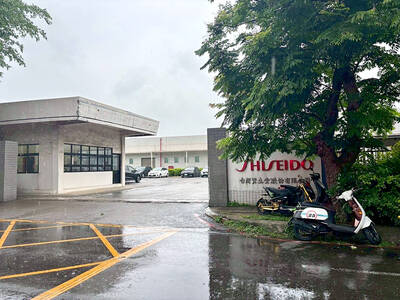
The Hsinchu County Government’s Labor Affairs Department yesterday said that it has received a plan from cosmetics brand Taiwan Shiseido Co (台灣資生堂) detailing mass layoffs at its plant in Hukou Township (湖口). While the labor authorities did not disclose the number of employees to be laid off, Japanese news media earlier in the day reported that the closure of the company’s factory in Hukou would result in 170 employees losing their jobs. Shiseido followed the law by reporting its layoff plan, the department said, adding that authorities would closely monitor negotiations between the management and affected employees and step in if any


 RSS
RSS