


IMF managing director Kristalina Georgieva yesterday urged China to fix its economic imbalances, saying the country of 1.4 billion people is too big to rely on exports for its growth.
Earlier this week, Beijing reported its trade surplus for this year had already exceeded a record US$1 trillion. However, Georgieva said the heavy reliance on exports risks provoking more moves by its trading partners to curb imports from China.
“(China’s) continuing to depend on export-led growth risks furthering global trade tensions,” Georgieva told a press conference in Beijing yesterday. “China is now too big to rely on exports as a source for growth… and (it has) a large domestic market that can be a big aspiration for growth in the years to come.”
.jpg)
Photo: Tingshu Wang, Reuters
At a high-level meeting in October aimed at drawing up plans for the next five years, China's leaders highlighted the need to boost domestic consumption. The ruling Chinese Communist Party has long sought to rebalance the economy away from heavy dependence both on exports and on massive investment in infrastructure.
But the COVID-19 pandemic intervened, along with a prolonged downturn in the real estate market that has slowed activity for that once powerful engine for growth. Meanwhile, Beijing has pushed hard to expand manufacturing in high-tech industries, struggling to rein in excessive capacity in some areas such as automaking.
Georgieva was visiting Beijing for an annual economic forum involving the heads of major international organizations. The IMF also was concluding its annual review of China.
Softening domestic consumption and demand in China has contributed to a weakened yuan versus the US dollar and other currencies. That has made China’s exports cheaper compared with those of other countries, reinforcing trade imbalances.
The IMF said comprehensive policies are needed to encourage Chinese people to spend more.
While China's market is huge and still growing at a nearly 5 percent annual pace, domestic demand has weakened as consumers cut back on spending due to job and income losses during and after the pandemic.
The years-long property downturn also has hit household wealth, crimping shoppers' appetites for spending and sapping demand for imports, amplifying the trade imbalance.
Helping to offset the decline in exports to the US, China is selling more in other countries in Africa, Latin America, Southeast Asia and Europe. That has led to complaints from China’s trading partners as its imports have failed to keep pace.
The EU Chamber of Commerce in China yesterday also warned its substantial trade surplus is raising worries.
A significant portion of that US$1 trillion surplus was generated by shipments to the European Union, which last year ran a trade deficit with the country of more than US$350 billion.
China is "continuing to export ever greater quantities of goods to the EU -- in part to compensate for weak domestic demand relative to supply growth," the EU Chamber of Commerce in China said in a report.
Beijing is also "failing to address several long-standing concerns that European companies have about the country's business environment," it added.
The trends mean that "China is pushing the EU to take a more offensive approach to its China policy than it currently does", the report said.
Additional reporting by AFP
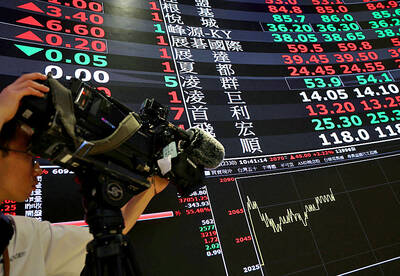
After several years flying high as Asia’s best Nvidia Corp proxy, Taiwan Semiconductor Manufacturing Co (TSMC, 台積電) is increasingly vying with other artificial intelligence (AI) stocks for investor attention. Stock traders are chasing a wider array of beneficiaries as mainstream usage of AI creates demand for hardware beyond the most-advanced chips TSMC makes for Nvidia. Subthemes from the deepening memory crunch to advances in robotics are also luring bids. At the same time, investment caps on single stocks are pushing funds to diversify, while retail investors long familiar with TSMC through its US depositary receipts are being offered a broader set of
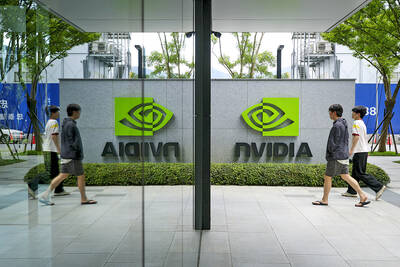
UNDER MICROSCOPE: Taiwan detained three people who allegedly conspired to buy servers in Taiwan and export them using fraudulent documentation, prosecutors said Nvidia Corp chief executive officer Jensen Huang (黃仁勳) on Saturday urged Super Micro Computer Inc to tighten up on compliance after Taiwan detained three people this week for allegedly making fraudulent declarations about artificial intelligence (AI) servers made by its US partner. The development marked the nation’s first crackdown on semiconductor smuggling, which grew after the US slapped restrictions on exports of high-end chips such as Nvidia AI accelerators to China. Nvidia is “rigorous” in explaining regulations to all of its partners, Huang told reporters after arriving in Taipei. “Ultimately Super Micro has to run their own company,” he said in response to

TECH RELIANCE: Growth is increasingly reflecting an unequal K-shaped distribution, where technology sectors outperform and other industries struggle, an expert said Standard Chartered Bank has significantly raised its forecast for Taiwan’s economic growth to 9.5 percent this year, up from 7.6 percent previously, citing surging artificial intelligence (AI) demand driving exports, semiconductor production and investment. The upgrade reflects a sustained AI supercycle that continues to fuel demand for advanced chips and technology infrastructure, which form the backbone of Taiwan’s exports, the bank said in a report this week. “We raise our 2026 growth forecast to reflect a much stronger-than-expected first-quarter GDP figure,” Standard Chartered senior economist for greater China and Asia Tommy Wu (胡東安) said in the report. Driven largely by a 35.3 percent
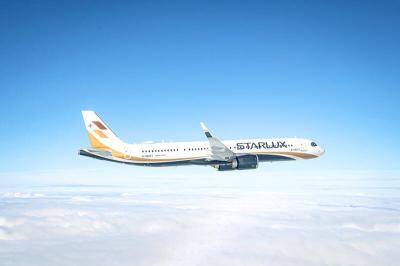
Two of Taiwan’s international carriers, Starlux Airlines Co (星宇航空) and EVA Airways Corp (長榮航空), have retained the five-star airline rating awarded by international airline review organization Skytrax. Starlux was awarded the distinction for a second consecutive year, while EVA Air received it for the 11th straight year, Skytrax said in statements released yesterday and on Thursday last week, respectively. The five-star rating is considered one of the airline industry's highest honors and is awarded following professional audits of airline product and frontline service standards, Skytrax said. The ratings are based on in-depth assessments using unified global quality standards rather than customer review scores


 RSS
RSS