


ByteDance Ltd (字節跳動) and Alibaba Group Holding Ltd (阿里巴巴) have asked Nvidia Corp about buying its powerful H200 artificial intelligence (AI) chips after US President Donald Trump said he would allow it to be exported to China, four people briefed on the matter said.
The Chinese companies are keen to place large orders for Nvidia’s second most powerful AI graphics processing unit (GPU), should Beijing give them the green light, two of the people said.
However, they remain concerned about supply and are seeking clarity from Nvidia, one added.
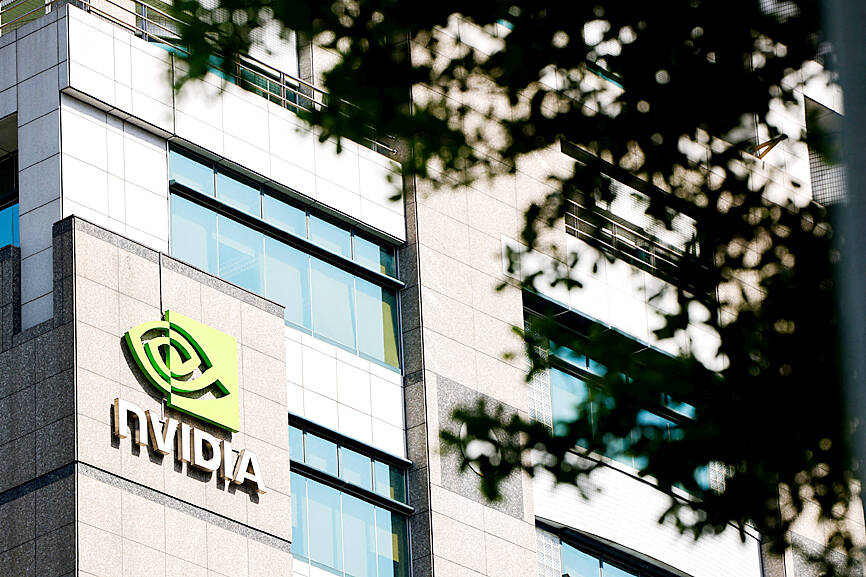
Photo: Ann Wang, Reuters
Before Trump’s decision to allow Nvidia’s Taiwan-manufactured H200 to be exported to China, the most advanced AI chip that could legally be exported to China was the H20. The H200 is almost six times as powerful as the H20.
The Chinese government has yet to give a clear answer to Trump’s announcement on H200. In the past few months, it has barred government-funded data centers and Chinese tech companies from buying Nvidia’s AI GPUs.
The Information reported yesterday that Chinese regulators gathered representatives from companies including Alibaba, ByteDance and Tencent Holdings Ltd (騰訊) and asked them to assess their demand for the H200.
The officials told the companies they would be informed of Beijing’s decision soon, The Information said, citing sources.
Very limited quantities of H200 are in production, two other people familiar with Nvidia’s supply chain said, as the US chip giant has been focused instead on its most advanced Blackwell and upcoming Rubin lines.
Chinese companies are keen on the H200 as its ability to train AI models is unmatched by domestic equivalents which are more suitable for inference, the sources said.
Elite Chinese universities, data center firms and entities affiliated with China’s military have also sought to procure H200 GPUs through gray-market channels, according to a Reuters review of more than 100 tenders and academic papers.
Before Trump's announcement, anyone supplying Chinese entities with the H200 chip would be in breach of federal law preventing US AI processors past a certain performance threshold from being sent to China.
The policy reversal has created an unusual situation where, in theory, older and less powerful Nvidia AI chips like the A100 and H100, two popular models in China, still fall under US export controls but the H200 does not.
Nevertheless, Chinese companies anticipate authorities might need to review purchase requests and require them to provide use cases, the people said, as they consider the costs and benefits of allowing H200 imports at a time they want to encourage sales of AI chips manufactured in China by the likes of Huawei Technologies Co (華為) and Cambricon Technologies Corp (寒武紀).
"The training of leading Chinese AI models still relies on Nvidia cards," said Zhang Yuchun, a general manager at Chinese cloud service provider SuperCloud's solution and ecology units.
"I expect the leading Chinese tech companies to buy a lot although in a low-key manner," he added.


Taiwanese firms have increased investment in the Philippines in recent years as Manila’s ties with Washington deepen and global supply chains continue to shift away from China, an expert at the Chung-Hua Institution for Economic Research (CIER, 中華經濟研究院) said yesterday. The Philippines had not been among Taiwanese investors’ top choices in Southeast Asia, CIER Taiwan ASEAN Studies Center director Kristy Hsu (徐遵慈) said at a seminar in Taipei. However, Taiwan’s investment in the country has grown significantly since the COVID-19 pandemic, reaching US $257 million last year, a high in recent years, she said. Although Taiwan’s total investment in the Philippines still lags

Intel Corp regards Taiwan Semiconductor Manufacturing Co (TSMC, 台積電) as a longstanding partner, as the US chipmaker would continue outsourcing production of advanced chips to TSMC, Intel chief executive officer Lip-Bu Tan (陳立武) said yesterday. “I don’t look at people as competitors. I look at the collaboration... Nvidia is also, you know, a good friend,” Tan told a news conference following his keynote speech at the Computex trade show in Taipei. “It’s a very trusted partnership for us... We are a big, top customer for them, and we’re going to continue doing that,” he said, referring to TSMC, the world’s largest foundry

Hon Hai Precision Industry Co (鴻海精密) yesterday said it would work with US chipmaker Intel Corp to jointly develop and deploy next-generation artificial intelligence (AI) infrastructure and intelligent computing platforms in a move to capture booming demand for AI computing systems. Hon Hai, also known as Foxconn Technology Group (富士康), said in a statement that the partnership would combine its global manufacturing scale, system integration expertise and AI data center deployment capabilities with Intel’s strengths in processor architecture, silicon technologies and software ecosystem. The companies said they plan to work on equipment used in AI data centers, including server racks powered by

Artificial intelligence (AI) agents would supplant smartphones as the center of people’s digital lives, fundamentally reshaping personal devices and driving a major computing upgrade cycle, Qualcomm Inc CEO Cristiano Amon said yesterday. In his keynote speech for this year’s Computex trade show in Taipei, Amon said that the rise of "agentic AI" — AI systems capable of reasoning, planning and carrying out tasks autonomously — would transform how people interact with technology across phones, PCs, vehicles and wearable devices. Describing the technology as the next major evolution in computing, Amon said that "2026 is the year of agents.” For decades, smartphones have sat


 RSS
RSS