


Hon Hai Precision Industry Co (鴻海精密), which assembles servers for Nvidia Corp, yesterday said that revenue last month rose 25.53 percent year-on-year, driven by growth in cloud and networking products amid continued front-loading of orders for artificial intelligence (AI) server racks.
Consolidated revenue expanded to NT$844.3 billion (US$27.01 billion) last month from NT$672.59 billion a year earlier, marking the highest ever for November, the company said in a statement.
Hon Hai attributed last month’s revenue growth to robust sales at its cloud and networking businesses amid rapid growth in server rack shipments.
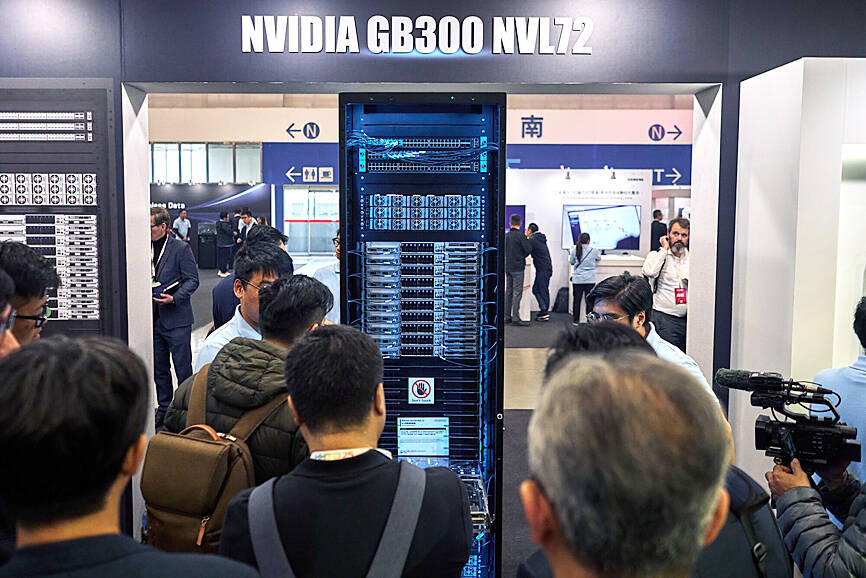
Photo: An Rong Xu, Bloomberg
Revenue from its computing division fell from a year earlier, affected by a shift in ordering patterns, it said.
The firm, which is also a major iPhone assembler, said that its electronic components division reported robust revenue growth last month, boosted by front-loading momentum from customers of its core business.
Sales in the smart consumer electronics division were flat from a year earlier, as rising front-loading momentum was partly offset by fluctuations in foreign exchange rates, it said.
Revenue in the first 11 months of this year totaled NT$7.24 trillion, a 16.63 percent increase from the same period last year, it said.
Revenue growth is expected to accelerate this month, as order visibility has improved from last month, the information and communications technology industry has entered its peak season, and the company continues to ramp up AI server rack shipments, Hon Hai said.
Overall performance this quarter is roughly in line with market expectations, but global political and economic conditions, as well as exchange rate fluctuations still need to be monitored, it said.
Separately, handset camera lens maker Largan Precision Co (大立光) said that its revenue last month fell 11.8 percent to NT$5.3 billion from NT$6.02 billion a year earlier.
The figure was down 15.3 percent from NT$6.26 billion the previous month, Largan said in a statement.
Revenue in the first 11 months of the year rose 3 percent from a year earlier to NT$55.51 billion, the company said.
Shipments last month were led by 10-megapixel lenses, which accounted for 50 to 60 percent of total volume, followed by high-end lenses above 20 megapixels at 10 to 20 percent, other products at 20 to 30 percent and 8-megapixel lenses at less than 10 percent, Largan said.
Shipments this month are expected to be flat from last month, it said.
Meanwhile, Qisda Co (佳世達) said it is targeting healthy year-on-year revenue growth in its medical business next year, driven by greater contributions from its hemodialysis operations, overseas expansion in China and Southeast Asia, and increased channel sales following its acquisition of drugstore chain TinTin (丁丁藥局) last year.
Qisda last month reported that third-quarter revenue from its medical business rose 15 percent year-on-year to NT$22.3 billion.
Revenue from its medical business is expected to be about NT$30 billion this year, with growth momentum likely to extend into next year, mainly driven by demand from China’s hemodialysis market, Qisda chairman Peter Chen (陳其宏) said on the sidelines of the Healthcare+ Expo in Taipei.
As the company has long invested in the sector in Taiwan and China, it expects a major takeoff next year and is optimistic about the division’s revenue contribution, Chen said, adding that momentum next year is also expected to be generated by the TinTin acquisition last year.
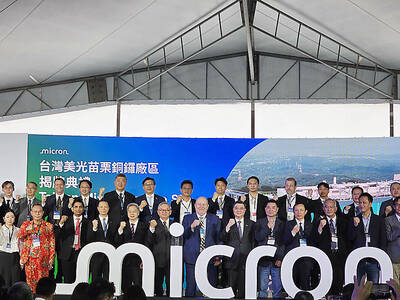
UNPRECEDENTED PACE: Micron Technology has announced plans to expand manufacturing capabilities with the acquisition of a new chip plant in Miaoli Micron Technology Inc unveiled a newly acquired chip plant in Miaoli County yesterday, as the company expands capacity to meet growing demand for advanced DRAM chips, including high-bandwidth memory chips amid the artificial intelligence boom. The plant in Miaoli County’s Tongluo Township (銅鑼), which Micron acquired from Powerchip Semiconductor Manufacturing Corp (力積電) for US$1.8 billion, is expected to make a sizeable capacity contribution to the company from fiscal 2028, the company said in a statement. It would be an extended production site of Micron’s large-scale manufacturing hub in Taichung, the company said. As the global semiconductor industry is racing to reach US$1 trillion

Singapore-based ride-hailing and delivery giant Grab Holdings Ltd has applied for regulatory approval to acquire the Taiwan operations of Germany-based Delivery Hero SE's Foodpanda in a deal valued at about US$600 million. Grab submitted the filing to the Fair Trade Commission on Friday last week, with the transaction subject to regulatory review and approval, the company said in a statement yesterday. Its independent governance structure would help foster a healthy and competitive market in Taiwan if the deal is approved, Grab said. Grab, which is listed on the NASDAQ, said in the filing that US-based Uber Technologies Inc holds about 13 percent of

Taiwan’s food delivery market could undergo a major shift if Singapore-based Grab Holdings Ltd completes its planned acquisition of Delivery Hero SE’s Foodpanda business in Taiwan, industry experts said. Grab on Monday last week announced it would acquire Foodpanda’s Taiwan operations for US$600 million. The deal is expected to be finalized in the second half of this year, with Grab aiming to complete user migration to its platform by the first half of next year. A duopoly between Uber Eats and Foodpanda dominates Taiwan’s delivery market, a structure that has remained intact since the Fair Trade Commission (FTC) blocked Uber Technologies Inc’s

Memory chip stocks extended their losses yesterday after Alphabet Inc’s Google publicized research that could allow more efficient use of the storage needed for artificial intelligence (AI) development. SK Hynix Inc and Samsung Electronics Co, South Korean leaders in the market, fell more than 6 percent and about 5 percent respectively in Seoul. In the US, Micron Technology Inc, Western Digital Corp and Sandisk Corp slid more than 2 percent in pre-market trading, after they all closed lower on Wednesday. Memory companies have been on a tear in recent months as the rapid development of AI infrastructure triggered a spike in chip


 RSS
RSS