


Nvidia Corp CEO Jensen Huang (黃仁勳) said he was unsure whether China would accept the company’s H200 artificial intelligence (AI) chips should the US relax restrictions on sales of the processors, following a meeting on Wednesday with US President Donald Trump.
Huang said he and Trump talked about export controls, but declined to offer specifics. The meeting comes after Trump administration officials discussed whether to allow the H200 to be sold in China.
Asked whether authorities in Beijing would allow Chinese companies to buy the H200, Huang expressed uncertainty.
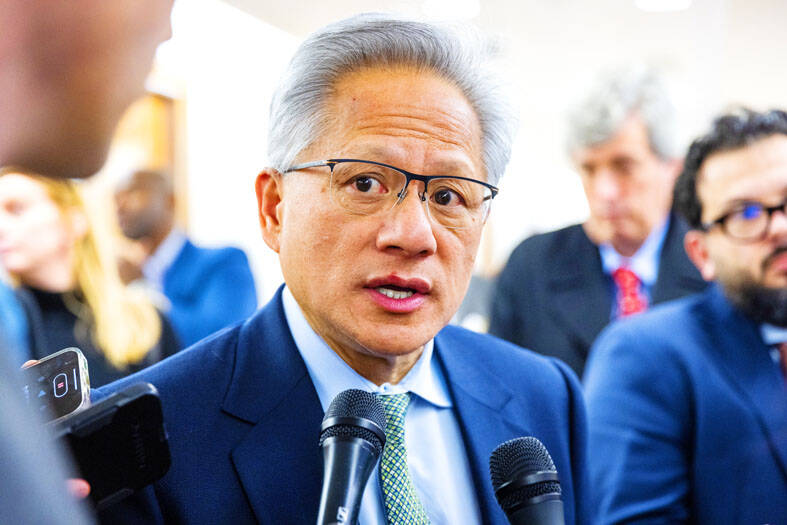
Photo: EPA
“We don’t know. We have no clue,” Huang said, as he headed into a closed-door meeting with members of the US Senate Committee on Banking, Housing and Urban Affairs, which has jurisdiction over export controls. “We can’t degrade chips that we sell to China, they won’t accept that.”
Meanwhile, Trump sidestepped questions about the status of export controls, but praised Huang as doing “an amazing job.”
Allowing H200 sales to China would mark a significant win for the world’s most valuable company, which has pressed the Trump administration and the US Congress for a relaxation of export controls that keep Nvidia from selling its AI chips in the world’s second-largest economy.
Huang’s Washington visit came as Nvidia neared a major lobbying win in the US Congress, where lawmakers kept a provision out of must-pass defense legislation that would have limited the company’s ability to sell its advanced AI chips to China and other adversary nations. The so-called GAIN AI Act would require chipmakers, including Nvidia and Advanced Micro Devices Inc, to give US customers first dibs on their powerful AI chips before selling in China and other arms-embargoed countries.
As the committee meeting concluded, Republican US Senator Mike Rounds acknowledged Nvidia’s desire to compete globally.
“They want the customers around the world,” Rounds said. “We understand that. And at the same time, we’re all concerned, including Jensen, with regard to having restrictions on what goes to China.”
This summer, Nvidia won approval to sell its less-powerful H20 chip, designed to fall just below existing export limits, but China promptly told potential domestic customers to shun the product and rely instead on processors made by Chinese companies.
More recent efforts by Nvidia to win US permission to export a hobbled version of its most advanced Blackwell-generation chip failed to materialize during a meeting between Trump and Chinese President Xi Jinping (習近平).
The H200, which began shipping to customers last year, is designed to train and run AI models. The prospect of selling a higher-caliber processor to China bolstered arguments by lawmakers from both parties who have pressed unsuccessfully for the GAIN AI Act’s adoption.
US Senator Elizabeth Warren, the top Democrat on the banking panel, warned that allowing sales of the H200 to China would “turbocharge China’s military and undercut American technological leadership.”
In a letter on Wednesday to Lutnick, Warren urged the administration to maintain limits on sales of Nvidia’s advanced AI chips to China and expressed concern over what she called a lack of transparency in the decisionmaking on export controls.

SECOND-RATE: Models distilled from US products do not perform the same as the original and undo measures that ensure the systems are neutral, the US’ cable said The US Department of State has ordered a global push to bring attention to what it said are widespread efforts by Chinese companies, including artificial intelligence (AI) start-up DeepSeek (深度求索), to steal intellectual property from US AI labs, according to a diplomatic cable. The cable, dated Friday and sent to diplomatic and consular posts around the world, instructs diplomatic staff to speak to their foreign counterparts about “concerns over adversaries’ extraction and distillation of US AI models.” Distillation is the process of training smaller AI models using output from larger, more expensive ones to lower the costs of training a powerful new

Singapore-based ride-hailing and delivery giant Grab Holdings’ planned acquisition of Foodpanda’s Taiwan operations has yet to enter the formal review stage, as regulators await supplementary documents, the Fair Trade Commission (FTC) said yesterday. Acting FTC Chairman Chen Chih-min (陳志民) told the legislature’s Economics Committee that although Grab submitted its application on March 27, the case has not been officially accepted because required materials remain incomplete. Once the filing is finalized, the FTC would launch a formal probe into the deal, focusing on issues such as cross-shareholding and potential restrictions on market competition, Chen told lawmakers. Grab last month announced that it would acquire
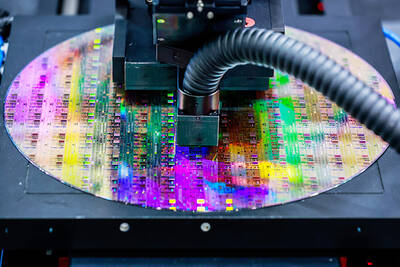
The artificial intelligence (AI) boom has triggered a seismic reshuffling of global equity markets, with Taiwan and South Korea muscling past European nations one by one. With its stock market now valued at nearly US$4.3 trillion, Taiwan surpassed the UK, Europe’s biggest market, earlier this month, data compiled by Bloomberg showed. South Korea is about US$140 billion away from doing the same. The tech-heavy Asian markets have shot past Germany and France in the past seven months. The shift is largely down to massive gains in shares of three companies that provide essential hardware for AI: Taiwan Semiconductor Manufacturing Co (TSMC, 台積電),
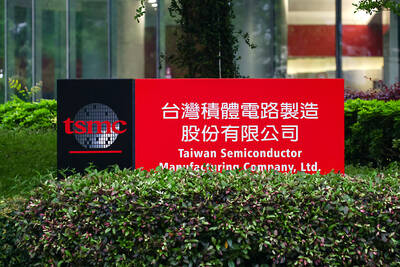
Shares of Taiwan Semiconductor Manufacturing Co (TSMC, 台積電) have repeatedly hit new highs, but an equity analyst said the stock’s valuation remains within a reasonable range and any pullback would likely be technical. The contract chipmaker’s historical price-to-earnings (P/E) ratio has ranged between 20 and 30, Cathay Futures Consultant Co (國泰證期) analyst Tsai Ming-han (蔡明翰) told Central News Agency. With market consensus projecting that TSMC would post earnings per share of about NT$100 (US$3.17) this year, supported by strong global demand for artificial intelligence (AI) applications, and the stock currently trading at a P/E ratio of below 25, Tsai said the valuation


 RSS
RSS