


Central bank Governor Yang Chin-long (楊金龍) yesterday took a cautious stance on stablecoins, saying they do not yet meet the standards needed to serve as pillars of the monetary system, despite their growing role in digital finance and tokenized assets.
Speaking at a conference organized by Financial Information Service Co (財金公司), Yang said stablecoins have payment potential, but fall short in key Bank for International Settlements criteria, such as monetary unity, elasticity and integrity, making them unsuitable to be core components of the financial system.
Different stablecoins often trade at discounts or premiums, depending on reserve quality and issuer credit risk, with secondary market prices diverging from their intended parity, he said regarding monetary unity.
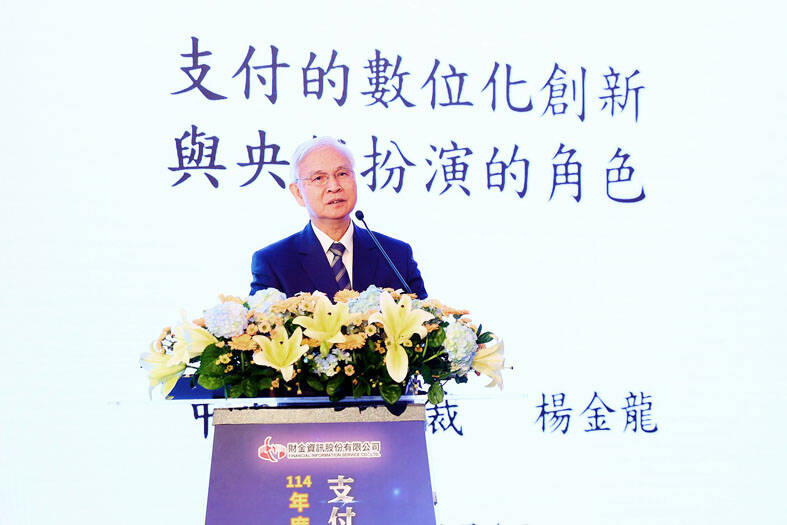
Photo courtesy of the central bank
Combined with many issuers being registered in lightly regulated jurisdictions, some academics have called the environment a modern version of the US’ “wildcat banking” from 1837 to 1865, when a lack of federal regulation allowed many poorly capitalized, state-chartered banks to issue their own currencies.
Talking about supply elasticity, Yang said stablecoins cannot be easily adjusted, because new tokens are only issued after users deposit fiat currency.
Most stablecoins could be used across borders and held by anyone, making it harder to track its users and increasing the risk of fraud or illegal activity, he said.
Taiwan’s payment infrastructure is already highly developed, Yang said.
New Taiwan dollar-based stablecoins would operate as “pay-before” stored-value instruments, similar to electronic payments, Yang said, questioning whether consumers would adopt them for real-world transactions, as people are becoming increasingly cost-conscious and might not see its benefits.
The global stablecoin market is also dominated by USDT and USDC, he said, adding that while the tokens offer fast, low-cost cross-border payments, they carry risks.
For example, USDT is not fully regulated and allows anonymous transactions, he added.
It remains uncertain whether stablecoins can maintain their speed and cost advantages once regulation is applied, Yang said.
Stablecoins’ monthly transaction volume, about US$10 billion, is also still far below traditional networks such as Visa and PayPal, he added.
For Taiwan, the development of NT dollar stablecoins would depend on market demand, regulatory clarity and technological readiness, Yang said, adding that he expects their use to first emerge in virtual asset markets and real world asset tokenization.
Although stablecoins might play a role in a tokenized monetary system, settlements would still require a central bank digital currency to ensure trust and compatibility between different types of private money, he said.

SECOND-RATE: Models distilled from US products do not perform the same as the original and undo measures that ensure the systems are neutral, the US’ cable said The US Department of State has ordered a global push to bring attention to what it said are widespread efforts by Chinese companies, including artificial intelligence (AI) start-up DeepSeek (深度求索), to steal intellectual property from US AI labs, according to a diplomatic cable. The cable, dated Friday and sent to diplomatic and consular posts around the world, instructs diplomatic staff to speak to their foreign counterparts about “concerns over adversaries’ extraction and distillation of US AI models.” Distillation is the process of training smaller AI models using output from larger, more expensive ones to lower the costs of training a powerful new
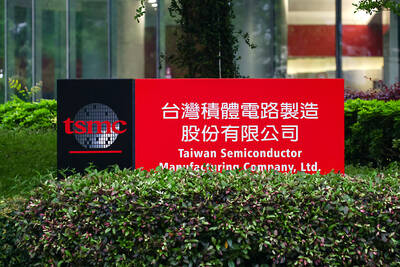
Shares of Taiwan Semiconductor Manufacturing Co (TSMC, 台積電) have repeatedly hit new highs, but an equity analyst said the stock’s valuation remains within a reasonable range and any pullback would likely be technical. The contract chipmaker’s historical price-to-earnings (P/E) ratio has ranged between 20 and 30, Cathay Futures Consultant Co (國泰證期) analyst Tsai Ming-han (蔡明翰) told Central News Agency. With market consensus projecting that TSMC would post earnings per share of about NT$100 (US$3.17) this year, supported by strong global demand for artificial intelligence (AI) applications, and the stock currently trading at a P/E ratio of below 25, Tsai said the valuation
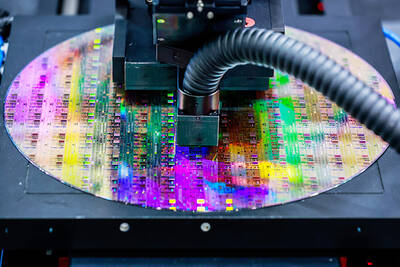
The artificial intelligence (AI) boom has triggered a seismic reshuffling of global equity markets, with Taiwan and South Korea muscling past European nations one by one. With its stock market now valued at nearly US$4.3 trillion, Taiwan surpassed the UK, Europe’s biggest market, earlier this month, data compiled by Bloomberg showed. South Korea is about US$140 billion away from doing the same. The tech-heavy Asian markets have shot past Germany and France in the past seven months. The shift is largely down to massive gains in shares of three companies that provide essential hardware for AI: Taiwan Semiconductor Manufacturing Co (TSMC, 台積電),

The US Department of Commerce last week ordered multiple chip equipment companies to halt shipments of certain tools to China’s second-largest chipmaker, Hua Hong Semiconductor Ltd (華虹半導體), its latest action to slow the country’s development of advanced chips, two people familiar with the matter said. The department sent letters to at least a handful of companies informing them of restrictions on tools and other materials destined for two Hua Hong facilities US officials believe make China’s most sophisticated chips, the people said. Top US chip equipment companies Lam Research Corp, Applied Materials Inc and KLA Corp, each of which has significant


 RSS
RSS