


Bank of Japan (BOJ) Governor Kazuo Ueda sent the clearest hint yet that his board might increase interest rates soon, highlighting the possibility of a move at the bank’s meeting this month.
The central bank “will consider the pros and cons of raising the policy interest rate and make decisions as appropriate” by examining the economy, inflation and financial markets at home and abroad, Ueda yesterday said during a speech to business leaders in Nagoya, Japan.
Any hike would be an adjustment in the degree of easing, with the real interest rate still at a very low level, he added.
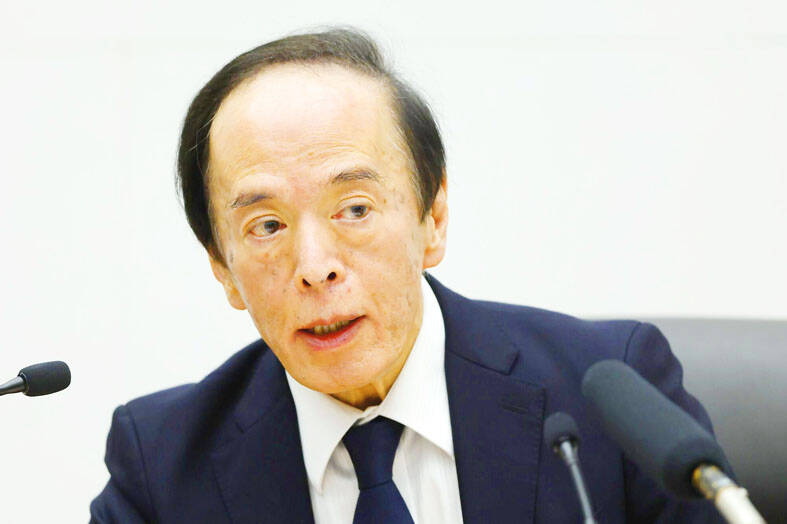
Photo: Bloomberg
Ueda emphasized that he has had smooth communications with the government, an assertion that might indicate Japanese Prime Minister Sanae Takaichi would not object to a move.
Takaichi is known to favor dovish policies, but she might be worried that inflation could further damage the ruling Liberal Democratic Party after two bruising election results that reflected frustration over costs of living.
“I think I’ve had frank, good discussions at face-to-face meetings with the prime minister and economic ministers since last month,” Ueda said. “I intend to continue to keep close communications.”
BNP Paribas SA economists in a research note wrote that Ueda’s speech was “almost an advance notice” for a hike this month, while economists at Barclays PLC and JPMorgan Securities LLC brought forward their rate hike predictions to this month after previously pegging it for next month.
Those sentiments were reflected in market moves. Government bonds slumped, with the two-year yield rising to its highest level since 2008, while yields on five-year and benchmark 10-year bonds climbed at least 6.5 basis points each to 1.375 percent and 1.87 percent respectively.
The yen rose as much as 0.5 percent to 155.4 against the US dollar.
“Raising the policy interest rate under accommodative financial conditions is about the process of easing off the accelerator as appropriate toward achieving stable economic growth and price developments, not about applying the brakes on economic activity,” Ueda said.
Ueda spoke after his fellow board members signaled support for raising rates, and two dissenting members called for the action at the past two meetings.
BOJ board member Junko Koeda said rate normalization should take place without specifying when.
Another member, Kazuyuki Masu, in an interview with the Nikkei said the timing of the hike is approaching.
Even dovish member Asahi Noguchi last week mentioned the risk of being too late on any policy change.
Ueda sketched out both sides of the timing dilemma in his morning remarks. He pointed to the BOJ’s appropriate policy conduct — moving neither too late nor too early — as an approach that would help the economy grow in a sustainable manner.
Adjusting the degree of accommodation appropriately will be necessary “to guide Japan’s economy onto a long-term growth path, which will ultimately lead to the success of the efforts undertaken by the government and the bank thus far,” he said.

Taiwan Semiconductor Manufacturing Co (TSMC, 台積電) last week recorded an increase in the number of shareholders to the highest in almost eight months, despite its share price falling 3.38 percent from the previous week, Taiwan Stock Exchange data released on Saturday showed. As of Friday, TSMC had 1.88 million shareholders, the most since the week of April 25 and an increase of 31,870 from the previous week, the data showed. The number of shareholders jumped despite a drop of NT$50 (US$1.59), or 3.38 percent, in TSMC’s share price from a week earlier to NT$1,430, as investors took profits from their earlier gains

AI TALENT: No financial details were released about the deal, in which top Groq executives, including its CEO, would join Nvidia to help advance the technology Nvidia Corp has agreed to a licensing deal with artificial intelligence (AI) start-up Groq, furthering its investments in companies connected to the AI boom and gaining the right to add a new type of technology to its products. The world’s largest publicly traded company has paid for the right to use Groq’s technology and is to integrate its chip design into future products. Some of the start-up’s executives are leaving to join Nvidia to help with that effort, the companies said. Groq would continue as an independent company with a new chief executive, it said on Wednesday in a post on its Web

CHINA RIVAL: The chips are positioned to compete with Nvidia’s Hopper and Blackwell products and would enable clusters connecting more than 100,000 chips Moore Threads Technology Co (摩爾線程) introduced a new generation of chips aimed at reducing artificial intelligence (AI) developers’ dependence on Nvidia Corp’s hardware, just weeks after pulling off one of the most successful Chinese initial public offerings (IPOs) in years. “These products will significantly enhance world-class computing speed and capabilities that all developers aspire to,” Moore Threads CEO Zhang Jianzhong (張建中), a former Nvidia executive, said on Saturday at a company event in Beijing. “We hope they can meet the needs of more developers in China so that you no longer need to wait for advanced foreign products.” Chinese chipmakers are in
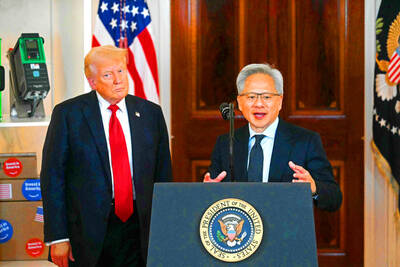
POLICY REVERSAL: The decision to allow sales of Nvidia’s H200 chips to China came after years of tightening controls and has drawn objections among some Republicans US House Republicans are calling for arms-sale-style congressional oversight of artificial intelligence (AI) chip exports as US President Donald Trump’s administration moves to approve licenses for Nvidia Corp to ship its H200 processor to China. US Representative Brian Mast, the Republican chairman of the US House Committee on Foreign Affairs, which oversees export controls, on Friday introduced a bill dubbed the AI Overwatch Act that would require the US Congress to be notified of AI chips sales to adversaries. Any processors equal to or higher in capabilities than Nvidia’s H20 would be subject to oversight, the draft bill says. Lawmakers would have


 RSS
RSS