


Shoppers turned out in big numbers for Black Friday, spending billions of dollars in stores and online, despite wider economic uncertainty hovering above this year’s holiday season.
US consumers on Friday spent a record US$11.8 billion online, a 9.1 percent jump from last year, said Adobe Analytics, which tracks e-commerce.
Traffic particularly piled up between the hours of 10am and 2pm local time nationwide, when US$12.5 million passed through online shopping carts every minute.

Photo: AP
Consumers also spent a record US$6.4 billion online on Thanksgiving Day, Adobe said.
Top categories that saw an uptick in sales across both days included video game consoles, electronics and home appliances.
Shopping services powered by artificial intelligence and social media advertising have also particularly influenced what consumers choose to buy, the firm said.
Meanwhile, software company Salesforce Inc — which tracks digital spending from a range of retailers, including grocers — estimated that Black Friday online sales totaled US$18 billion in the US and US$79 billion globally.
E-commerce platform Shopify Inc said its merchants raked in a record US$6.2 billion in sales worldwide on Black Friday.
At its peak, sales reached US$5.1 million per minute — with top categories including cosmetics and clothing, the Canadian company said.
Mastercard SpendingPulse, which tracks in-person and online spending, reported that overall Black Friday sales excluding automotive rose 4.1 percent from a year earlier.
The retail sales indicator, which is not adjusted for inflation, showed online sales jumped by 10.4 percent, while in-store purchases inched up 1.7 percent.
Consumers are “navigating an uncertain environment” this holiday season “by shopping early, leveraging promotions and investing in wish-list items,” Mastercard Economics Institute chief economist Michelle Meyer said.
Black Friday is far from the sales event that created midnight mall crowds or doorbuster mayhem just decades ago. More consumers have instead turned to online deals to make post-Thanksgiving purchases from the comfort of their homes — or opt to stretch out spending across longer promotions offered by retailers.
“Black Friday has really turned into like a full week event, or even further,” Sensormatic Solutions retail consulting and analytics head Grant Gustafson said.
“Black Friday is really the start of just a really and critical stretch for retailers,” he said, adding that the weekend following Thanksgiving, as well as the days leading up to Christmas, would also be some of the busiest in terms of in-store traffic.
In terms of e-commerce, Adobe expects US shoppers to spend another US$5.5 billion on Saturday and US$5.9 billion on Sunday — before reaching an estimated US$14.2 billion peak on Cyber Monday, which would mark yet another record.
Still, rising prices could be contributing to some of those numbers.
US President Donald Trump’s barrage of tariffs on foreign imports have strained businesses and households alike over the last year, and despite spending more overall, Salesforce found US shoppers purchased fewer items at checkout on Black Friday (down 2 percent from last year).
Order volumes also slipped 1 percent, as average selling prices climbed 7 percent, the firm said.
For the November-December holiday season overall, the National Retail Federation estimates that US shoppers would spend more than US$1 trillion for the first time this year.
However, the rate of growth is slowing, with an anticipated increase of 3.7 percent to 4.2 percent year-on-year, compared with 4.3 percent in last year’s holiday season.

Netherlands-based semiconductor equipment supplier ASML Holding NV yesterday said that it is planning to hire an additional 1,000 people in Taiwan this year in response to growing demand from clients. ASML had previously planned to recruit 600 people this year, but that the plan has been adjusted upward, ASML vice president and ASML Taiwan general manager Grace Wang (汪佳慧) told reporters. ASML has a workforce of more than 4,500 in Taiwan, accounting for about 10 percent of its global total, Wang said. This year’s recruitment campaign would focus on adding people in the customer support, manufacturing and supply chain domains to assist ASML

UNDER MICROSCOPE: Taiwan detained three people who allegedly conspired to buy servers in Taiwan and export them using fraudulent documentation, prosecutors said Nvidia Corp chief executive officer Jensen Huang (黃仁勳) on Saturday urged Super Micro Computer Inc to tighten up on compliance after Taiwan detained three people this week for allegedly making fraudulent declarations about artificial intelligence (AI) servers made by its US partner. The development marked the nation’s first crackdown on semiconductor smuggling, which grew after the US slapped restrictions on exports of high-end chips such as Nvidia AI accelerators to China. Nvidia is “rigorous” in explaining regulations to all of its partners, Huang told reporters after arriving in Taipei. “Ultimately Super Micro has to run their own company,” he said in response to

Nvidia Corp yesterday announced that CEO Jensen Huang (黃仁勳) would attend an employee meeting in Taipei tomorrow to celebrate the launch of the company’s Taiwan headquarters project. Huang would attend a gathering at the site of Nvidia’s planned headquarters in Beitou Shilin Technology Park (北投士林科技園區), the company said in a statement. After arriving in Taiwan on Saturday last week, Huang told reporters that he plans to meet with Quanta Computer Inc (廣達) chairman Barry Lam (林百里) and Taiwan Semiconductor Manufacturing Co (TSMC, 台積電) chairman C.C. Wei (魏哲家), and would attend the groundbreaking ceremony for Nvidia’s Taiwan headquarters tomorrow. Nvidia has not yet applied
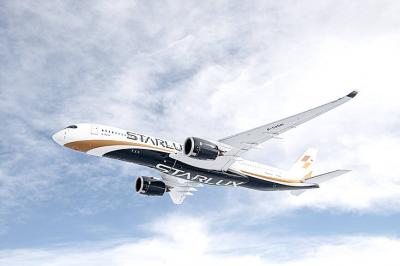
Starlux Airlines Co (星宇航空) today unveiled a long-haul network expansion plan at a shareholders’ meeting in Taipei, including direct flights to Barcelona, Spain, and Zurich, Switzerland, as well as a service connecting Taipei, Sydney and New Zealand. Starlux is to become the first Taiwanese carrier to offer non-stop services to the two European cities, while the inaugural oceanic route is expected to expand transit opportunities within the Australia-New Zealand market, Starlux said. Flight services to Chicago, Dallas, Washington and New York are under evaluation, the airline added. Prior to the shareholders’ meeting, the airline earlier this year announced that it would be


 RSS
RSS