

The agenda of the one hour and 40 minutes meeting between U.S. President Donald Trump and Chinese President Xi Jinping appears not to have touched on some perennial problems such as tensions over the self-governed island of Taiwan.
But Trump said China had agreed to buy large quantities of American farm products and to ensure steady supplies of rare earths elements used in many industries. Here are some of the key takeaways from the meeting.
Rolling back tariffs
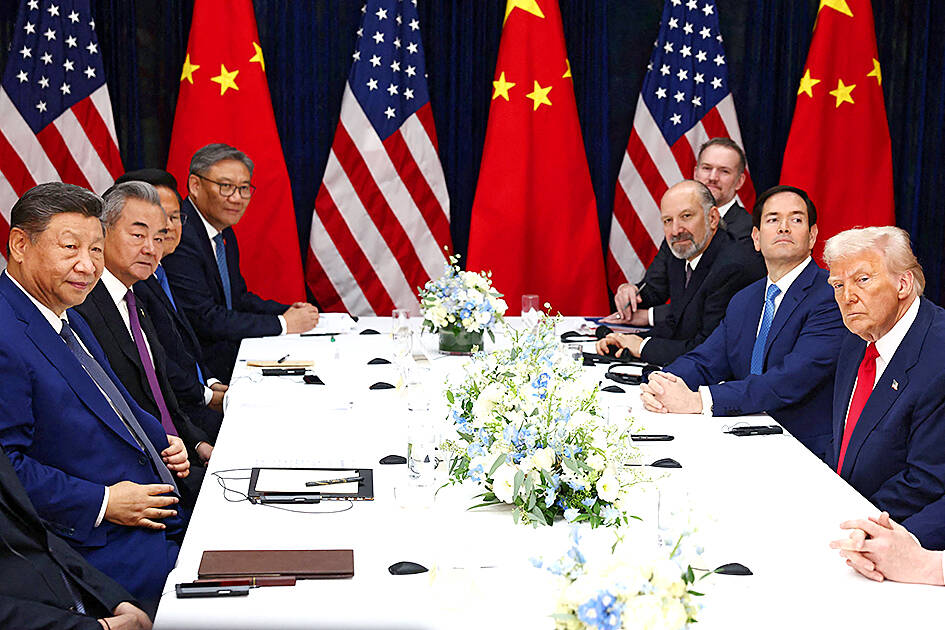
Photo: Reuters
Trump told reporters that he had agreed to cut to 10% his 20% tariff increase imposed over China’s role in producing fentanyl and chemicals used to make it. China confirmed that will take average tariffs on Chinese goods the U.S. imports to 47% from 57%.
Other tariff increases remain in place, but for now, the two sides have extended a truce on even steeper tariff increases that began in May when Trump and Xi agreed to pause those to allow time to work on a framework for resolving trade tensions.
Trump said that he would go to China in April and Xi would come to the U.S. “some time after that.”
Sales of computer chips to China
China will speak with Silicon Valley chipmaker Nvidia about purchasing their computer chips. That won’t include its next-generation Blackwell AI chip, Trump said, “but a lot of the chips.”
U.S. soybeans and other farm exports
Trump said the Chinese side has committed to buying “a tremendous amount” of American soybeans, sorghum and other farm products.
U.S. Treasury Secretary Scott Bessent said China has agreed to buy 12 million metric tons of American soybeans during the current season and to buying 25 million tons annually for the next three years.
Rare earths, port fees and U.S energy sales
Trump said China had agreed not to tighten restrictions on exports of rare earths and the technology and equipment used to process them. Trump earlier had threatened a 100% import tax because of China’s rare earth restrictions.
“Xi had agreed to a one-year reprieve on the curbs that is likely to be “routinely extended.” “All of the rare earth has been settled, and that’s for the world,” Trump said.
China and the U.S. likewise said they would not impose higher port fees on each others vessels. Trump also said China had agreed to begin purchasing oil and gas from Alaska.
No TikTok deal yet
Beijing said it will work with the Trump administration to resolve issues related to TokTok’s ownership.
Ukraine
The U.S. and China will “work together” on ending the war between Russia and Ukraine, Trump said, adding, “Ukraine came up very strongly, we talked about it for a long time.”
China’s take on the meeting
According to Chinese state media, stressing that dialogue is better than confrontation, Xi listed a range of issues where China and the U.S. could work together, including combating illegal immigration and telecom fraud, anti-money laundering efforts, artificial intelligence and handling infectious diseases.
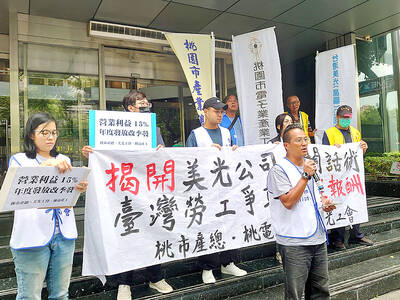
UNION DETERMINATION: Rejecting an offer for a one-time payout as an attempt to influence opinion, the union said a strike at the memory chip manufacturer is possible The Micron Taiwan workers’ union yesterday rejected a one-time payout unveiled by US-based Micron Technology Inc last week, saying it wants a long-term mechanism under which employees would share 15 percent of the company’s operating profits. While the union and the company are still in talks over the dispute, the reward package was proposed unilaterally by the employer without reaching an agreement with the union, union head Jerry Lin (林哲瑞) told reporters. Lin said he suspected the company was seeking to influence public opinion with the move. On Friday last week, Micron announced a reward package under which employees in Taiwan would receive
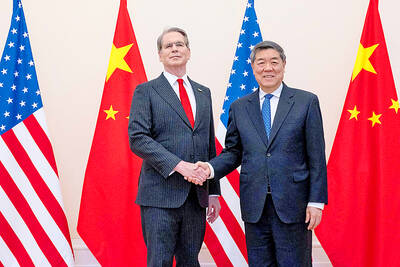
MINIMAL EXPECTATIONS: Analysts think that the two sides are likely to aim for ‘status quo’-level agreements, maintaining civility, without major trade breakthroughs US Secretary of the Treasury Scott Bessent and Chinese Vice Premier He Lifeng (何立峰) were set to meet yesterday to try to set up potential agreements on artificial intelligence (AI), tariffs and critical minerals for a summit in Washington this week between US President Donald Trump and Chinese President Xi Jinping (習近平). The meetings at JPMorgan Chase & Co’s headquarters in Manhattan, which included US Trade Representative Jamieson Greer, were due to start at about 10:30am on Sunday morning and were expected to run all day. Key topics would be the status of a US-China trade truce that is set to expire

BUILDER’s RITES: The topping out ceremony is held when a project being built has its highest point laid out, a sure sign that TSMC’s European project is making solid progress A “topping out” ceremony was held on Monday at a plant under construction in Germany by Taiwan Semiconductor Manufacturing Co (TSMC, 台積電), indicating that the fab is progressing as planned and within budget, the head of a joint-venture company in charge of the project said. A topping out ceremony is the construction milestone of laying the final beam or structural piece at the highest point of a building, and it honors the construction crew, architects and engineers. European Semiconductor Manufacturing Co (ESMC) president Christian Koitzsch said that about 2,000 workers from 106 countries are working around the clock at the site in
APPEAL: Any agreement to produce advanced memory such as HBM or DRAM could run into opposition from Seoul as those technologies are sensitive, sources said South Korea’s SK Hynix Inc is in talks with Intel Corp about a deal that would see it manufacture memory chips on US soil for the first time, three people familiar with the discussions said. Under one potential scenario, SK Hynix would lease part of Intel’s long-planned chipmaking facility in Ohio, they said. Under another scenario, it could form a venture with Intel and major cloud firms that are keen to lock in memory supplies, two of the people said. A deal would relieve pressure on Intel, which has been struggling, and mark a big win for US President Donald


 RSS
RSS