

Hon Hai Precision Industry Co (鴻海精密) yesterday said it is partnering with Nvidia Corp, Stellantis NV and Uber Technologies Inc to jointly develop self-driving vehicles and deploy a global robotaxi service.
Hon Hai, also known as Foxconn Technology Group (富士康科技集團), in a statement said that the alliance aims to accelerate the commercialization of fully autonomous vehicles worldwide, centered around Nvidia’s artificial intelligence (AI)-powered self-driving systems.
Hon Hai said it would provide “hardware and integration know-how” to combine Nvidia’s technology with the vehicle platforms of Stellantis, while Uber would leverage its global network to operate robotaxi services.
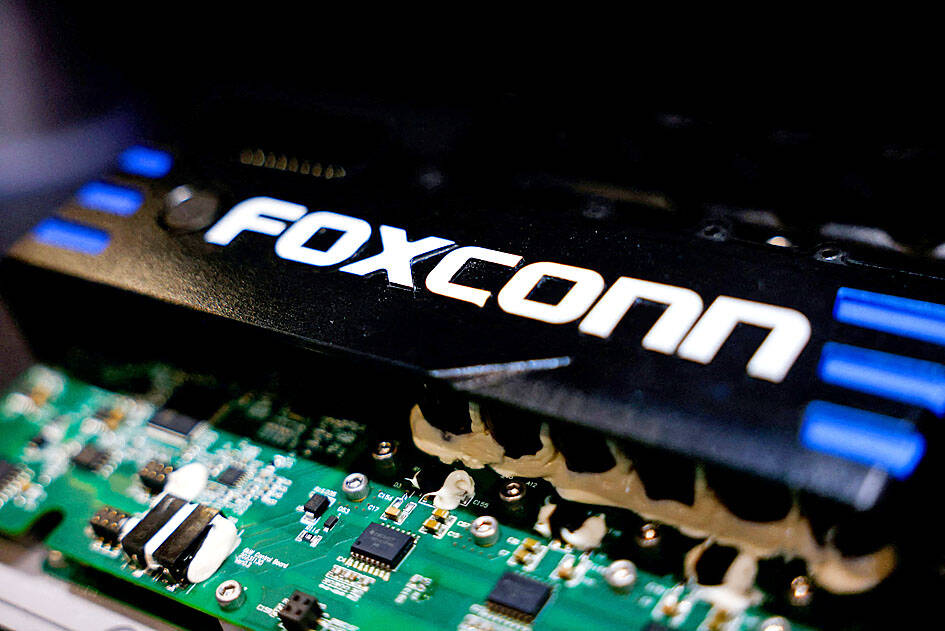
Photo: Ann Wang, REUTERS
“Autonomous mobility is a strategic priority within Foxconn’s EV [electric vehicle] program,” Hon Hai chairman Young Liu (劉揚偉) was quoted as saying in the statement.
On Tuesday, Liu at Nvidia’s GPU Technology Conference in Washington said that Hon Hai is working closely with Nvidia to build AI-related infrastructure and integrate AI into its manufacturing processes.
The efforts include an ongoing project to integrate AI into Hon Hai’s manufacturing plant in Houston, Texas, plans that were made public for the first time at the conference, according to a separate statement issued by Hon Hai.
The project would leverage Nvidia’s AI systems to simulate factory scenarios, build thermal analysis software, plan routes for robots that move around in the factory and monitor manufacturing operations, the company said.
The Houston facility would be the first to deploy humanoid robots, powered by the Nvidia Isaac GR00T N model, on its production lines to create a “benchmark AI smart factory,” Nvidia said.
Meanwhile, Hon Hai said it would continue to expand its AI-related production lines in the US, with additional facilities planned in Texas, Wisconsin and California in partnership with Nvidia to meet growing customer demand.
Hon Hai has been operating in the US since 1985, and operates more than 40 facilities across 12 states, according to its Web site.
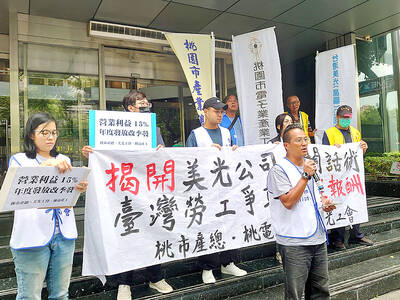
UNION DETERMINATION: Rejecting an offer for a one-time payout as an attempt to influence opinion, the union said a strike at the memory chip manufacturer is possible The Micron Taiwan workers’ union yesterday rejected a one-time payout unveiled by US-based Micron Technology Inc last week, saying it wants a long-term mechanism under which employees would share 15 percent of the company’s operating profits. While the union and the company are still in talks over the dispute, the reward package was proposed unilaterally by the employer without reaching an agreement with the union, union head Jerry Lin (林哲瑞) told reporters. Lin said he suspected the company was seeking to influence public opinion with the move. On Friday last week, Micron announced a reward package under which employees in Taiwan would receive

BUILDER’s RITES: The topping out ceremony is held when a project being built has its highest point laid out, a sure sign that TSMC’s European project is making solid progress A “topping out” ceremony was held on Monday at a plant under construction in Germany by Taiwan Semiconductor Manufacturing Co (TSMC, 台積電), indicating that the fab is progressing as planned and within budget, the head of a joint-venture company in charge of the project said. A topping out ceremony is the construction milestone of laying the final beam or structural piece at the highest point of a building, and it honors the construction crew, architects and engineers. European Semiconductor Manufacturing Co (ESMC) president Christian Koitzsch said that about 2,000 workers from 106 countries are working around the clock at the site in
APPEAL: Any agreement to produce advanced memory such as HBM or DRAM could run into opposition from Seoul as those technologies are sensitive, sources said South Korea’s SK Hynix Inc is in talks with Intel Corp about a deal that would see it manufacture memory chips on US soil for the first time, three people familiar with the discussions said. Under one potential scenario, SK Hynix would lease part of Intel’s long-planned chipmaking facility in Ohio, they said. Under another scenario, it could form a venture with Intel and major cloud firms that are keen to lock in memory supplies, two of the people said. A deal would relieve pressure on Intel, which has been struggling, and mark a big win for US President Donald
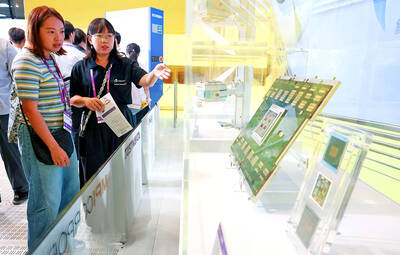
Prices of high-capacity NOR flash memory chips are projected to increase 90 to 110 percent in the second half of this year amid growing demand and slower capacity expansion, after jumping 100 to 120 percent on average in the first half, TrendForce Corp (集邦科技) said yesterday. “Emerging applications such as AI servers and aerospace communications are propelling demand in 2026, aside from existing applications such as advanced driver assistance, digital cockpit systems and industrial devices,” the Taipei-based research group said in a report. Demand from AI servers is exceptionally strong as each AI server requires three to five times more NOR flash


 RSS
RSS