


US and Chinese officials reached a “very successful” framework for the upcoming leaders’ summit, US Secretary of the Treasury Scott Bessent said after two days of talks in Malaysia.
Bessent told reporters in Kuala Lumpur yesterday morning that the two sides discussed agricultural purchases, TikTok, fentanyl, trade, rare earths and the overall bilateral relationship.
He described the talks as “constructive, far-reaching and in-depth, and giving us the ability to move forward to set the stage for the leaders’ meeting in a very positive framework.”
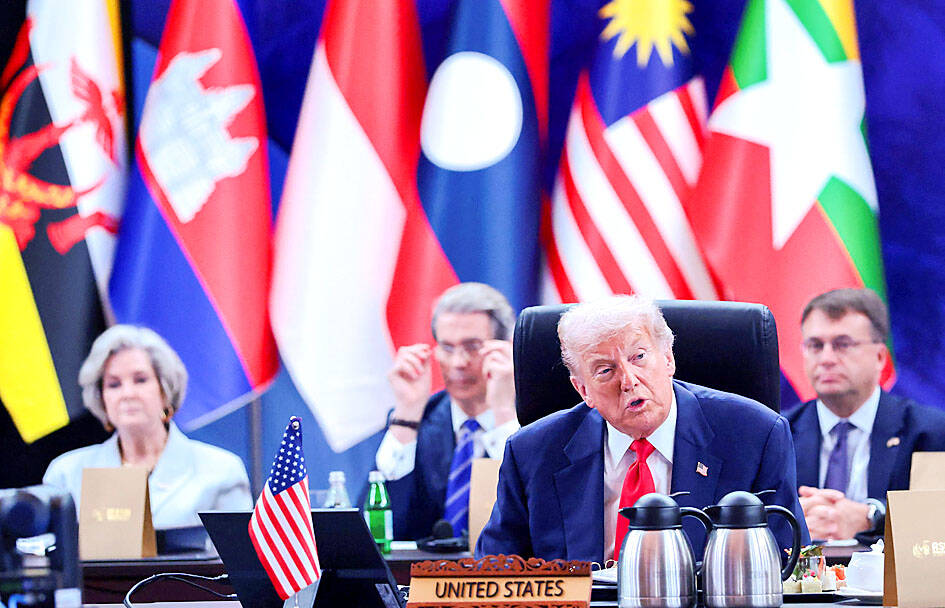
Photo: Reuters
The negotiations took place at the skyscraper Merdeka 118 as US President Donald Trump met with Southeast Asian leaders at a nearby convention center.
Chinese Vice Premier He Lifeng (何立峰) led the Chinese side and was joined by Chinese Trade Representative Li Chenggang (李成鋼) and Vice Finance Minister Liao Min (廖岷). US Trade Representative Jamieson Greer was part of the US team.
Trump landed in Malaysia yesterday to begin his first tour of the region during his second term. He was greeted by Malaysian Prime Minister Anwar Ibrahim on the tarmac and oversaw the signing of a peace declaration between Thailand and Cambodia.
Trump and Anwar Ibrahim signed a trade agreement and critical minerals pact, as the US leader looked to boost trade across Southeast Asia and respond to China’s tightening of access to rare earths.
Greer said at the signing in Kuala Lumpur that the critical minerals deal made sure that trade and investment in the rare earths would make trade “as free as possible and resilient as possible.”
The deal with Malaysia is set to ease concerns surrounding its exports to China. Trump set a 19 percent tariff on the country in August, lower than the 25 percent he had threatened in July.
Malaysia had been seeking less onerous US trade conditions for months, and has vowed to crack down on the smuggling of advanced semiconductors through the country to China.
Anwar called the deals “a significant milestone” that would improve the relationship between the nations beyond trade.
Earlier in the day, Trump also announced a broad trade agreement with Cambodia and a critical minerals pact with Thailand, although the latter was mostly an aspirational pledge to work together. The Cambodia deal would see hundreds of types of goods exempted from the reciprocal tariff rate on exports imposed by Trump earlier this year.
The US president is scheduled to hold bilateral meetings in Malaysia and later in Japan and South Korea, where he is also expected to meet with Chinese President Xi Jinping (習近平) on the sidelines of the APEC summit.
Trump, speaking to reporters aboard Air Force One, said he hopes the talks with Xi would yield “a complete deal.”
The meeting would be the first face-to-face between the leaders of the two biggest economies since Trump returned to the White House in January. The two have spoken at least three times this year, and Trump has said direct talks are the best way to resolve issues, including tariffs, export curbs, agricultural purchases, fentanyl trafficking, geopolitical flashpoints such as Taiwan and the war in Ukraine.
“We’ll be talking about a lot of things. I think we have a really good chance of making a very comprehensive deal,” he said.
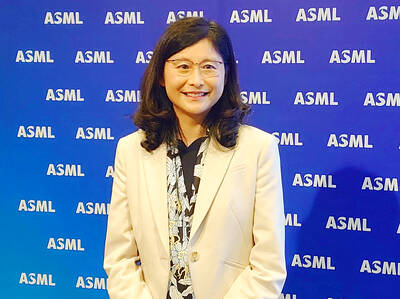
Netherlands-based semiconductor equipment supplier ASML Holding NV yesterday said that it is planning to hire an additional 1,000 people in Taiwan this year in response to growing demand from clients. ASML had previously planned to recruit 600 people this year, but that the plan has been adjusted upward, ASML vice president and ASML Taiwan general manager Grace Wang (汪佳慧) told reporters. ASML has a workforce of more than 4,500 in Taiwan, accounting for about 10 percent of its global total, Wang said. This year’s recruitment campaign would focus on adding people in the customer support, manufacturing and supply chain domains to assist ASML

UNDER MICROSCOPE: Taiwan detained three people who allegedly conspired to buy servers in Taiwan and export them using fraudulent documentation, prosecutors said Nvidia Corp chief executive officer Jensen Huang (黃仁勳) on Saturday urged Super Micro Computer Inc to tighten up on compliance after Taiwan detained three people this week for allegedly making fraudulent declarations about artificial intelligence (AI) servers made by its US partner. The development marked the nation’s first crackdown on semiconductor smuggling, which grew after the US slapped restrictions on exports of high-end chips such as Nvidia AI accelerators to China. Nvidia is “rigorous” in explaining regulations to all of its partners, Huang told reporters after arriving in Taipei. “Ultimately Super Micro has to run their own company,” he said in response to
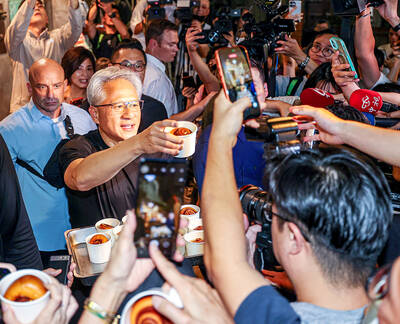
Nvidia Corp yesterday announced that CEO Jensen Huang (黃仁勳) would attend an employee meeting in Taipei tomorrow to celebrate the launch of the company’s Taiwan headquarters project. Huang would attend a gathering at the site of Nvidia’s planned headquarters in Beitou Shilin Technology Park (北投士林科技園區), the company said in a statement. After arriving in Taiwan on Saturday last week, Huang told reporters that he plans to meet with Quanta Computer Inc (廣達) chairman Barry Lam (林百里) and Taiwan Semiconductor Manufacturing Co (TSMC, 台積電) chairman C.C. Wei (魏哲家), and would attend the groundbreaking ceremony for Nvidia’s Taiwan headquarters tomorrow. Nvidia has not yet applied

Huawei Technologies Co (華為) said it has come up with a new pathway to shorten its gap with industry leader Taiwan Semiconductor Manufacturing Co (TSMC, 台積電), potentially achieving a breakthrough in making advanced semiconductors without cutting-edge equipment. Right now there is about a five-year gap between what TSMC is capable of and what Huawei, together with its manufacturing partner Semiconductor Manufacturing International Corp (中芯), can produce. Huawei is to start making 1.4-nanometer chips by 2031 with its own “LogicFolding” technology, Huawei semiconductor chief He Tingbo (何庭波) said in a rare public appearance during a chip conference yesterday, while TSMC has


 RSS
RSS