


New Yorkers run on coffee. From high-end experimental boutique cafes to the humble sidewalk cart, millions of cups of java are sold every day.
However, coffee-lovers are facing increasing pain as they pay for their simple espresso shots and elaborate pumpkin spiced lattes as the cost of beans has jumped 21 percent between August last year and August this year in the US — the world’s largest market for coffee.
Climate shocks drove the cost of arabica soaring, with the beans hitting an all-time high in February. That has been compounded by elevated transport costs and the 50 percent tariffs imposed by US President Donald Trump since Aug. 6 on many products from Brazil.
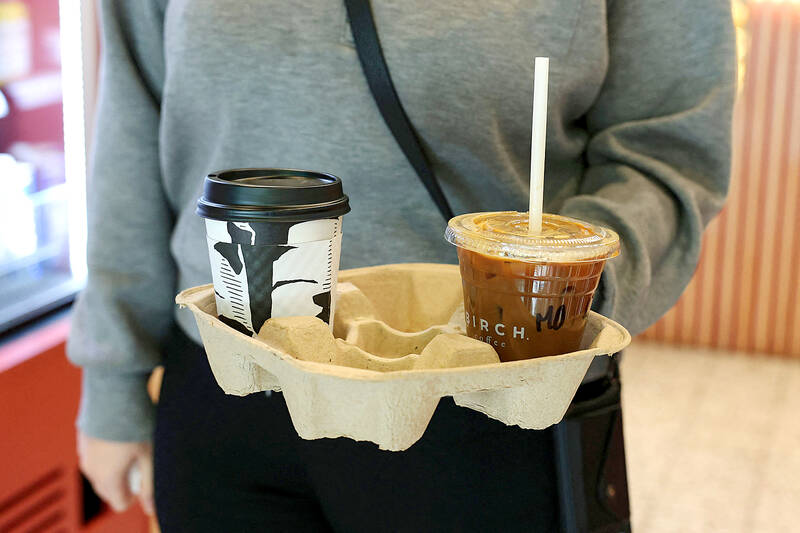
Photo: AFP
Brazil, the largest coffee producer, has been sanctioned by the Trump administration for its prosecution of former Brazilian president Jair Bolsonaro for a coup attempt. It supplies 30 percent of the US’ unroasted beans.
“It’s having a major impact on us, on small business owners, on farmers, across the board,” said Jeremy Lyman, cofounder of the New York-based chain Birch Coffee.
Founded in 2009, the brand has 14 outlets citywide, roasting its own specialty coffee in Queens since 2015.
“The price of coffee on the market has just been on a steady incline over the last probably year. I think it’s gone up about 55 percent from this time last year... it’s impacting the prices that we charge,” Lyman said.
He said that Brazil’s production had become “unaffordable,” forcing Birch to look elsewhere for beans, with its importer “pushing pause” on its orders unless specially requested.
Cecafe, the Council of Coffee Exporters of Brazil, reports that exports to the US have dropped almost 53 percent as of last month compared with the year before, with exporters looking instead to Mexico, Peru and Ethiopia.
Lyman said that market forces have meant price hikes for his customers, with Birch adding US$0.50 to cups sold in-store, and US$2 to US$3 per bag of roasted coffee sold online.
“Typically, it’ll be small, incremental [increases] because it also helps us get a little bit more time to navigate how we’re going to be sourcing,” he said, adding that he tried to give customers two weeks of warning.
Other cafes have adopted a novel approach: adding an adjustable premium to the base price of each cup according to what level Trump has set tariffs that day, Lyman said.
However, customers would only swallow so much, the Birch founder said, adding that there is a real risk of losing customers.
Jason Nickel, 45, said that while he still seeks out a daily caffeine hit, he is “a little more careful about where I go.”
He cannot imagine paying more than US$6 a cup, including tip, for a cortado — an espresso shot with a dash of milk foam.
Anna Simonovsky, 32, said that her upper limit had gone from US$7 for a latte — a milkier, frothier drink than a cortado — to as much as US$10. She enjoys coffee as a treat for special occasions, like a visit with a friend, she said.
Trump recently threw a lifeline to the two-thirds of Americans who drink coffee daily when he placed coffee on a list of products not cultivated by US farmers in sufficient quantity — potentially exempting it from tariffs, alongside tea and cocoa, and in a rare glimmer of bipartisanship, coffee-loving Republicans and Democrats are jointly sponsoring a bill intended to protect coffee products.
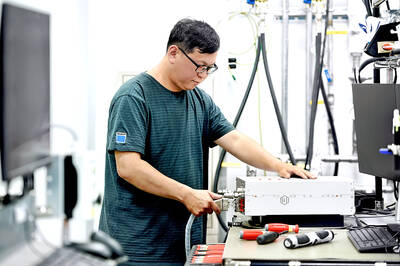
SEMICONDUCTORS: The German laser and plasma generator company will expand its local services as its specialized offerings support Taiwan’s semiconductor industries Trumpf SE + Co KG, a global leader in supplying laser technology and plasma generators used in chip production, is expanding its investments in Taiwan in an effort to deeply integrate into the global semiconductor supply chain in the pursuit of growth. The company, headquartered in Ditzingen, Germany, has invested significantly in a newly inaugurated regional technical center for plasma generators in Taoyuan, its latest expansion in Taiwan after being engaged in various industries for more than 25 years. The center, the first of its kind Trumpf built outside Germany, aims to serve customers from Taiwan, Japan, Southeast Asia and South Korea,

Gasoline and diesel prices at domestic fuel stations are to fall NT$0.2 per liter this week, down for a second consecutive week, CPC Corp, Taiwan (台灣中油) and Formosa Petrochemical Corp (台塑石化) announced yesterday. Effective today, gasoline prices at CPC and Formosa stations are to drop to NT$26.4, NT$27.9 and NT$29.9 per liter for 92, 95 and 98-octane unleaded gasoline respectively, the companies said in separate statements. The price of premium diesel is to fall to NT$24.8 per liter at CPC stations and NT$24.6 at Formosa pumps, they said. The price adjustments came even as international crude oil prices rose last week, as traders
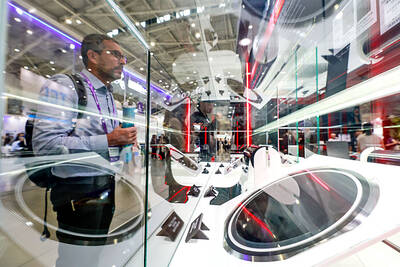
SIZE MATTERS: TSMC started phasing out 8-inch wafer production last year, while Samsung is more aggressively retiring 8-inch capacity, TrendForce said Chipmakers are expected to raise prices of 8-inch wafers by up to 20 percent this year on concern over supply constraints as major contract chipmakers Taiwan Semiconductor Manufacturing Co (TSMC, 台積電) and Samsung Electronics Co gradually retire less advanced wafer capacity, TrendForce Corp (集邦科技) said yesterday. It is the first significant across-the-board price hike since a global semiconductor correction in 2023, the Taipei-based market researcher said in a report. Global 8-inch wafer capacity slid 0.3 percent year-on-year last year, although 8-inch wafer prices still hovered at relatively stable levels throughout the year, TrendForce said. The downward trend is expected to continue this year,
Taiwan Semiconductor Manufacturing Co (TSMC, 台積電), which supplies advanced chips to Nvidia Corp and Apple Inc, yesterday reported NT$1.046 trillion (US$33.1 billion) in revenue for last quarter, driven by constantly strong demand for artificial intelligence (AI) chips, falling in the upper end of its forecast. Based on TSMC’s financial guidance, revenue would expand about 22 percent sequentially to the range from US$32.2 billion to US$33.4 billion during the final quarter of 2024, it told investors in October last year. Last year in total, revenue jumped 31.61 percent to NT$3.81 trillion, compared with NT$2.89 trillion generated in the year before, according to


 RSS
RSS