


Tokyo stocks surged almost 5 percent to a record high yesterday, and the yen sank on bets that the new leader of Japan’s ruling party would embark on a new era of loose monetary policy to revive the country’s economy.
However, the gains came on a mixed day for the rest of Asia, while Paris tumbled more than 2 percent on news that newly appointed French Prime Minister Sebastien Lecornu had stepped down, compounding a political crisis in the country.
News of the victory of Liberal Democratic Party (LDP) President Sanae Takaichi — who is expected to become Japan’s prime minister this month — fanned a fresh wave of optimism on Japanese trading floors, as she has previously backed aggressive monetary easing and expanded government spending.
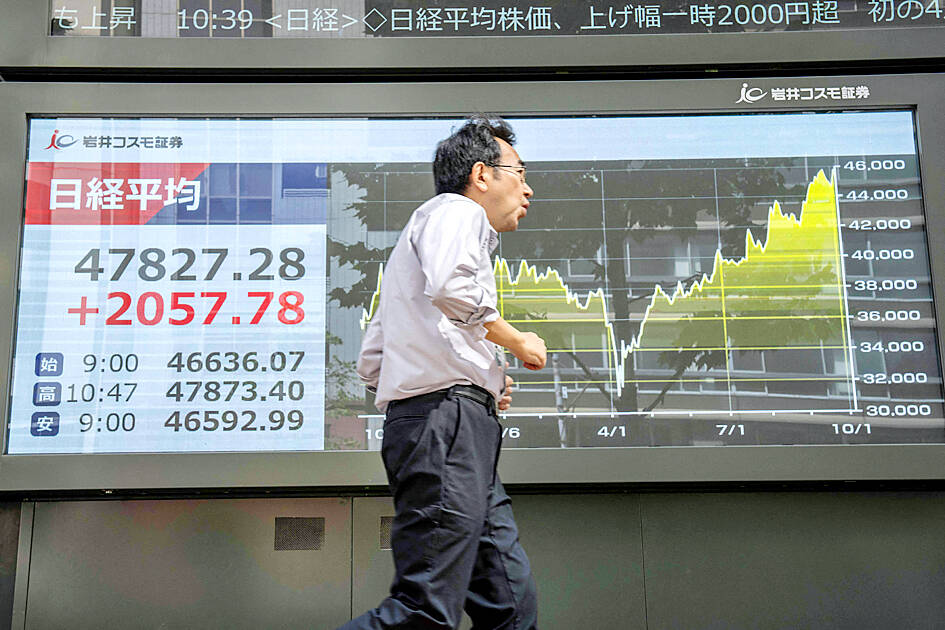
Photo: AFP
Expectations the US Federal Reserve would cut interest rates this month continue to support risk assets, with the S&P 500 and Dow both hitting peaks along with bitcoin and gold.
After her victory on Saturday, Takaichi pledged first to implement measures to address inflation and boost Japan’s economy, rural areas and primary industries.
Takaichi “looks more inclined than the others to juice the economy,” Bloomberg Economics senior economist Taro Kimura said.
“Still, with inflation rising and long-term [bond] yields climbing, she will have to balance her stance with reality, in order not to accelerate cost-of-living squeeze and jolt the rate market,” Kimura added.
The Nikkei 225’s surge came as the yen weakened more than 1 percent to top ¥150 per US dollar, while it hit a record low against the euro, touching ¥176.25 to the single currency.
“An immediate market reaction is likely to be a return of a so-called Takaichi trade, which means higher equity prices [except banks], yen depreciation and higher super-long bond yields,” UBS Securities Japan Co chief economist Masamichi Adachi said.
Yields on 30-year Japanese bonds also rose sharply, reflecting fears the country’s already colossal debt would balloon further.
Takaichi’s win also raised questions about the chances of more Bank of Japan rate hikes, adding to downward pressure on the yen.
There were also gains in Singapore and Mumbai, but Hong Kong, Sydney, Wellington, Manila and Bangkok were all in the red.
Markets in Taiwan, China and South Korea were closed for holidays.
However, sentiment remains up, as bitcoin on Sunday hit a new peak of US$125,689.
Gold pushed past US$3,945 and closer to US$4,000 yesterday, with the US shutdown and expected rate cuts boosting its attractiveness. Oil jumped more than 1 percent after OPEC+ agreed at the weekend to boost supplies by 137,000 barrels a day — less than initially expected.
The plunge in Paris’ CAC 40 index came after French President Emmanuel Macron accepted Lecornu’s resignation, plunging the country further into political deadlock.
Macron appointed Lecornu last month, but the largely unchanged Cabinet lineup he unveiled late on Sunday was met with fierce criticism across the political spectrum.
London’s FTSE dipped in the morning, after ending last week at a record, while Frankfurt also sank.
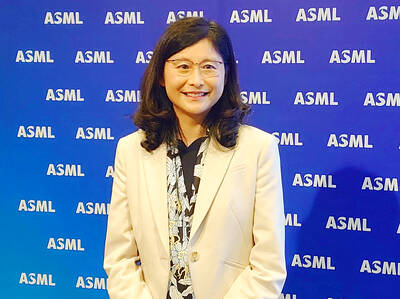
Netherlands-based semiconductor equipment supplier ASML Holding NV yesterday said that it is planning to hire an additional 1,000 people in Taiwan this year in response to growing demand from clients. ASML had previously planned to recruit 600 people this year, but that the plan has been adjusted upward, ASML vice president and ASML Taiwan general manager Grace Wang (汪佳慧) told reporters. ASML has a workforce of more than 4,500 in Taiwan, accounting for about 10 percent of its global total, Wang said. This year’s recruitment campaign would focus on adding people in the customer support, manufacturing and supply chain domains to assist ASML
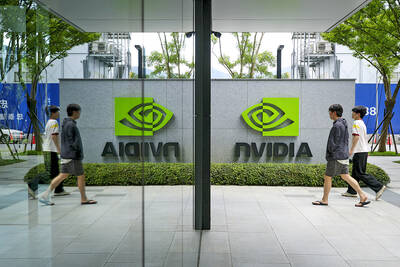
UNDER MICROSCOPE: Taiwan detained three people who allegedly conspired to buy servers in Taiwan and export them using fraudulent documentation, prosecutors said Nvidia Corp chief executive officer Jensen Huang (黃仁勳) on Saturday urged Super Micro Computer Inc to tighten up on compliance after Taiwan detained three people this week for allegedly making fraudulent declarations about artificial intelligence (AI) servers made by its US partner. The development marked the nation’s first crackdown on semiconductor smuggling, which grew after the US slapped restrictions on exports of high-end chips such as Nvidia AI accelerators to China. Nvidia is “rigorous” in explaining regulations to all of its partners, Huang told reporters after arriving in Taipei. “Ultimately Super Micro has to run their own company,” he said in response to
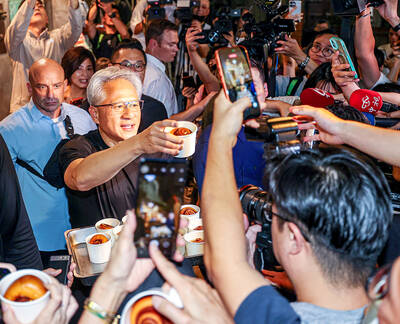
Nvidia Corp yesterday announced that CEO Jensen Huang (黃仁勳) would attend an employee meeting in Taipei tomorrow to celebrate the launch of the company’s Taiwan headquarters project. Huang would attend a gathering at the site of Nvidia’s planned headquarters in Beitou Shilin Technology Park (北投士林科技園區), the company said in a statement. After arriving in Taiwan on Saturday last week, Huang told reporters that he plans to meet with Quanta Computer Inc (廣達) chairman Barry Lam (林百里) and Taiwan Semiconductor Manufacturing Co (TSMC, 台積電) chairman C.C. Wei (魏哲家), and would attend the groundbreaking ceremony for Nvidia’s Taiwan headquarters tomorrow. Nvidia has not yet applied

Huawei Technologies Co (華為) said it has come up with a new pathway to shorten its gap with industry leader Taiwan Semiconductor Manufacturing Co (TSMC, 台積電), potentially achieving a breakthrough in making advanced semiconductors without cutting-edge equipment. Right now there is about a five-year gap between what TSMC is capable of and what Huawei, together with its manufacturing partner Semiconductor Manufacturing International Corp (中芯), can produce. Huawei is to start making 1.4-nanometer chips by 2031 with its own “LogicFolding” technology, Huawei semiconductor chief He Tingbo (何庭波) said in a rare public appearance during a chip conference yesterday, while TSMC has


 RSS
RSS