


Taiwan’s consumer confidence index (CCI) climbed to a four-month high of 64.69 last month, buoyed by stock market gains fueled by artificial intelligence (AI) demand, even as sentiment toward jobs, household finances and housing weakened, National Central University (NCU) said yesterday.
The headline index rose 1.38 points from August, driven almost entirely by a surge in the stock investment subindex, which jumped 20.48 points to 51.68 — the steepest monthly gain among the six CCI components. The other five subindexes all declined.
“The AI boom has sparked strong demand for Taiwan’s electronics and pushed the local bourse to record highs,” NCU Research Center for Taiwan Economic Development director Dachrahn Wu (吳大任) said.
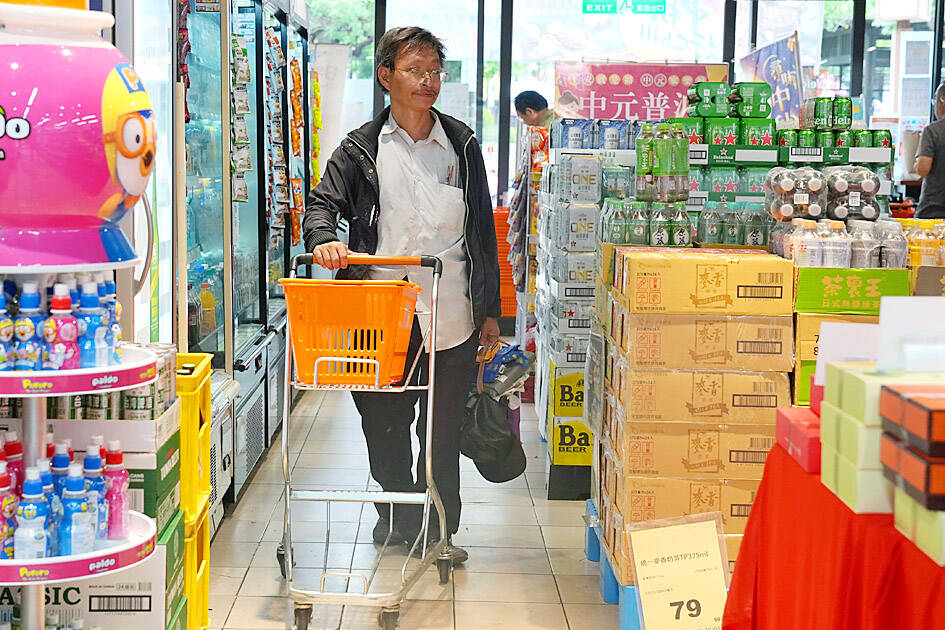
Photo: CNA
Wu cited how shares of Taiwan Semiconductor Manufacturing Co (TSMC, 台積電), the world’s largest supplier of advanced chips, recently topped NT$1,300, helping propel the TAIEX to a record peak of 26,394 points.
However, overheating risks and external uncertainties remain, Wu said, citing a US proposal for a “50-50” split in Taiwan-US chipmaking capacity.
Such a move could be Taiwan’s biggest economic challenge over the next decade, potentially dampening private investment, overall economic momentum and local stock market performance, he said.
Eventually, “more tech firms could shift their manufacturing capacity to the US,” Wu said.
Wu also flagged a separate US trade investigation into semiconductors and information and communications technology (ICT) products, which could trigger higher tariffs or other headwinds.
The latest CCI survey showed a sharp deterioration in housing-related sentiment. The durable goods subindex fell 3.83 points to 90.7, while the real-estate subindex dropped 3.79 points to 88.94 — both at their lowest levels in more than five years
Broader expectations also softened, with the six-month economic outlook index down 2.99 points to 76.18, despite stronger-than-expected GDP growth this year, driven by AI-fueled exports, the survey showed.
Confidence in household finances fell 2.61 points to 72.54, while expectations for job opportunities dropped 2.05 points to 67.07, weighed down by unpaid leave programs at non-tech firms after Washington imposed a 20 percent tariff on Taiwanese goods in August.
Consumer price expectations showed the smallest decline, edging down 0.77 points to 29.95, reflecting a moderation in inflationary pressures, Wu said.
The CCI survey was conducted by telephone on Sept. 18 and Sept. 19, polling 3,125 adults aged 20 and older, with a margin of error of plus or minus 2 percentage points.

Netherlands-based semiconductor equipment supplier ASML Holding NV yesterday said that it is planning to hire an additional 1,000 people in Taiwan this year in response to growing demand from clients. ASML had previously planned to recruit 600 people this year, but that the plan has been adjusted upward, ASML vice president and ASML Taiwan general manager Grace Wang (汪佳慧) told reporters. ASML has a workforce of more than 4,500 in Taiwan, accounting for about 10 percent of its global total, Wang said. This year’s recruitment campaign would focus on adding people in the customer support, manufacturing and supply chain domains to assist ASML

UNDER MICROSCOPE: Taiwan detained three people who allegedly conspired to buy servers in Taiwan and export them using fraudulent documentation, prosecutors said Nvidia Corp chief executive officer Jensen Huang (黃仁勳) on Saturday urged Super Micro Computer Inc to tighten up on compliance after Taiwan detained three people this week for allegedly making fraudulent declarations about artificial intelligence (AI) servers made by its US partner. The development marked the nation’s first crackdown on semiconductor smuggling, which grew after the US slapped restrictions on exports of high-end chips such as Nvidia AI accelerators to China. Nvidia is “rigorous” in explaining regulations to all of its partners, Huang told reporters after arriving in Taipei. “Ultimately Super Micro has to run their own company,” he said in response to

Nvidia Corp yesterday announced that CEO Jensen Huang (黃仁勳) would attend an employee meeting in Taipei tomorrow to celebrate the launch of the company’s Taiwan headquarters project. Huang would attend a gathering at the site of Nvidia’s planned headquarters in Beitou Shilin Technology Park (北投士林科技園區), the company said in a statement. After arriving in Taiwan on Saturday last week, Huang told reporters that he plans to meet with Quanta Computer Inc (廣達) chairman Barry Lam (林百里) and Taiwan Semiconductor Manufacturing Co (TSMC, 台積電) chairman C.C. Wei (魏哲家), and would attend the groundbreaking ceremony for Nvidia’s Taiwan headquarters tomorrow. Nvidia has not yet applied

Huawei Technologies Co (華為) said it has come up with a new pathway to shorten its gap with industry leader Taiwan Semiconductor Manufacturing Co (TSMC, 台積電), potentially achieving a breakthrough in making advanced semiconductors without cutting-edge equipment. Right now there is about a five-year gap between what TSMC is capable of and what Huawei, together with its manufacturing partner Semiconductor Manufacturing International Corp (中芯), can produce. Huawei is to start making 1.4-nanometer chips by 2031 with its own “LogicFolding” technology, Huawei semiconductor chief He Tingbo (何庭波) said in a rare public appearance during a chip conference yesterday, while TSMC has


 RSS
RSS