


Ali Akbar knows everyone, and everyone knows him: The last newspaper hawker in Paris, he zigzags each day from cafe to cafe, shouting humorous headlines in the heart of the French capital.
“France is getting better,” he says to people passing by, just one of the headlines he invents to sell his wares around the upmarket streets of Saint-German-des-Pres.
“[Eric] Zemmour has converted to Islam,” he shouts, referring to the former French presidential candidate and right-wing commentator.
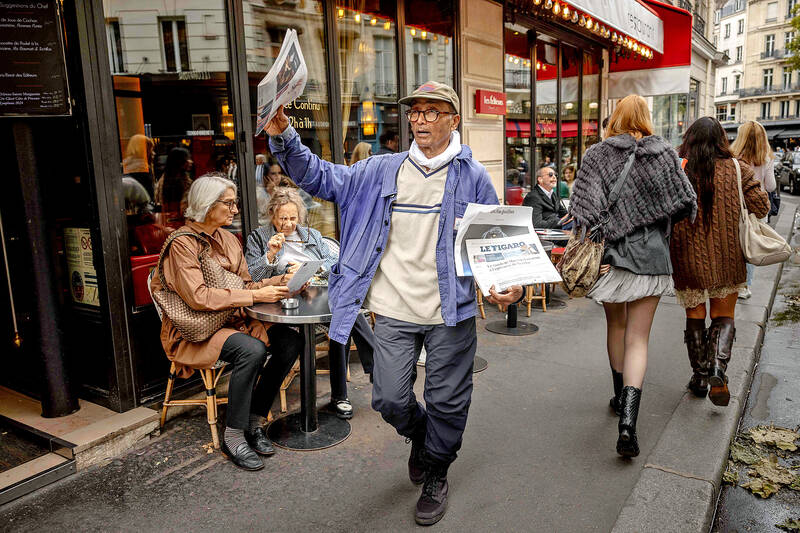
Photo: AFP
Locals and tourists on the Left Bank, the intellectual and cultural heart of Paris, look on amused.
“Even the walls could talk about Ali,” smiled Amina Qissi, a waitress at a restaurant opposite the Marche Saint-Germain, who has known Akbar for more than 20 years.
Now 73, Akbar, a slim, fine-featured “character” with newspapers tucked under his arm, is an inseparable part of the neighborhood, she added.
“Even regular tourists ask where he is if they don’t see him,” she said.
HARD LIFE
French President Emmanuel Macron has vowed to soon make Akbar a knight in the national order of merit in recognition of his “dedicated service to France.”
“At first, I didn’t believe it. Friends must have asked him [Macron], or maybe he decided on his own. We often crossed paths when he was a student,” Akbar said.
“I believe it’s related to my courage, because I’ve worked hard,” he added.
Akbar, who wears round spectacles, a blue work jacket and a Gavroche cap, mainly sells copies of the French daily Le Monde.
When he arrived in France at the age of 20, hoping to escape poverty and send back money to his family in Pakistan, he worked as a sailor, then a dishwasher in a restaurant in the northern city of Rouen.
Then in Paris, he bumped into Georges Bernier, the humorist also known as Professeur Choron, who gave him the chance to sell his satirical newspapers Hara-Kiri, a French satirical magazine, first launched in 1960, and Charlie Hebdo.
Akbar has been homeless, attacked and experienced extreme poverty, but despite the hardships, he said he has never given up.
“Emmanuel Macron is going to put a bit of antiseptic on my wounds,” he told his son Shahab, who at 30 is the youngest of his five children.
Shahab, who describes himself as “very proud” of his father, enjoys cataloguing the numerous profiles dedicated to his father in the foreign press.
When he started out as a hawker in the 1970s, Akbar focused on the sixth arrondissement of Paris on the left bank of the river Seine, which was a university area “where you could eat cheaply,” he said.
On the rue Saint-Guillaume in front of the prestigious Sciences Po university, he recalled learning French from interactions with students like former prime minister Edouard Philippe and “many others who became ministers or lawmakers.”
‘A GOOD MOOD’
Paris used to have about 40 newspaper hawkers — street vendors without a fixed newsstand — who were posted at strategic locations such as the entrances to subway stations.
Akbar stood out by choosing to walk around, selecting the Latin Quarter. In the 1980s, he started inventing sensational headlines.
“I want people to live happily. I do it to create a good mood, that’s all,” he said.
However, he said he is finding it increasingly difficult to come up with good jokes.
“Everything is such a mess,” he added.
‘KEEP GOING’
Akbar, who receives a pension of 1,000 euros (US$1,170) a month, still works from 3pm until 10pm each day.
However, recently, customers have been few and far between. On average, he sells about 30 newspapers every day, compared with between 150 and 200 when he started.
“As long as I’ve got the energy, I’ll keep going. I’ll work until I die,” he joked.
On the terrace of one cafe, Amel Ghali, 36, said Akbar was “inspiring.”
“It’s good to see it in the digital age,” he said. “Unfortunately, our children won’t experience the pleasure of reading a newspaper with a coffee.”

Netherlands-based semiconductor equipment supplier ASML Holding NV yesterday said that it is planning to hire an additional 1,000 people in Taiwan this year in response to growing demand from clients. ASML had previously planned to recruit 600 people this year, but that the plan has been adjusted upward, ASML vice president and ASML Taiwan general manager Grace Wang (汪佳慧) told reporters. ASML has a workforce of more than 4,500 in Taiwan, accounting for about 10 percent of its global total, Wang said. This year’s recruitment campaign would focus on adding people in the customer support, manufacturing and supply chain domains to assist ASML
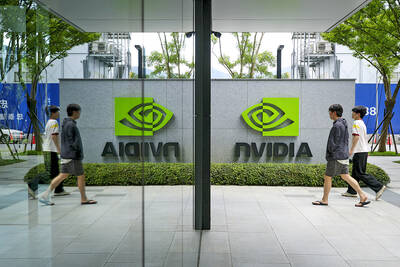
UNDER MICROSCOPE: Taiwan detained three people who allegedly conspired to buy servers in Taiwan and export them using fraudulent documentation, prosecutors said Nvidia Corp chief executive officer Jensen Huang (黃仁勳) on Saturday urged Super Micro Computer Inc to tighten up on compliance after Taiwan detained three people this week for allegedly making fraudulent declarations about artificial intelligence (AI) servers made by its US partner. The development marked the nation’s first crackdown on semiconductor smuggling, which grew after the US slapped restrictions on exports of high-end chips such as Nvidia AI accelerators to China. Nvidia is “rigorous” in explaining regulations to all of its partners, Huang told reporters after arriving in Taipei. “Ultimately Super Micro has to run their own company,” he said in response to
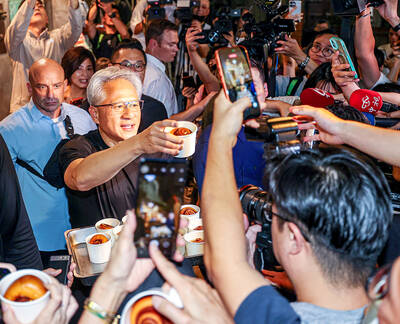
Nvidia Corp yesterday announced that CEO Jensen Huang (黃仁勳) would attend an employee meeting in Taipei tomorrow to celebrate the launch of the company’s Taiwan headquarters project. Huang would attend a gathering at the site of Nvidia’s planned headquarters in Beitou Shilin Technology Park (北投士林科技園區), the company said in a statement. After arriving in Taiwan on Saturday last week, Huang told reporters that he plans to meet with Quanta Computer Inc (廣達) chairman Barry Lam (林百里) and Taiwan Semiconductor Manufacturing Co (TSMC, 台積電) chairman C.C. Wei (魏哲家), and would attend the groundbreaking ceremony for Nvidia’s Taiwan headquarters tomorrow. Nvidia has not yet applied

Huawei Technologies Co (華為) said it has come up with a new pathway to shorten its gap with industry leader Taiwan Semiconductor Manufacturing Co (TSMC, 台積電), potentially achieving a breakthrough in making advanced semiconductors without cutting-edge equipment. Right now there is about a five-year gap between what TSMC is capable of and what Huawei, together with its manufacturing partner Semiconductor Manufacturing International Corp (中芯), can produce. Huawei is to start making 1.4-nanometer chips by 2031 with its own “LogicFolding” technology, Huawei semiconductor chief He Tingbo (何庭波) said in a rare public appearance during a chip conference yesterday, while TSMC has


 RSS
RSS