


TCC Group Holdings Co (台泥) on Wednesday said that it would incur a financial loss of NT$11 billion (US$366.81 million) from a fire that badly damaged its lithium-ion battery cell “gigafactory” in Kaohsiung last month.
To shoulder responsibility, the management team, led by TCC chief executive officer Nelson Chang (張安平) and TCC president Roman Cheng (程耀輝), would take a 20 percent salary cut from this month through the end of the year, the company said in a statement.
The factory in Kaohsiung’s Siaogang District (小港) caught fire on July 14. It is operated by Molie Quantum Energy Corp (MQE, 三元能源), which is 78.1 percent owned by the holding company.
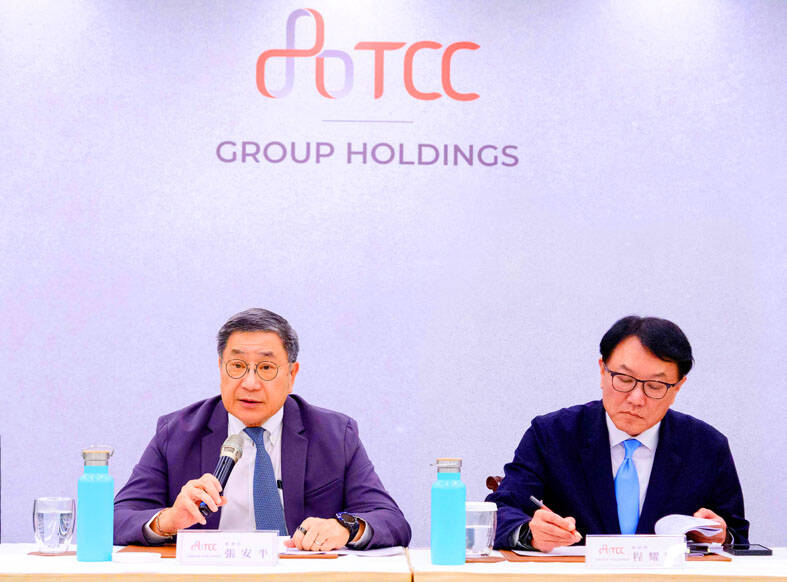
Photo courtesy of TCC Group Holdings Co
The incident resulted in total losses of NT$16.4 billion, including repair costs, as the blaze damaged the plant, manufacturing equipment and inventory, TCC said, adding that the figure would drop to about NT$11 billion after deducting insurance payouts.
The plant and items in it are covered by property insurance with total coverage of NT$21.9 billion and a maximum payout of NT$3 billion per incident, it said.
The exact losses are yet to be determined, but the estimate does not involve additional spending, it added.
TCC said the incident has prompted it to accelerate efforts to expand partnerships with foreign original equipment manufacturing service providers and re-evaluate the possibility of building overseas battery cell capacity.
Human error and mechanical equipment malfunction were the two possible causes of the blaze, TCC said.
The employees of MQE directly involved in the fire face disciplinary measures that might include penalties, salary reductions or reassignment, it said.
To prevent supply disruptions following the fire, TCC’s battery cell business has quickly negotiated with international customers and partners to arrange overseas supply chain outsourcing, the firm said.
It has also accelerated the activation of a backup production line operated by E-One Moli Energy Corp (能源科技) — also owned by TCC — in Tainan, which can partially support the MQE battery plant’s capacity from this month.
Additionally, some customers are willing to provide non-recurring engineering fees and support for overseas production resources, the company said.
TCC on Wednesday reported net profit in the first half of this year slumped 77 percent to NT$961 million, from NT$4.22 billion in the same period last year.
Earnings per share were down to NT$0.07 from NT$0.51.
SECOND-RATE: Models distilled from US products do not perform the same as the original and undo measures that ensure the systems are neutral, the US’ cable said The US Department of State has ordered a global push to bring attention to what it said are widespread efforts by Chinese companies, including artificial intelligence (AI) start-up DeepSeek (深度求索), to steal intellectual property from US AI labs, according to a diplomatic cable. The cable, dated Friday and sent to diplomatic and consular posts around the world, instructs diplomatic staff to speak to their foreign counterparts about “concerns over adversaries’ extraction and distillation of US AI models.” Distillation is the process of training smaller AI models using output from larger, more expensive ones to lower the costs of training a powerful new
Micron Technology Inc is a driving force pushing the US Congress to pass legislation that would put new export restrictions on equipment its Chinese competitors use to make their chips, according to people familiar with the matter. A US House of Representatives panel yesterday was to vote on the “MATCH Act,” a bill designed to close gaps in restrictions on chipmaking equipment. It would also pressure foreign companies that sell equipment to Chinese chipmaking facilities to align with export curbs on US companies like Lam Research Corp and Applied Materials Inc. The bill targets facilities operated by China’s ChangXin Memory Technologies Inc

Singapore-based ride-hailing and delivery giant Grab Holdings’ planned acquisition of Foodpanda’s Taiwan operations has yet to enter the formal review stage, as regulators await supplementary documents, the Fair Trade Commission (FTC) said yesterday. Acting FTC Chairman Chen Chih-min (陳志民) told the legislature’s Economics Committee that although Grab submitted its application on March 27, the case has not been officially accepted because required materials remain incomplete. Once the filing is finalized, the FTC would launch a formal probe into the deal, focusing on issues such as cross-shareholding and potential restrictions on market competition, Chen told lawmakers. Grab last month announced that it would acquire
The artificial intelligence (AI) boom has triggered a seismic reshuffling of global equity markets, with Taiwan and South Korea muscling past European nations one by one. With its stock market now valued at nearly US$4.3 trillion, Taiwan surpassed the UK, Europe’s biggest market, earlier this month, data compiled by Bloomberg showed. South Korea is about US$140 billion away from doing the same. The tech-heavy Asian markets have shot past Germany and France in the past seven months. The shift is largely down to massive gains in shares of three companies that provide essential hardware for AI: Taiwan Semiconductor Manufacturing Co (TSMC, 台積電),


 RSS
RSS