


Taiwan is not necessarily at a disadvantage under the US’ 20 percent tariff announced last week, given structural differences in its export economy compared with Japan and South Korea, Nomura Asset Management Taiwan Ltd (野村投信) said in a report on Friday.
Nomura’s Taiwan equity team holds a neutral view on the newly announced tariff rate, even as markets expressed disappointment that Taiwan’s rate trails the 15 percent levied on exports from South Korea and Japan.
The Nomura report said that Taiwan’s export competitiveness remains intact, as much of its production is already offshore, particularly in China and Southeast Asia.
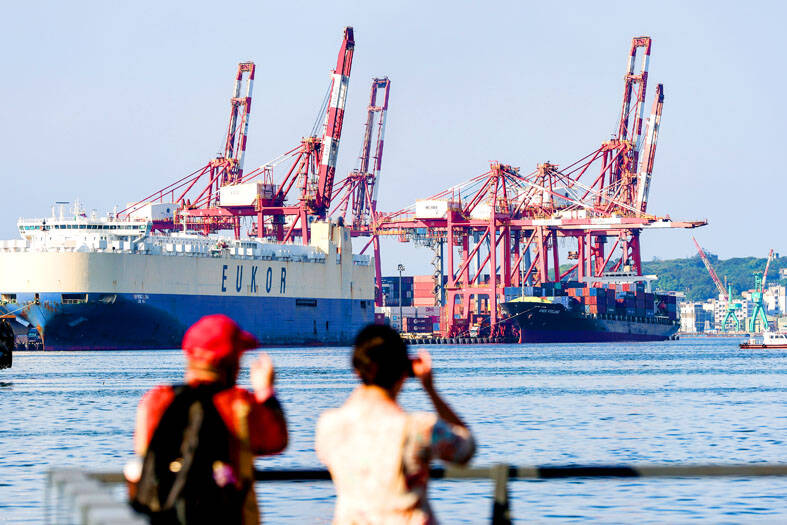
Photo: Ritchie B. Tongo, EPA-EFE
Unlike Japan and South Korea, whose automotive exports are heavily dependent on the US market, Taiwan’s export profile is more complementary to US demand, it said.
Moreover, the lower tariffs granted to Japan and South Korea reflect their reliance on US-bound auto exports and the substantial concessions in terms of pledged investments and purchases made during trade talks, it said.
The 20 percent levy for Taiwan is broadly consistent with the rates imposed by Washington on other countries in the region, it said.
For example, China faces duties ranging from 37.5 to 55 percent, although the rate drops to 20 percent for consumer electronics, the report said.
In Southeast Asia, where many Taiwanese firms have manufacturing bases, tariffs are 20 percent in Vietnam, and 19 percent in Thailand, Malaysia and Indonesia, roughly matching Taiwan’s, it said.
Nomura said that Taiwan’s outcome is “reasonable” and sees no urgent need to further shift production abroad in pursuit of lower tariffs.
While the new US tariffs could temporarily raise costs for US buyers of Taiwan-made artificial intelligence (AI) server components, the total cost would still undercut US domestic manufacturing, the report said.
As US President Donald Trump’s trade policies reshape global supply chains, Taiwan’s strategic relationship with US chipmaker Nvidia Corp is likely to deepen in AI, reinforcing long-term tailwinds for Taiwanese equities, it said.
Some Taiwanese suppliers are already ramping up investments in the US and Mexico to reduce tariff exposure — a trend Nomura expects to continue.
In the longer term, robust global demand for AI servers and high-performance computing would help preserve Taiwan’s central role in the tech supply chain, with reciprocal tariffs having limited fundamental impact, Nomura said.
Any near-term market pullbacks triggered by sentiment shifts might present buying opportunities, particularly in AI-related names with low consumer cycle exposure, it said.
The firm advises caution in consumer electronics, where front-loaded shipments earlier this year might result in elevated inventories.
Investment focus would remain on AI supply chain beneficiaries with strong end-market demand and minimal tariff sensitivity, it said.
Despite the resolution of one major source of uncertainty, the TAIEX has traded within a narrow range, while AI-related stocks are expected to continue outperforming due to strong growth positioning, the report said.
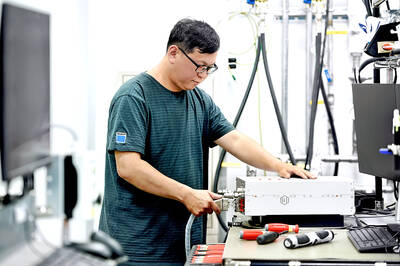
SEMICONDUCTORS: The German laser and plasma generator company will expand its local services as its specialized offerings support Taiwan’s semiconductor industries Trumpf SE + Co KG, a global leader in supplying laser technology and plasma generators used in chip production, is expanding its investments in Taiwan in an effort to deeply integrate into the global semiconductor supply chain in the pursuit of growth. The company, headquartered in Ditzingen, Germany, has invested significantly in a newly inaugurated regional technical center for plasma generators in Taoyuan, its latest expansion in Taiwan after being engaged in various industries for more than 25 years. The center, the first of its kind Trumpf built outside Germany, aims to serve customers from Taiwan, Japan, Southeast Asia and South Korea,

Gasoline and diesel prices at domestic fuel stations are to fall NT$0.2 per liter this week, down for a second consecutive week, CPC Corp, Taiwan (台灣中油) and Formosa Petrochemical Corp (台塑石化) announced yesterday. Effective today, gasoline prices at CPC and Formosa stations are to drop to NT$26.4, NT$27.9 and NT$29.9 per liter for 92, 95 and 98-octane unleaded gasoline respectively, the companies said in separate statements. The price of premium diesel is to fall to NT$24.8 per liter at CPC stations and NT$24.6 at Formosa pumps, they said. The price adjustments came even as international crude oil prices rose last week, as traders
Taiwan Semiconductor Manufacturing Co (TSMC, 台積電), which supplies advanced chips to Nvidia Corp and Apple Inc, yesterday reported NT$1.046 trillion (US$33.1 billion) in revenue for last quarter, driven by constantly strong demand for artificial intelligence (AI) chips, falling in the upper end of its forecast. Based on TSMC’s financial guidance, revenue would expand about 22 percent sequentially to the range from US$32.2 billion to US$33.4 billion during the final quarter of 2024, it told investors in October last year. Last year in total, revenue jumped 31.61 percent to NT$3.81 trillion, compared with NT$2.89 trillion generated in the year before, according to
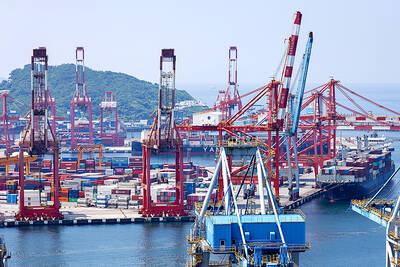
PRECEDENTED TIMES: In news that surely does not shock, AI and tech exports drove a banner for exports last year as Taiwan’s economic growth experienced a flood tide Taiwan’s exports delivered a blockbuster finish to last year with last month’s shipments rising at the second-highest pace on record as demand for artificial intelligence (AI) hardware and advanced computing remained strong, the Ministry of Finance said yesterday. Exports surged 43.4 percent from a year earlier to US$62.48 billion last month, extending growth to 26 consecutive months. Imports climbed 14.9 percent to US$43.04 billion, the second-highest monthly level historically, resulting in a trade surplus of US$19.43 billion — more than double that of the year before. Department of Statistics Director-General Beatrice Tsai (蔡美娜) described the performance as “surprisingly outstanding,” forecasting export growth


 RSS
RSS