


Fitch Ratings has revised its outlook for Taiwan’s banking sector to “deteriorating” from “neutral,” amid rising pressures on profitability and asset quality.
The change reflects growing concern that Taiwan’s export-heavy economy would face intensifying headwinds in the second half of this year and into next year, as cyclical demand cools and geopolitical uncertainty clouds the investment climate, Fitch said in a report issued on Thursday.
Fitch forecast Taiwan’s GDP growth to ease to 2.8 percent this year and slow further to 2.5 percent next year, down from 4.8 percent last year.
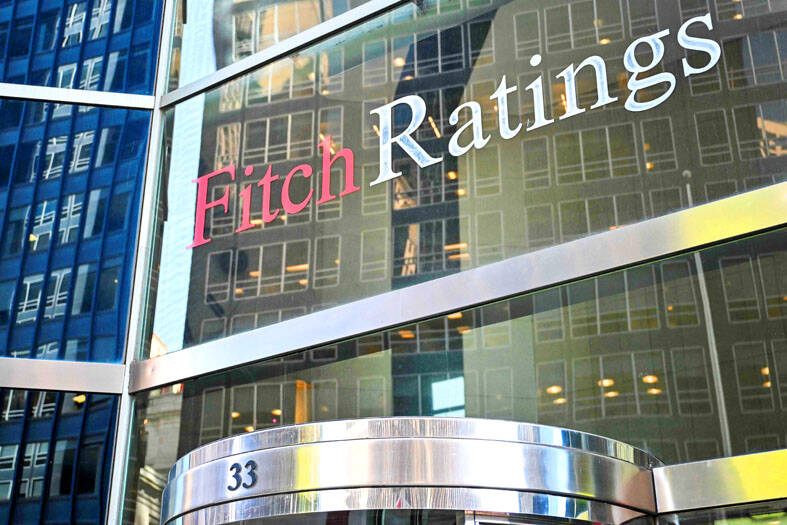
Photo: AFP
“External risks will weigh heavily on bank earnings and credit performance,” Fitch said.
The agency maintained Taiwan’s operating environment score at category “A” in line with what it sees as a fundamentally resilient system. Solid macroeconomic indicators — such as a rising GDP per capita and stable unemployment — help provide a buffer against rising global uncertainty, it said.
Local banks retain ample capital and liquidity buffers, with risk-weighted asset growth broadly aligned with internal capital generation, it added.
Loan quality remains sound for now, with only a moderate rise in impaired loans expected — particularly in sectors exposed to new US tariffs. The share of such loans is expected to remain less than 10 percent of total system lending, Fitch said.
Private-sector banks are seen weathering the storm through continued loan growth and a stable stream of recurring fee income, which should partially offset rising credit costs and softening trading revenues, it said.
System liquidity remains ample in both New Taiwan dollar and US dollar terms, aided in part by reshoring activities from Taiwanese firms shifting production back from China, it added.
Fitch warned that upside potential for bank ratings is limited barring transformational mergers or formal designation as systemically important banks. On the downside, major risks include a global demand shock or a significant housing correction — both of which could undermine asset quality and earnings.
However, housing market risks appear contained for now. The central bank’s prudential tightening, such as raising reserve ratios and capping loan-to-value limits for second homes, has begun to bear fruit, it said.
Mortgage and construction lending dipped to 36.8 percent of total loans in the first quarter of this year, from 37.3 percent at the end of last year, while housing prices have softened modestly, it added.
Although Taiwan’s banking sector could eventually benefit from structural tailwinds, the fragmented nature of the market and persistent geopolitical risks are likely to cap near-term improvements, Fitch said.
Shares of contract chipmaker Taiwan Semiconductor Manufacturing Co (TSMC, 台積電) came under pressure yesterday after a report that Apple Inc is looking to shift some orders from the Taiwanese company to Intel Corp. TSMC shares fell NT$55, or 2.4 percent, to close at NT$2,235 on the local main board, Taiwan Stock Exchange data showed. Despite the losses, TSMC is expected to continue to benefit from sound fundamentals, as it maintains a lead over its peers in high-end process development, analysts said. “The selling was a knee-jerk reaction to an Intel-Apple report over the weekend,” Mega International Investment Services Corp (兆豐國際投顧) analyst Alex Huang
Taiwan Semiconductor Manufacturing Co (TSMC, 台積電) is expected to remain Apple Inc’s primary chip manufacturing partner despite reports that Apple could shift some orders to Intel Corp, industry experts said yesterday. The comments came after The Wall Street Journal reported on Friday that Apple and Intel had reached a preliminary agreement following more than a year of negotiations for Intel to manufacture some chips for Apple devices. Taiwan Institute of Economic Research (台灣經濟研究院) economist Arisa Liu (劉佩真) said TSMC’s advanced packaging technologies, including integrated fan-out and chip-on-wafer-on-substrate, remain critical to the performance of Apple’s A-series and M-series chips. She said Intel and Samsung
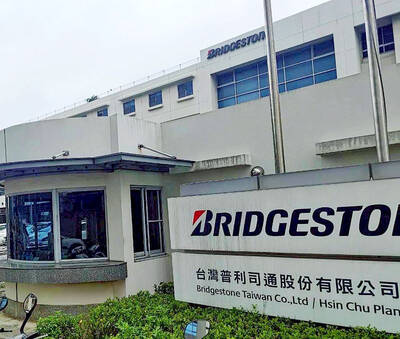
TRANSITION: With the closure, the company would reorganize its Taiwanese unit to a sales and service-focused model, Bridgestone said Bridgestone Corp yesterday announced it would cease manufacturing operations at its tire plant in Hsinchu County’s Hukou Township (湖口), affecting more than 500 workers. Bridgestone Taiwan Co (台灣普利司通) said in a statement that the decision was based on the Tokyo-based tire maker’s adjustments to its global operational strategy and long-term market development considerations. The Taiwanese unit would be reorganized as part of the closure, effective yesterday, and all related production activities would be concluded, the statement said. Under the plan, Bridgestone would continue to deepen its presence in the Taiwanese market, while transitioning to a sales and service-focused business model, it added. The Hsinchu
Taiwan Semiconductor Manufacturing Co (TSMC, 台積電) has approved a capital budget of US$31.28 billion for production expansion to meet long-term development needs during the artificial intelligence (AI) boom. The company’s board meeting yesterday approved the capital appropriation plan for purposes such as the installation of advanced technology capacity and fab construction, the world’s largest contract chipmaker said in a statement. At an earnings conference last month, TSMC forecast that its capital expenditure for this year would be at the higher end of the US$52 billion to US$56 billion range it forecast in January in response to robust demand for 5G, AI and


 RSS
RSS