


Taiwan Semiconductor Manufacturing Co (TSMC, 台積電) on Friday said that its investments in the US would not affect its existing projects elsewhere, rejecting a report by the Wall Street Journal (WSJ) that said the company was postponing the construction of a second fabrication plant in Japan to focus on US expansion amid tariff threats from US President Donald Trump.
The world’s largest contract chipmaker said in a statement that its global expansion strategy is based on several factors, including customer demand, business opportunities, operational efficiency, government support and overall costs.
As a result, the company’s US investments would not compromise its plans in other regions, TSMC said.
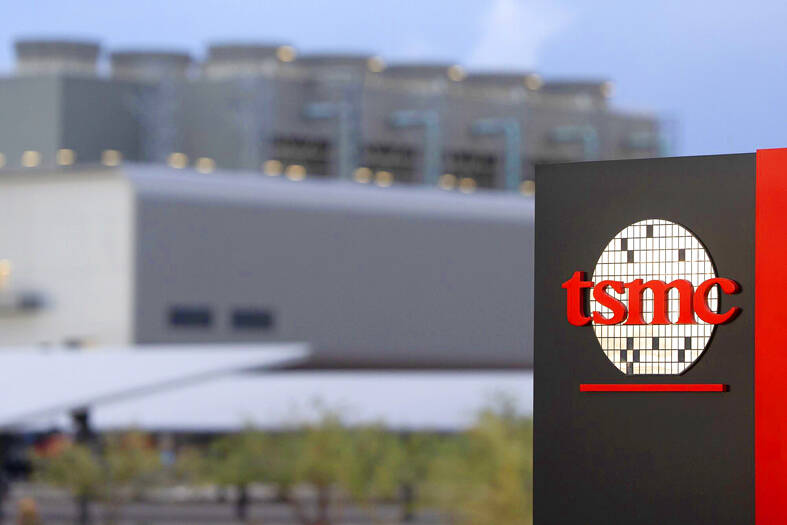
Photo: Bloomberg
The Wall Street Journal said that TSMC is taking Trump’s tariff threats seriously and is diverting resources to speed up investments in Arizona, where the company is already building a large chip manufacturing hub. The report suggested that the shift would delay the construction of a second plant in Kumamoto, Japan.
Trump’s administration has launched an investigation under Section 232 of the Trade Expansion Act of 1962, which could lead to new tariffs on semiconductor imports. Trump has accused Taiwan of “stealing” chip business from the US and has threatened to impose tariffs as high as 100 percent on imported semiconductors.
TSMC’s first fab in Kumamoto began mass production late last year, and construction of the second fab, originally scheduled to begin early this year, has been “slightly delayed” due to local traffic concerns, TSMC chairman C.C. Wei (魏哲家) said last month, without providing a revised timeline.
Sources cited in the WSJ report said that construction could be pushed back further, although no definite schedule has been set.
TSMC’s first fab in Arizona began commercial production last year. The second plant is nearing completion, with equipment installation underway. A third fab broke ground in April. The company’s newly pledged US$100 billion investment would be used to build three more fabs, two integrated circuits assembly plants, and a research and development center.
However, TSMC in May said that any future tariffs on Taiwanese chips could dampen demand and threaten its expansion plans in the US.
Elsewhere, TSMC has also begun building a new fab in Dresden, Germany, with production expected to begin in 2027.
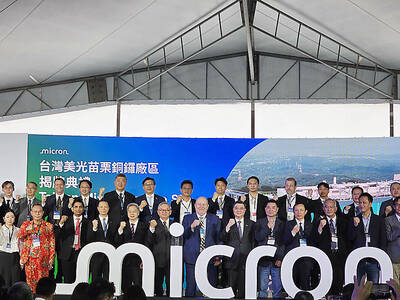
UNPRECEDENTED PACE: Micron Technology has announced plans to expand manufacturing capabilities with the acquisition of a new chip plant in Miaoli Micron Technology Inc unveiled a newly acquired chip plant in Miaoli County yesterday, as the company expands capacity to meet growing demand for advanced DRAM chips, including high-bandwidth memory chips amid the artificial intelligence boom. The plant in Miaoli County’s Tongluo Township (銅鑼), which Micron acquired from Powerchip Semiconductor Manufacturing Corp (力積電) for US$1.8 billion, is expected to make a sizeable capacity contribution to the company from fiscal 2028, the company said in a statement. It would be an extended production site of Micron’s large-scale manufacturing hub in Taichung, the company said. As the global semiconductor industry is racing to reach US$1 trillion

Singapore-based ride-hailing and delivery giant Grab Holdings Ltd has applied for regulatory approval to acquire the Taiwan operations of Germany-based Delivery Hero SE's Foodpanda in a deal valued at about US$600 million. Grab submitted the filing to the Fair Trade Commission on Friday last week, with the transaction subject to regulatory review and approval, the company said in a statement yesterday. Its independent governance structure would help foster a healthy and competitive market in Taiwan if the deal is approved, Grab said. Grab, which is listed on the NASDAQ, said in the filing that US-based Uber Technologies Inc holds about 13 percent of

Taiwan’s food delivery market could undergo a major shift if Singapore-based Grab Holdings Ltd completes its planned acquisition of Delivery Hero SE’s Foodpanda business in Taiwan, industry experts said. Grab on Monday last week announced it would acquire Foodpanda’s Taiwan operations for US$600 million. The deal is expected to be finalized in the second half of this year, with Grab aiming to complete user migration to its platform by the first half of next year. A duopoly between Uber Eats and Foodpanda dominates Taiwan’s delivery market, a structure that has remained intact since the Fair Trade Commission (FTC) blocked Uber Technologies Inc’s

Memory chip stocks extended their losses yesterday after Alphabet Inc’s Google publicized research that could allow more efficient use of the storage needed for artificial intelligence (AI) development. SK Hynix Inc and Samsung Electronics Co, South Korean leaders in the market, fell more than 6 percent and about 5 percent respectively in Seoul. In the US, Micron Technology Inc, Western Digital Corp and Sandisk Corp slid more than 2 percent in pre-market trading, after they all closed lower on Wednesday. Memory companies have been on a tear in recent months as the rapid development of AI infrastructure triggered a spike in chip


 RSS
RSS