


Chinese Premier Li Qiang (李強) said the country is prepared for “shocks that exceed expectations” as the world braces for US President Donald Trump to announce more tariffs on its trading partners next month.
Countries should open up markets in the face of growing economic fragmentation, Li yesterday told a gathering of global business leaders and visiting US Senator Steve Daines at the start of the China Development Forum in Beijing.
“Instability and uncertainty are on the upswing,” Li said. “At this time, I think it is even more important for each of our countries to open up markets more, and for all of our businesses to share their resources more.”
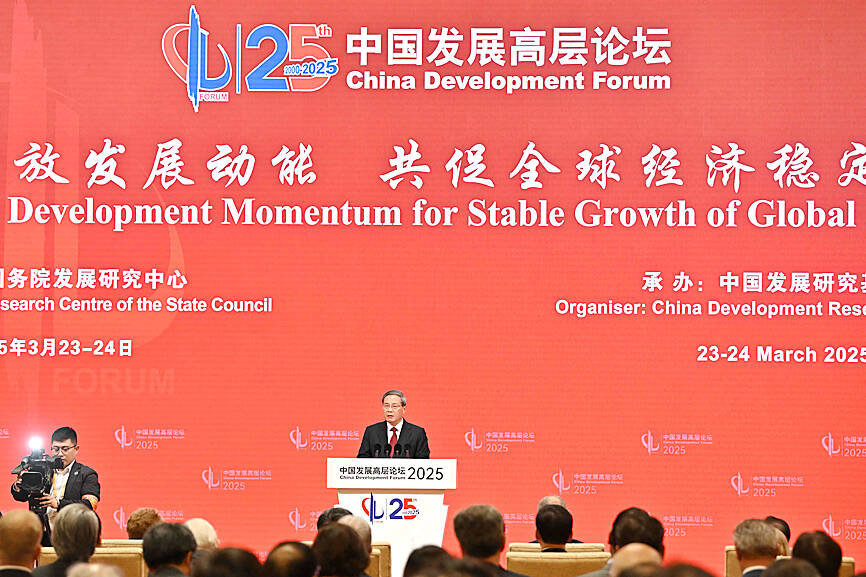
Photo: AFP
Top executives including Apple Inc’s Tim Cook, Qualcomm Inc’s Cristiano Amon, Pfizer Inc’s Albert Bourla and Saudi Aramco’s Amin Nasser are attending the two-day conference. Bloomberg News earlier reported that plans were being made for corporate titans to meet Chinese President Xi Jinping (習近平) on Friday.
Daines, a member of the US Senate Foreign Relations Committee, on Saturday met with Chinese Vice Premier He Lifeng (何立峰), a rare public exchange between US and Chinese officials since Trump returned to the White House. The US senator also met Li yesterday.
The Chinese premier reiterated a central bank pledge that policymakers would cut interest rates and the reserve requirement ratio when “timely,” and vowed to offer more support when necessary to ensure the economy runs smoothly.
Li’s remarks come as China renews efforts to attract foreign businesses after inbound investment tumbled last year to its lowest in over three decades.
“We are beginning to see some re-engagement with international investors coming into China,” Standard Chartered PLC chief executive officer Bill Winters said on the sidelines of the forum. “The only thing slowing down a little bit is the consumer credit business in China, because we know the economy is a little sluggish, so that stream of activities has not been growing as fast.”
The China Development Forum started in 2000, serving as a platform for high-level dialogue between China and the world.
Most years, the keynote speech was delivered by a vice premier, and the premier would hold a closed-door meeting with executives. In a break with precedence, Li addressed the forum last year while Xi met with a number of US business chiefs after the event, as Beijing sought to counter the downbeat narrative on its economy.
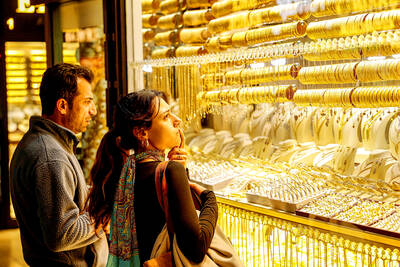
In Italy’s storied gold-making hubs, jewelers are reworking their designs to trim gold content as they race to blunt the effect of record prices and appeal to shoppers watching their budgets. Gold prices hit a record high on Thursday, surging near US$5,600 an ounce, more than double a year ago as geopolitical concerns and jitters over trade pushed investors toward the safe-haven asset. The rally is putting undue pressure on small artisans as they face mounting demands from customers, including international brands, to produce cheaper items, from signature pieces to wedding rings, according to interviews with four independent jewelers in Italy’s main
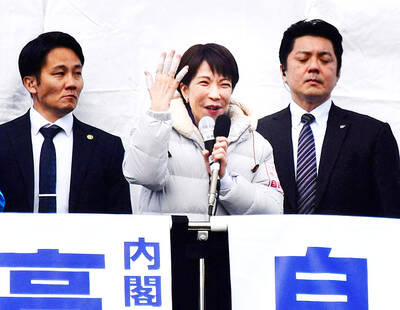
Japanese Prime Minister Sanae Takaichi has talked up the benefits of a weaker yen in a campaign speech, adopting a tone at odds with her finance ministry, which has refused to rule out any options to counter excessive foreign exchange volatility. Takaichi later softened her stance, saying she did not have a preference for the yen’s direction. “People say the weak yen is bad right now, but for export industries, it’s a major opportunity,” Takaichi said on Saturday at a rally for Liberal Democratic Party candidate Daishiro Yamagiwa in Kanagawa Prefecture ahead of a snap election on Sunday. “Whether it’s selling food or
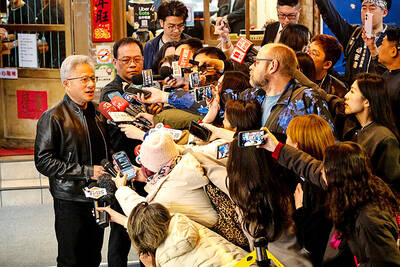
CONCERNS: Tech companies investing in AI businesses that purchase their products have raised questions among investors that they are artificially propping up demand Nvidia Corp chief executive officer Jensen Huang (黃仁勳) on Saturday said that the company would be participating in OpenAI’s latest funding round, describing it as potentially “the largest investment we’ve ever made.” “We will invest a great deal of money,” Huang told reporters while visiting Taipei. “I believe in OpenAI. The work that they do is incredible. They’re one of the most consequential companies of our time.” Huang did not say exactly how much Nvidia might contribute, but described the investment as “huge.” “Let Sam announce how much he’s going to raise — it’s for him to decide,” Huang said, referring to OpenAI
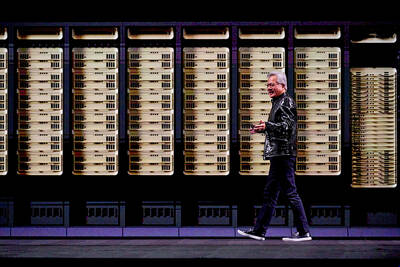
The global server market is expected to grow 12.8 percent annually this year, with artificial intelligence (AI) servers projected to account for 16.5 percent, driven by continued investment in AI infrastructure by major cloud service providers (CSPs), market researcher TrendForce Corp (集邦科技) said yesterday. Global AI server shipments this year are expected to increase 28 percent year-on-year to more than 2.7 million units, driven by sustained demand from CSPs and government sovereign cloud projects, TrendForce analyst Frank Kung (龔明德) told the Taipei Times. Demand for GPU-based AI servers, including Nvidia Corp’s GB and Vera Rubin rack systems, is expected to remain high,


 RSS
RSS