


Elon Musk’s artificial intelligence (AI) company on Monday unveiled the latest version of its chatbot, Grok 3, which the billionaire hopes will find traction in a highly competitive sector contested by the likes of ChatGPT and China’s DeepSeek (深度求索).
“Grok is to understand the universe,” Musk said at the start of the Grok 3 launch presentation.
“We’re driven by curiosity about the nature of the universe — that’s also what causes us to be a maximally truth-seeking AI, even if that truth is sometimes at odds with what is politically correct,” he said.
Photo: Reuters
Musk has promoted Grok 3 as “scary smart,” with 10 times the computational resources of its predecessor that was released in August last year.
The flagship product of his X.AI Corp (xAI) was trained on synthetic data and employs self-correction mechanisms that avoid errors — known as “hallucinations” — that plague some AI chatbots and lead them to process false or misleading data as fact.
Across math, science and coding benchmarks, Grok-3 beats OpenAI’s GPT-4o, Alphabet Inc’s Google Gemini, DeepSeek’s V3 model and Anthropic’s Claude, xAI said via a live stream on Monday.
“Grok 3 has very powerful reasoning capabilities, so in the tests that we’ve done thus far, Grok 3 is outperforming anything that’s been released, that we’re aware of, so that’s a good sign,” Musk said in a video call last week with the World Governments Summit in Dubai.
Grok 3 would be made available first to Premium+ paid subscribers of X before rolling out to other users. xAI is starting a new subscription called SuperGrok for the bot’s mobile app and Grok.com Web site, and plans to open-source preceding versions of Grok models as soon as the latest one is fully mature. Musk said he expects that transition to be complete for Grok-3 in a few months.
After the Grok-3 updates were released, Andrej Karpathy, an OpenAI co-founder no longer at the company, posted a preliminary review of the new model on X, writing that it “feels somewhere around the state of the art territory of OpenAI’s strongest models.”
But the computer scientist, who formerly lead AI efforts at Tesla Inc, said Musk’s model also fabricated facts and lagged behind in certain functions. Karpathy said more evaluations are needed over the next days and weeks to get a better idea of the model’s capabilities.
The upgraded chatbot enters a crowded field with countries racing to introduce more sophisticated — and cost-effective — AI products.
Chinese startup DeepSeek shocked the global AI industry last month with the launch of its low-cost, high-quality R1 chatbot — a direct challenge to US ambitions to lead the world in developing the technology.
Grok 3 is also going up against OpenAI’s chatbot, ChatGPT, pitting Musk against collaborator-turned-archrival Sam Altman.
Musk, who also acts as boss of Space Exploration Technologies Corp and Tesla, launched xAI in July 2023 as an alternative to the ChatGPT maker, which he’s publicly criticized for its plans to restructure as a for-profit business.
The company has been canvassing potential investors in a round of funding for about US$10 billion, which would value the company at about US$75 billion, Bloomberg has reported.
Additional reporting by Bloomberg

Cairo’s new monorail slices across the city skyline, running above the familiar chaos of blaring horns and aging buses’ exhaust fumes that mark rush hour below. The US$4.5 billion monorail, opened this month, is among Egypt’s most prominent new transport projects, part of a debt-funded infrastructure drive criticized for sapping state finances while bringing limited benefits to most of the country’s 109 million people. “It feels like you’re in a different country,” said Ramy Sayed, a restaurant manager, aboard a driverless Innovia 300 train. “No noise, no traffic, we’re not used to this.” The eastern line runs 56km from the bustling middle-class

Taiwanese firms have increased investment in the Philippines in recent years as Manila’s ties with Washington deepen and global supply chains continue to shift away from China, an expert at the Chung-Hua Institution for Economic Research (CIER, 中華經濟研究院) said yesterday. The Philippines had not been among Taiwanese investors’ top choices in Southeast Asia, CIER Taiwan ASEAN Studies Center director Kristy Hsu (徐遵慈) said at a seminar in Taipei. However, Taiwan’s investment in the country has grown significantly since the COVID-19 pandemic, reaching US $257 million last year, a high in recent years, she said. Although Taiwan’s total investment in the Philippines still lags
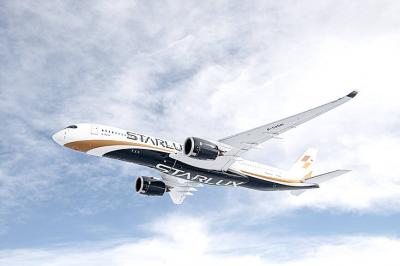
Starlux Airlines Co (星宇航空) today unveiled a long-haul network expansion plan at a shareholders’ meeting in Taipei, including direct flights to Barcelona, Spain, and Zurich, Switzerland, as well as a service connecting Taipei, Sydney and New Zealand. Starlux is to become the first Taiwanese carrier to offer non-stop services to the two European cities, while the inaugural oceanic route is expected to expand transit opportunities within the Australia-New Zealand market, Starlux said. Flight services to Chicago, Dallas, Washington and New York are under evaluation, the airline added. Prior to the shareholders’ meeting, the airline earlier this year announced that it would be

Intel Corp regards Taiwan Semiconductor Manufacturing Co (TSMC, 台積電) as a longstanding partner, as the US chipmaker would continue outsourcing production of advanced chips to TSMC, Intel chief executive officer Lip-Bu Tan (陳立武) said yesterday. “I don’t look at people as competitors. I look at the collaboration... Nvidia is also, you know, a good friend,” Tan told a news conference following his keynote speech at the Computex trade show in Taipei. “It’s a very trusted partnership for us... We are a big, top customer for them, and we’re going to continue doing that,” he said, referring to TSMC, the world’s largest foundry


 RSS
RSS