


Three data centers squatting alongside the cruise ships and freighters in the French Mediterranean port of Marseille are testing water-saving cooling methods by pumping out an old coal mine.
Efforts like these are under the spotlight as generative artificial intelligence (AI) consumes growing volumes of water, one of the environmental priorities for the global AI summit in Paris this month.
The portside data centers “pump water at a rate of about 3,000 cubic meters per hour,” said Fabrice Coquio, president of their operator Digital Realty’s French business.
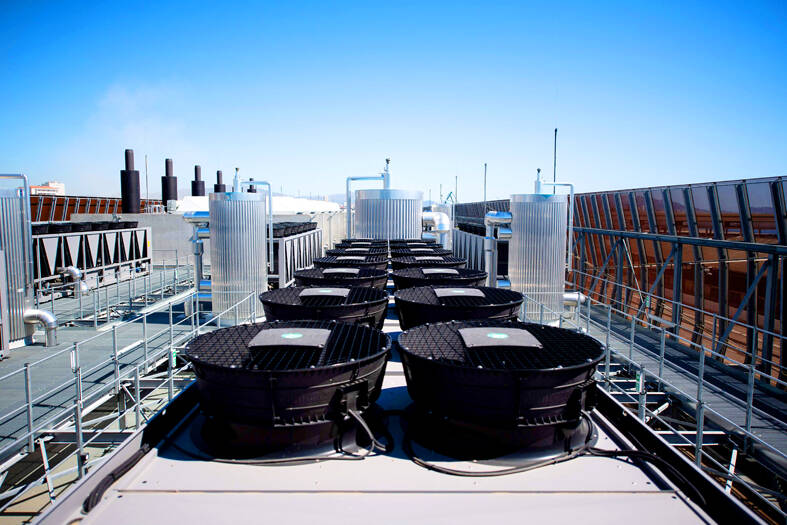
Photo: AFP
Water keeping the banks of servers at optimal temperature is “unfit for human consumption ... laden with minerals and particles,” Coquio said.
Digital Realty counts major platforms, from Microsoft to Disney and TikTok, among clients for its processing and storage.
In the past few months the Marseille site has seen installation of a supercomputer powering AI start-up Sesterce’s operations.
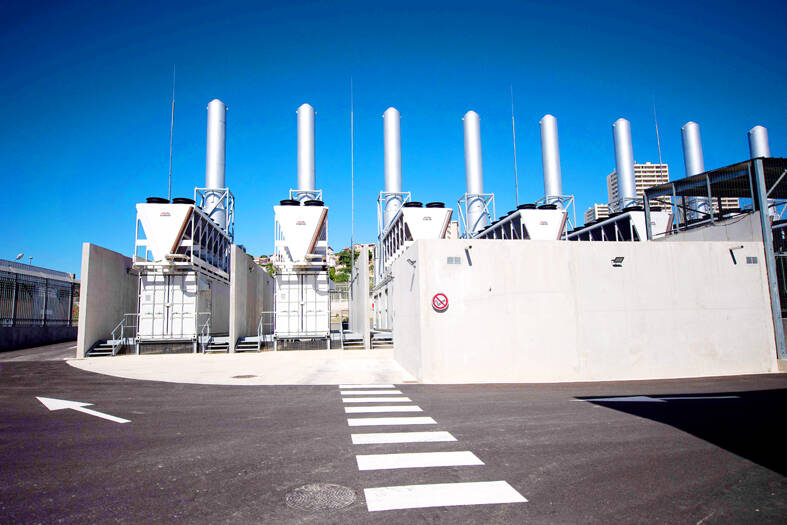
Photo: AFP
Every door on the heavily secured site is opened by fingerprint scanner.
Available year-round at a steady 14°C, the coal mine water enters the server rooms’ heat exchangers in a closed-loop system dubbed “river cooling.”
The data center’s machines must be kept at 25°C and with atmospheric humidity of 60 to 80 percent for top performance, Coquio said.
“If the cooling system stops, any computer room will climb to 45°C within 10 minutes,” potentially halting work, he said. “Cold is just as vital as the electrical socket powering the machines.”
Digital Realty says its river cooling has all but eliminated the need for energy-hungry air conditioning, lowering the three data centers’ consumption by 20 percent.
Exploiting such savings will be vital if use of generative AI and its attendant infrastructure grows in line with forecasts.
“The electrical densities our clients are asking for are in a different class than what we’ve been doing for the last 25 years,” Coquio said.
AI chips tend to be more powerful, consuming more energy and producing more heat than traditional processors.
Chipmaker Nvidia’s latest hardware is like a “radiator,” clocking in at “several hundred watts” of power usage, said Jacques Sainte-Marie, director of the environment program at France’s INRIA computing research institute.
To cool all these chips, many data centers still turn to air-conditioning or a water-evaporation system known as adiabatic cooling, in use at Microsoft among others.
Water usage is a major environmental challenge for the AI sector, alongside consumption of power and raw materials.
Google’s data centers used 14 percent more water in 2023 than the year before to reach 24 million cubic meters — enough to fill 9,600 Olympic swimming pools to a depth of 2m — while Microsoft’s surged 22 percent.
Alternative cooling methods include ambient air cooling, used by Microsoft in northern Europe and by Digital Realty, French operator Data4 and others.
“Our water strategy is localized and specific to the areas that we operate in, because there’s different requirements” depending on the site, said Alistair Speirs, infrastructure chief at Microsoft’s Azure cloud-computing arm.
Microsoft is even experimenting with immersing computer components in a coolant that carries heat away, but does not damage the parts as water would.
It is not deploying the method widely because “the chemicals that exist to do this right now generally have a high PFAS quotient,” Speirs said, referring to so-called “forever chemicals” that have made headlines as widespread pollutants.
However, even methods touted as green alternatives can meet resistance.
In Marseille, the city government and a local campaign group have blasted Digital Realty for monopolizing water that they say could be used in other ways.
The water “can’t be drunk directly, but it could be used to relaunch local agriculture projects, clean streets, water parks,” campaigner Antoine Devillet said.
While data center cooling is getting better, companies could still use that for “greenwashing,” Devillet said. “You have to look at the whole production chain, from ores to chips, with huge consumption of electricity, water and sometimes rare raw materials at each step.”
Shares of contract chipmaker Taiwan Semiconductor Manufacturing Co (TSMC, 台積電) came under pressure yesterday after a report that Apple Inc is looking to shift some orders from the Taiwanese company to Intel Corp. TSMC shares fell NT$55, or 2.4 percent, to close at NT$2,235 on the local main board, Taiwan Stock Exchange data showed. Despite the losses, TSMC is expected to continue to benefit from sound fundamentals, as it maintains a lead over its peers in high-end process development, analysts said. “The selling was a knee-jerk reaction to an Intel-Apple report over the weekend,” Mega International Investment Services Corp (兆豐國際投顧) analyst Alex Huang
Taiwan Semiconductor Manufacturing Co (TSMC, 台積電) is expected to remain Apple Inc’s primary chip manufacturing partner despite reports that Apple could shift some orders to Intel Corp, industry experts said yesterday. The comments came after The Wall Street Journal reported on Friday that Apple and Intel had reached a preliminary agreement following more than a year of negotiations for Intel to manufacture some chips for Apple devices. Taiwan Institute of Economic Research (台灣經濟研究院) economist Arisa Liu (劉佩真) said TSMC’s advanced packaging technologies, including integrated fan-out and chip-on-wafer-on-substrate, remain critical to the performance of Apple’s A-series and M-series chips. She said Intel and Samsung
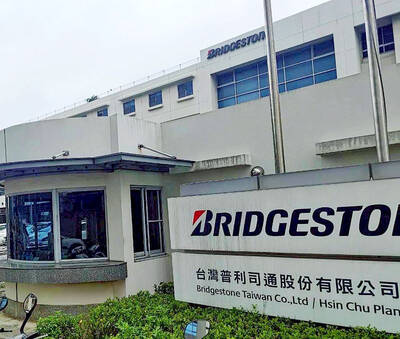
TRANSITION: With the closure, the company would reorganize its Taiwanese unit to a sales and service-focused model, Bridgestone said Bridgestone Corp yesterday announced it would cease manufacturing operations at its tire plant in Hsinchu County’s Hukou Township (湖口), affecting more than 500 workers. Bridgestone Taiwan Co (台灣普利司通) said in a statement that the decision was based on the Tokyo-based tire maker’s adjustments to its global operational strategy and long-term market development considerations. The Taiwanese unit would be reorganized as part of the closure, effective yesterday, and all related production activities would be concluded, the statement said. Under the plan, Bridgestone would continue to deepen its presence in the Taiwanese market, while transitioning to a sales and service-focused business model, it added. The Hsinchu
Taiwan Semiconductor Manufacturing Co (TSMC, 台積電) has approved a capital budget of US$31.28 billion for production expansion to meet long-term development needs during the artificial intelligence (AI) boom. The company’s board meeting yesterday approved the capital appropriation plan for purposes such as the installation of advanced technology capacity and fab construction, the world’s largest contract chipmaker said in a statement. At an earnings conference last month, TSMC forecast that its capital expenditure for this year would be at the higher end of the US$52 billion to US$56 billion range it forecast in January in response to robust demand for 5G, AI and


 RSS
RSS