


Chip industry linchpin Advantest Corp yesterday lifted its full-year forecast almost 40 percent in anticipation of elevated spending around artificial intelligence (AI) and downplayed the impact of DeepSeek’s (深度求索) big debut.
Advantest raised its operating profit outlook above analyst estimates as chief executive officer Douglas Lefever said long-term AI development upside is near certain.
The company sells chip-testing equipment that has been in hot demand with a surge in AI investment powering sales of Nvidia Corp and Advanced Micro Devices Inc semiconductors.
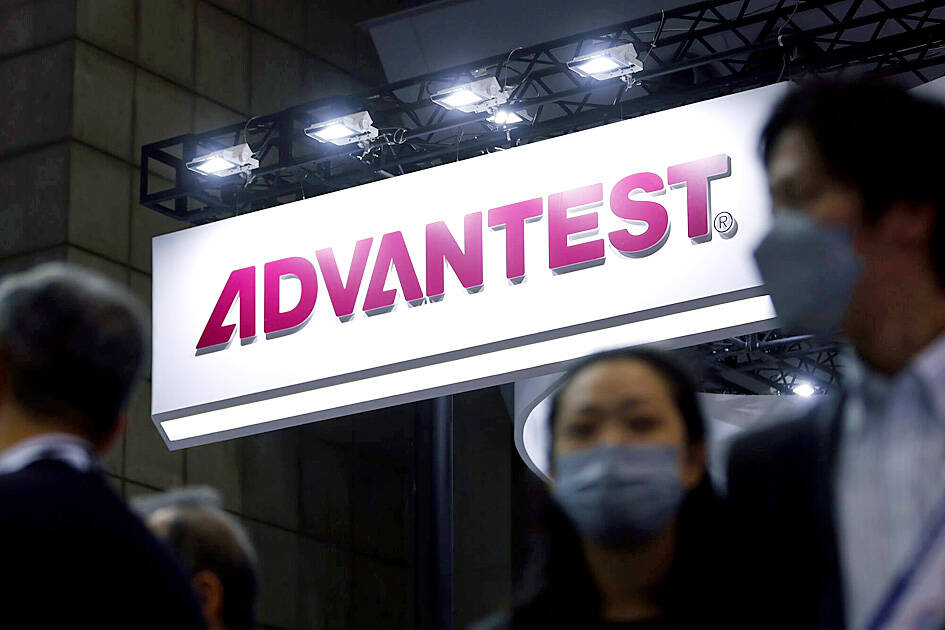
Photo: Bloomberg
DeepSeek has not had any impact on the company’s view at this time, Lefever said, following a furious two days of tech sector re-evaluation after the Chinese AI startup rocketed in popularity.
Advantest’s results coincided with ASML Holding NV, the Dutch supplier of advanced semiconductor lithography gear, reporting bookings that were roughly double what had been expected and lifting expectations of a prolonged boom in AI chip demand.
Advantest upped its forecast to an operating profit of ¥226 billion (US$1.5 billion) for the year to March. Analysts on average expected the company to earn record operating profit of ¥203 billion.
While datacenter-driven business is to make up the lion’s portion of Advantest’s income in the business year starting April, the market for chips that process AI in robots, consumer devices and other machines is growing, Lefever said.
“A lot of work is being done in the area of robotics,” he said. “Edge AI is definitely evolving, which will be good for the volume of AI semiconductors.”
The company said it expects the rising number of new entrants in the AI field to further support demand in the months ahead.
Hype around DeepSeek’s claims of low development costs triggered fears about its US rival OpenAI, as well as concerns about the companies supplying AI infrastructure. Shares of Advantest — whose equipment is needed to develop and monitor increasingly complex semiconductors — have shed more than 15 percent since Friday’s close.
Signs of a rebound after the DeepSeek-led selloff in chip stocks already emerged this week, with Nvidia shares recovering by 9 percent on Tuesday and ASML surging more than 11 percent after its results yesterday.

HORMUZ ISSUE: The US president said he expected crude prices to drop at the end of the war, which he called a ‘minor excursion’ that could continue ‘for a little while’ The United Arab Emirates (UAE) and Kuwait started reducing oil production, as the near-closure of the crucial Strait of Hormuz ripples through energy markets and affects global supply. Abu Dhabi National Oil Co (ADNOC) is “managing offshore production levels to address storage requirements,” the company said in a statement, without giving details. Kuwait Petroleum Corp said it was lowering production at its oil fields and refineries after “Iranian threats against safe passage of ships through the Strait of Hormuz.” The war in the Middle East has all but closed Hormuz, the narrow waterway linking the Persian Gulf to the open seas,

Apple Inc increased iPhone production in India by about 53 percent last year and now makes a quarter of its marquee devices there, reflecting the US company’s efforts to avoid tariffs on China. The company assembled about 55 million iPhones in India last year, up from 36 million a year earlier, people familiar with the matter said, asking not to be named because the numbers aren’t public. Apple makes about 220 million to 230 million iPhones a year globally, with India’s share of the total increasing rapidly. Apple has accelerated its expansion in the world’s most populous country in recent years, bolstered

HEADWINDS: The company said it expects its computer business, as well as consumer electronics and communications segments to see revenue declines due to seasonality Pegatron Corp (和碩) yesterday said it aims to grow its artificial intelligence (AI) server revenue more than 10-fold this year from last year, driven by orders from neocloud solutions clients and large cloud service providers. The electronics manufacturing service provider said AI server revenue growth would be driven primarily by the Nvidia Corp GB300 server platform. Server shipments are expected to increase each quarter this year, with the second half likely to outperform the first half, it said. The AI server market is expected to broaden this year as more inference applications emerge, which would drive demand for system-on-chip, application-specific integrated circuits
PROJECTION: TSMC said it expects strong growth this year, with revenue in US dollars projected to grow by about 30 percent, outperforming the industry Taiwan Semiconductor Manufacturing Co (TSMC, 台積電) yesterday reported consolidated sales last month reached NT$317.66 billion (US$9.98 billion), the highest ever for the month of February, driven by robust demand for chips built using the company’s advanced 3-nanometer (3nm) process. Last month’s figure was up 22.2 percent from a year earlier, but fell 20.8 percent from January, the world’s largest contract chipmaker said in a statement. For the first two months of the year, TSMC posted cumulative sales of NT$718.91 billion, up 29.9 percent from a year earlier. Analysts attributed the growth to sustained global demand for artificial intelligence (AI) products


 RSS
RSS