


SK Hynix Inc’s shares slid after record quarterly results failed to impress investors grappling with stagnant smartphone demand and questions about artificial intelligence (AI) spending this year.
Nvidia Corp’s main supplier of high-bandwidth memory reported a more than 20-fold jump in operating profit last quarter to 8.08 trillion won (US$5.6 billion) — eclipsing rival Samsung Electronics Co’s earnings for the first time.
However, the stock slid more than 2 percent after investors cashed out of a 30 percent share rally this year.
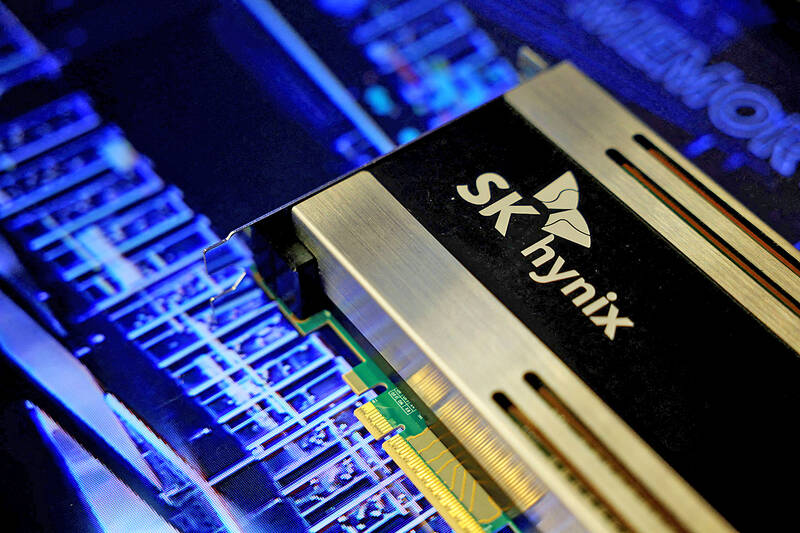
Photo: Reuters
SK Hynix’s scorching growth underscores the extent of a global boom in data center spending and the company’s place at the forefront of the high-bandwidth memory (HBM) chips that Nvidia accelerators need to train AI.
It might also help assuage concerns that an AI-fueled spending spree by big tech companies from Microsoft Corp to Meta Platforms Inc has peaked.
This week, Softbank Group Corp, OpenAI, Oracle Corp and Abu Dhabi-backed MGX unveiled a US$100 billion venture to bankroll and build data centers. News of the Stargate project, promoted by US President Donald Trump, fueled a rally in industry players from Nvidia to Arm Holdings PLC as investors anticipated a surge in data center construction.
SK Hynix said it expects HBM sales to more than double this year.
The South Korean company also boosted its annual dividend by 25 percent to 1,500 won a share.
“SK Hynix will be a big beneficiary” of Stargate, said Sanjeev Rana, an analyst at CLSA Securities Korea. “They have a significant lead, whether in terms of product quality or production yields... It will take some time for competitors to catch up.”
Well ahead of Samsung and Micron Technology Inc in designing and supplying HBM, SK Hynix said it plans to ship cutting-edge 16-layer HBM4 chips in the second half of next year.
HBM made up 40 percent of its overall DRAM chip revenue in the quarter. Demand for such high-end memory would continue to increase as investment in AI servers expands and inference — making predictions from data — grows in importance, the company said.
And while smartphone demand — even for Apple Inc’s iPhone — remains muted, the South Korean firm expects sales of PCs and devices equipped with AI features to expand, fueling a second-half pickup.
The hope is that AI demand would more than make up for weakness in traditional memory.
The company is racing to supply customers with its next HBM offering this year.
It said last year that it is investing about US$15 billion in South Korea to meet surging demand for high-end chips, on top of a plan to spend US$3.9 billion on an advanced packaging plant and research center for AI products in Indiana.
SK Hynix’s first-quarter sales could decline sequentially, yet grow strongly year-over-year. This follows robust 75 percent growth in the fourth quarter last year versus a year earlier on surging demand for HBM chips. Operating profit this quarter might also rise strongly from a year earlier.
The average selling price (ASP) for DRAM last quarter was up about 10 percent sequentially due to HBM chips, while NAND chips’ ASP was down about 5 percent sequentially.
DRAM-bit shipments this quarter could decline by about a low-teen percentage sequentially, after last quarter’s rise of about 5 percent.

NEW IDENTITY: Known for its software, India has expanded into hardware, with its semiconductor industry growing from US$38bn in 2023 to US$45bn to US$50bn India on Saturday inaugurated its first semiconductor assembly and test facility, a milestone in the government’s push to reduce dependence on foreign chipmakers and stake a claim in a sector dominated by China. Indian Prime Minister Narendra Modi opened US firm Micron Technology Inc’s semiconductor assembly, test and packaging unit in his home state of Gujarat, hailing the “dawn of a new era” for India’s technology ambitions. “When young Indians look back in the future, they will see this decade as the turning point in our tech future,” Modi told the event, which was broadcast on his YouTube channel. The plant would convert

‘SEISMIC SHIFT’: The researcher forecast there would be about 1.1 billion mobile shipments this year, down from 1.26 billion the prior year and erasing years of gains The global smartphone market is expected to contract 12.9 percent this year due to the unprecedented memorychip shortage, marking “a crisis like no other,” researcher International Data Corp (IDC) said. The new forecast, a dramatic revision down from earlier estimates, gives the latest accounting of the ongoing memory crunch that is affecting every corner of the electronics industry. The demand for advanced memory to power artificial intelligence (AI) tasks has drained global supply until well into next year and jeopardizes the business model of many smartphone makers. IDC forecast about 1.1 billion mobile shipments this year, down from 1.26 billion the prior

People stand in a Pokemon store in Tokyo on Thursday. One of the world highest-grossing franchises is celebrated its 30th anniversary yesterday.

Zimbabwe’s ban on raw lithium exports is forcing Chinese miners to rethink their strategy, speeding up plans to process the metal locally instead of shipping it to China’s vast rechargeable battery industry. The country is Africa’s largest lithium producer and has one of the world’s largest reserves, according to the US Geological Survey (USGS). Zimbabwe already banned the export of lithium ore in 2022 and last year announced it would halt exports of lithium concentrates from January next year. However, on Wednesday it imposed the ban with immediate effect, leaving unclear what the lithium mining sector would do in the


 RSS
RSS