


Meta Platforms Inc is cutting about 5 percent of its staff through performance-based terminations and plans to hire new people to fill their roles this year, an internal memo sent to all employees said.
As of September last year, Meta employed about 72,000 people, so a 5 percent reduction could affect about 3,600 jobs.
“I’ve decided to raise the bar on performance management and move out low-performers faster,” Meta CEO Mark Zuckerberg said in the note posted to an internal message board and reviewed by Bloomberg News.
Photo: Reuters
“We typically manage out people who aren’t meeting expectations over the course of a year, but now we’re going to do more extensive performance-based cuts during this cycle,” he said.
Meta’s performance cycle is expected to wrap up next month, said a person familiar with the matter, who asked not to be identified discussing internal company procedures.
Affected workers in the US are expected to be notified on Feb. 10, while those based in other countries are to be informed at a later date, the memo said.
The terminations would only include staff who have been at the company long enough to be eligible for a performance review.
Zuckerberg told employees that the company would “provide generous severance” in line with past cuts.
Zuckerberg had declared 2023 the company’s “year of efficiency” and announced plans then to eliminate 10,000 positions. Now, he has taken on a different tone.
In a note to managers, he said that the performance-based cuts are aimed at ensuring the company has the “strongest talent” and is able to “bring new people in.”
Altogether, Meta expects its headcount to be down 10 percent by the end of the current performance cycle.
That total includes an additional 5 percent reduction from attrition last year, according to the message to managers.
The Menlo Park, California-based company that includes Facebook, Instagram and WhatsApp would make headcount decisions for each organization based on their respective number of reductions last year.
Zuckerberg last week announced a series of changes at Meta, including disbanding US-based fact-checking on its platforms, ending many of its diversity and inclusion efforts, and changing its “hateful conduct” policy to allow more flexibility around language used to discuss immigrants, women, and transgender and nonbinary people.
In the note to staff, Zuckerberg said that he was positioning the company for what he expects to be an “intense year” focused on artificial intelligence, smart glasses and the future of social media.
Meta is not alone in making performance-based job cuts at the start of the new year. Last week, Business Insider reported that Microsoft Corp would be making job cuts targeting underperforming employees.
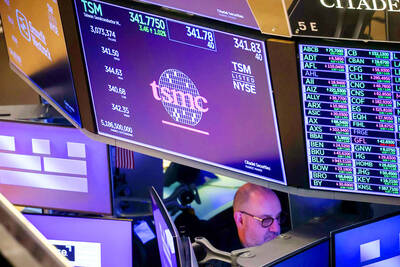
STRONG INTEREST: Analysts have pointed to optimism in TSMC’s growth prospects in the artificial intelligence era as the cause of the rising number of shareholders The number of people holding shares of chipmaker Taiwan Semiconductor Manufacturing Co (TSMC, 台積電) hit a new high last week despite a decline in its stock price, the Taiwan Depository and Clearing Corp (TDCC, 台灣集保) said. The number of TSMC shareholders rose to 2.46 million as of Friday, up 75,536 from a week earlier, TDCC data showed. The stock price fell 1.34 percent during the same week to close at NT$1,840 (US$57.55). The decline in TSMC’s share price resulted from volatility in global tech stocks, driven by rising international crude oil prices as the war against Iran continues. Dealers said
PRICE HIKES: The war in the Middle East would not significantly disrupt supply in the short term, but semiconductor companies are facing price surges for materials Taiwan’s semiconductor companies are not facing imminent supply disruptions of essential chemicals or raw materials due to the war in the Middle East, but surges in material costs loom large, industry association SEMI Taiwan said yesterday. The association’s comments came amid growing concerns that supplies of helium and other key raw materials used in semiconductor production could become a choke point after Qatar shut down its liquefied natural gas (LNG) production and helium output earlier this month due to the conflict. Qatar is the second-largest LNG supplier in the world and accounts for about 33 percent of global helium output. Helium is
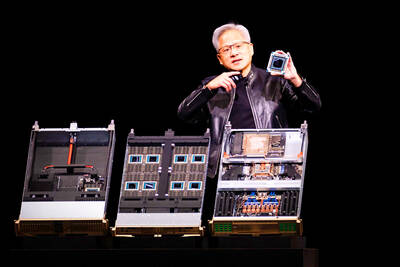
DOMESTIC COMPONENT: Huang identified several Taiwanese partners to be a key part of Nvidia’s Vera Rubin supply chain, including Asustek, Hon Hai and Wistron Nvidia Corp chief executive officer Jensen Huang (黃仁勳), addressing crowds at the company’s biggest annual event, unveiled a variety of new products while predicting that its flagship artificial intelligence (AI) processors would help generate US$1 trillion in sales through next year. During a two-and-a-half-hour keynote address, Huang announced plans to push deeper into central processing units (CPUs) — Intel Corp’s home turf — and introduced semiconductors made with technology acquired from start-up Groq Inc. The company even said it was developing chips for data centers in outer space. At the heart of Huang’s speech was the message that demand for computing power
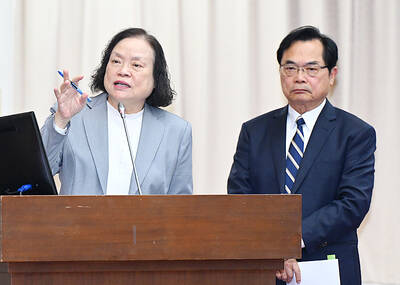
OPTIMISTIC: Inflation still has a chance of remaining below the central bank’s 2 percent alert level, as Taiwan’s economy is resilient with healthy exports, the NDC minister said Taiwan’s inflation could exceed 2 percent this year if oil prices continue to surge amid escalating tensions in the Middle East, prompting the government to reassess its economic outlook, the Directorate-General of Budget, Accounting and Statistics (DGBAS) said yesterday. DGBAS Minister Chen Shu-tzu (陳淑姿) told lawmakers at a meeting of the legislature’s Finance Committee that the agency’s earlier growth forecast of 1.68 percent in the consumer price index (CPI) and 7.71 percent for GDP this year did not account for the ongoing Middle East conflict and would need revision, if tensions persist. The previous forecast assumed an average international crude price of


 RSS
RSS