


China’s central bank yesterday boosted support for markets by opening up tens of billions of dollars in liquidity for firms to buy stocks as part of a raft of measures by Beijing to kick-start the country’s flagging economy.
Authorities last month unveiled several stimulus policies — from interest rate cuts to relaxing home-buying rules — after struggling since the end of COVID-19 restrictions to reignite growth and get business activity back on track.
Yesterday, the People’s Bank of China (PBoC) fleshed out plans to encourage “the healthy and stable development of the capital market” by opening up a “swap facility” worth 500 billion yuan (US$70.6 billion) that would allow firms to access cash to buy stocks.
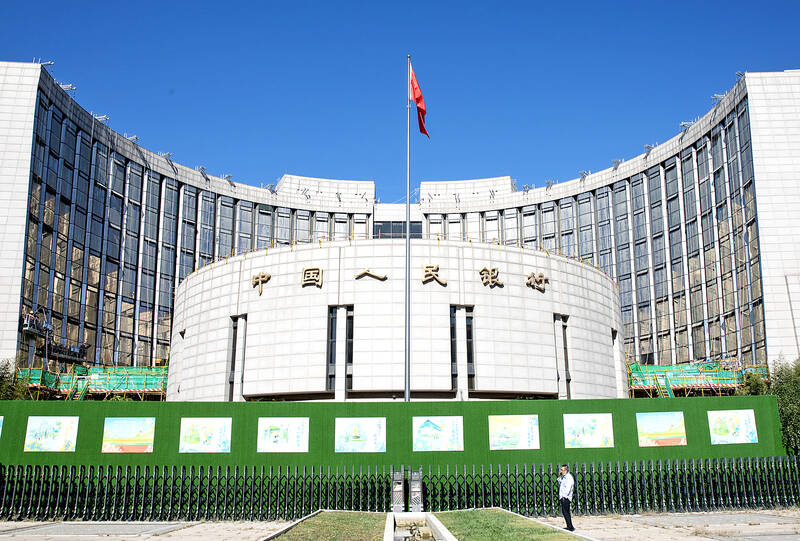
Photo:EPA-EFE
Companies would be allowed to use equities, bonds and other assets as collateral for “high-grade liquid assets such as treasury bonds and central bank bills,” the central bank said.
The program might be “further expanded depending on the situation,” it added.
The move helped the Shanghai Composite Index rise more than 1 percent, having dived more than 6 percent on Wednesday — its worst day in more than four years.
Hong Kong’s Hang Seng Index rose 3 percent, building on the previous day’s advance that followed a plunge of more than 9 percent, its heftiest in 16 years.
China faces multiple issues including a prolonged crisis in the property sector, chronically low consumption, high unemployment among young people and elevated local government debt, with analysts saying more direct state support is needed to boost consumption and achieve the government’s 5 percent growth target for this year.
An analyst said the central bank had been “doing much of the heavy lifting in the latest wave of stimulus.”
“The PBoC recognizes the urgency needed to address the economic issues in China,” Moody’s Analytics economist Heron Lim (林師順) said.
“But the PBoC actions are only one part of the equation in boosting sentiment,” he said. “What is required now is the action plan for fiscal support to come through.”
Traders are hoping that plan comes tomorrow, when Chinese Minister of Finance Lan Fo’an (藍佛安) is set to hold a briefing on fiscal policy in Beijing.
Lan would outline “countercyclical adjustment of fiscal policy to promote high-quality economic development,” the State Council Information Office said in a statement on Wednesday.

The domestic unit of the Chinese-owned, Dutch-headquartered chipmaker Nexperia BV will soon be able to produce semiconductors locally within China, according to two company sources. Nexperia is at the center of a global tug-of-war over critical semiconductor technology, with a Dutch court in February ordering a probe into alleged mismanagement at the company. The geopolitical tussle has disrupted supply chains, with some carmakers reportedly forced to cut production due to chip shortages. Local production would allow Nexperia’s domestic arm, Nexperia Semiconductors (China) Ltd (安世半導體中國), to bypass restrictions in place since October on the supply of silicon wafers — etched with tiny components to

Singapore-based ride-hailing and delivery giant Grab Holdings Ltd has applied for regulatory approval to acquire the Taiwan operations of Germany-based Delivery Hero SE's Foodpanda in a deal valued at about US$600 million. Grab submitted the filing to the Fair Trade Commission on Friday last week, with the transaction subject to regulatory review and approval, the company said in a statement yesterday. Its independent governance structure would help foster a healthy and competitive market in Taiwan if the deal is approved, Grab said. Grab, which is listed on the NASDAQ, said in the filing that US-based Uber Technologies Inc holds about 13 percent of

Taiwan Semiconductor Manufacturing Co (TSMC, 台積電) yesterday received government approval to deploy its advanced 3-nanometer (3nm) process at its second fab currently under construction in Japan, the Ministry of Economic Affairs said in a news release. The ministry green-lit the plan for the facility in Kumamoto, which is scheduled to start installing equipment and come online in 2028 with a monthly production capacity of 15,000 12-inch wafers, the ministry said. The Department of Investment Review in June 2024 authorized a US$5.26 billion investment for the facility, slated to manufacture 6- to 12nm chips, significantly less advanced than 3nm process. At a meeting with

Taiwan is open to joining a global liquefied natural gas (LNG) program if one is created, but on the condition that countries provide delivery even in a scenario where there is a conflict with China, an energy department official said yesterday. While Taiwan’s priority is to have enough LNG at home, the nation is open to exploring potential strategic reserves in other countries such as Japan or South Korea, Energy Administration Deputy Director-General Chen Chung-hsien (陳崇憲) said. While the LNG market does not have a global reserve for emergencies like that of oil, the concept has been raised a few times —


 RSS
RSS