


As France faces a 2035 deadline to phase out new combustion engine vehicles, workers in the industry worry their days might be numbered too.
While there is plenty of optimism in certain regions of France, in particular in the north of the country where a “Battery Valley” is emerging, workers at parts suppliers elsewhere are pessimistic.
With the sale of new vehicles with gasoline and diesel engines allowed for only the next decade in Europe, the industry that employs 200,000 people in France faces a forced march to change.
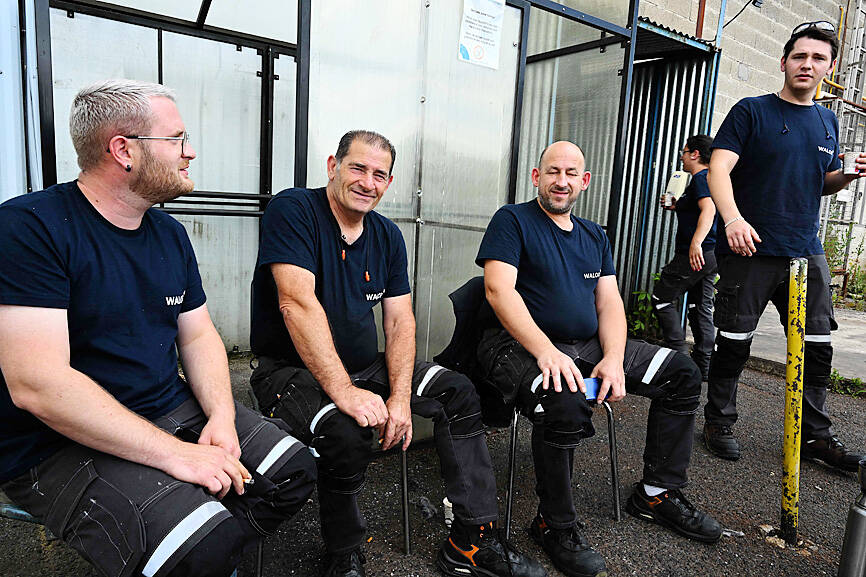
Photo: AFP
“The transition [to electric vehicles], it could have been done when Walor bought us but they didn’t invest,” said Severine Person, a quality control expert at the company’s facility in the town of Vouziers in France’s northeastern Ardennes region.
Walor SA bought the facility in 2018. Its production of connecting rods for tractors and trucks is not threatened by the shift to electric vehicles (EVs), but demand for transmission differential housings and engine manifolds is likely to see big changes.
Walor was bought out last year by a German fund that specializes in turning around struggling firms and is looking to sell the site in Vouziers and another nearby.
“Before, Citroen would distribute work to everyone in the Ardennes. They didn’t go to the other side of the world to get parts,” said Bruno Bodson, a shop steward with the French Democratic Confederation of Labor trade union.
Person and her colleagues are resigned to the factory’s likely closure given its shrinking order book.
However, the mood is different in the north, where a number of battery “gigafactories” are being built, including that of the Automotive Cells Co (ACC) in Douvrin.
The joint venture includes automakers Stellantis NV and Mercedes AG along with French oil and gas giant TotalEnergies SE.
ACC built its massive battery plant on the site of a factory that makes engines for Stellantis, whose vehicles include storied French brands Citroen and Peugeot.
The location was chosen to respond to a “social need” to retrain the factory’s employees, Stellantis said.
Staff numbers have fallen from about 5,000 in the 1980s to 700 today. At the joint venture’s battery training center, Stellantis-Douvrin employees receive 12 weeks of training on how to oversee the highly automated production lines in the battery factory.
Plateforme Automobile, a trade association which unites the firms in the sector, said that by 2026, about 17,000 jobs should be created in the gigafactories making batteries and facilities to recycle them.
While the intention is to recruit heavily from the sector, it is unclear if it would be enough to avoid many workers being left out in the cold.
The latest study conducted by the French metalworking industry, in 2021, found that the transition to EVs put 65,000 jobs in the sector at risk by 2030.
Bernard Jullien, an economist and researcher who is an expert on the French auto industry, puts the job losses from shifting from gasoline-fueled to electric engines in the auto parts sector at 40,000 over the horizon of 10 to 15 years.
That could be reduced as many workers in the industry are nearing retirement.
Ludovic Bouvier, a regional leader of the General Confederation of Labor metalworkers union, said he worries auto manufacturers and their suppliers would follow the playbook of the steel industry.
With the industry under fierce pressure to cut costs, “the announcement by Europe of the end of internal combustion engines became the opportunity for manufacturers to offshore their production,” he said.
Bouvier was mostly targeting Stellantis, which is producing its new Citroen mass-market electric hatchback in Slovakia. Renault SA is producing its R5 hatchback in France.
A recent study by two climate groups found that the lower human labor needed to manufacture electric vehicles could favor making small cars in Europe.
It is more likely that the electrification of vehicles would be accompanied by more offshoring, taking overall employment in the French auto industry down to 100,000 or even fewer, Jullien said.

The domestic unit of the Chinese-owned, Dutch-headquartered chipmaker Nexperia BV will soon be able to produce semiconductors locally within China, according to two company sources. Nexperia is at the center of a global tug-of-war over critical semiconductor technology, with a Dutch court in February ordering a probe into alleged mismanagement at the company. The geopolitical tussle has disrupted supply chains, with some carmakers reportedly forced to cut production due to chip shortages. Local production would allow Nexperia’s domestic arm, Nexperia Semiconductors (China) Ltd (安世半導體中國), to bypass restrictions in place since October on the supply of silicon wafers — etched with tiny components to

Singapore-based ride-hailing and delivery giant Grab Holdings Ltd has applied for regulatory approval to acquire the Taiwan operations of Germany-based Delivery Hero SE's Foodpanda in a deal valued at about US$600 million. Grab submitted the filing to the Fair Trade Commission on Friday last week, with the transaction subject to regulatory review and approval, the company said in a statement yesterday. Its independent governance structure would help foster a healthy and competitive market in Taiwan if the deal is approved, Grab said. Grab, which is listed on the NASDAQ, said in the filing that US-based Uber Technologies Inc holds about 13 percent of

Taiwan Semiconductor Manufacturing Co (TSMC, 台積電) yesterday received government approval to deploy its advanced 3-nanometer (3nm) process at its second fab currently under construction in Japan, the Ministry of Economic Affairs said in a news release. The ministry green-lit the plan for the facility in Kumamoto, which is scheduled to start installing equipment and come online in 2028 with a monthly production capacity of 15,000 12-inch wafers, the ministry said. The Department of Investment Review in June 2024 authorized a US$5.26 billion investment for the facility, slated to manufacture 6- to 12nm chips, significantly less advanced than 3nm process. At a meeting with

Taiwan’s food delivery market could undergo a major shift if Singapore-based Grab Holdings Ltd completes its planned acquisition of Delivery Hero SE’s Foodpanda business in Taiwan, industry experts said. Grab on Monday last week announced it would acquire Foodpanda’s Taiwan operations for US$600 million. The deal is expected to be finalized in the second half of this year, with Grab aiming to complete user migration to its platform by the first half of next year. A duopoly between Uber Eats and Foodpanda dominates Taiwan’s delivery market, a structure that has remained intact since the Fair Trade Commission (FTC) blocked Uber Technologies Inc’s


 RSS
RSS