


The US is considering unilateral restrictions on China’s access to artificial intelligence (AI) memory chips and equipment capable of making those semiconductors as soon as next month, a move that would further escalate the tech rivalry between the world’s biggest economies.
The measure is designed to keep Micron Technology Inc and South Korea’s leading memorychip makers SK Hynix Inc and Samsung Electronics Co from supplying Chinese firms with so-called high-bandwidth memory (HBM) chips, people familiar with the matter said. The three firms dominate the global HBM market.
US President Joe Biden’s administration is working on several restrictions aimed at keeping vital technology out of the hands of Chinese manufacturers, including limits on sales of chipmaking equipment. This rule would deliver a new set of constraints against memory chips for AI, the latest arena of US-China competition.
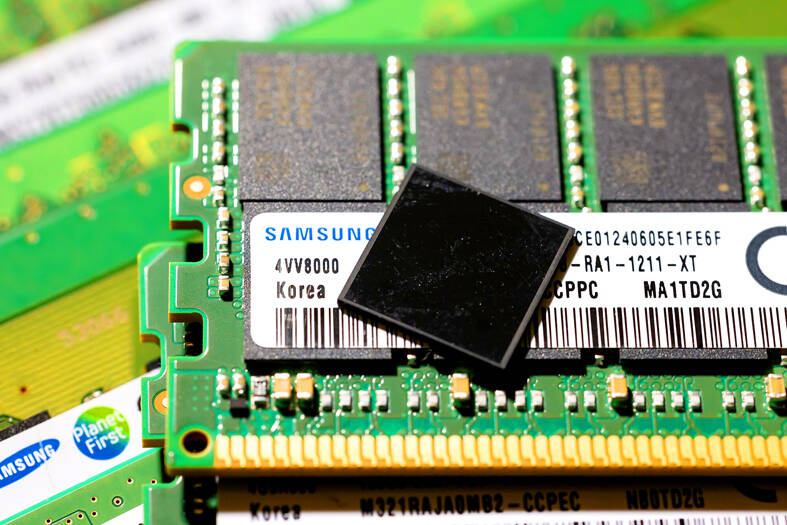
Photo: Bloomberg
If enacted, the measure would capture HBM2 and more advanced chips including HBM3 and HBM3E, the most cutting-edge AI memory chips being produced right now, as well as the tools required to make them, the sources said.
HBM chips are required to run AI accelerators like those offered by Nvidia Corp and Advanced Micro Devices Inc.
Micron would largely be unaffected as the Boise, Idaho-based chipmaker has refrained from selling its HBM products to China after Beijing banned its memory chips from critical infrastructure last year, the people said.
It is unclear what authority the US would use to restrict the South Korean firms, the people said. One possibility is the Foreign Direct Product Rule, which lets Washington impose controls on foreign-made products that use even the tiniest amount of US technology. SK Hynix and Samsung rely on US chip design software and equipment from the likes of Cadence Design Systems Inc and Applied Materials Inc.
Micron, Samsung and SK Hynix representatives declined to comment.
The new restrictions are likely to be unveiled later this month as part of a broader package that also includes sanctions against more than 120 Chinese firms and fresh limits on various types of chip equipment, with carve-outs for key allies including Japan, the Netherlands and South Korea, the people said.
As part of its comprehensive HBM-related curbs in the same export control package, the US plans to lower the threshold for what qualifies as advanced DRAM. A single HBM chip contains several DRAM dies.
New restrictions on HBM equipment and DRAM aim to deter leading Chinese memorychip maker ChangXin Memory Technologies Inc (長鑫存儲) from advancing its technology, the sources said. ChangXin is now capable of making HBM2, which first became commercially available in 2016.
Biden administration officials also plan to create a list of the critical components that China needs to keep producing semiconductors. They are also eyeing what is called a zero de-minimis rule, an even tighter standard for Foreign Direct Product Rule under which any products containing US technology would be subject to potential restrictions. A large group of US allies would be exempted from that measure, including Japan and the Netherlands.

The domestic unit of the Chinese-owned, Dutch-headquartered chipmaker Nexperia BV will soon be able to produce semiconductors locally within China, according to two company sources. Nexperia is at the center of a global tug-of-war over critical semiconductor technology, with a Dutch court in February ordering a probe into alleged mismanagement at the company. The geopolitical tussle has disrupted supply chains, with some carmakers reportedly forced to cut production due to chip shortages. Local production would allow Nexperia’s domestic arm, Nexperia Semiconductors (China) Ltd (安世半導體中國), to bypass restrictions in place since October on the supply of silicon wafers — etched with tiny components to

Singapore-based ride-hailing and delivery giant Grab Holdings Ltd has applied for regulatory approval to acquire the Taiwan operations of Germany-based Delivery Hero SE's Foodpanda in a deal valued at about US$600 million. Grab submitted the filing to the Fair Trade Commission on Friday last week, with the transaction subject to regulatory review and approval, the company said in a statement yesterday. Its independent governance structure would help foster a healthy and competitive market in Taiwan if the deal is approved, Grab said. Grab, which is listed on the NASDAQ, said in the filing that US-based Uber Technologies Inc holds about 13 percent of

Taiwan Semiconductor Manufacturing Co (TSMC, 台積電) yesterday received government approval to deploy its advanced 3-nanometer (3nm) process at its second fab currently under construction in Japan, the Ministry of Economic Affairs said in a news release. The ministry green-lit the plan for the facility in Kumamoto, which is scheduled to start installing equipment and come online in 2028 with a monthly production capacity of 15,000 12-inch wafers, the ministry said. The Department of Investment Review in June 2024 authorized a US$5.26 billion investment for the facility, slated to manufacture 6- to 12nm chips, significantly less advanced than 3nm process. At a meeting with

Taiwan is open to joining a global liquefied natural gas (LNG) program if one is created, but on the condition that countries provide delivery even in a scenario where there is a conflict with China, an energy department official said yesterday. While Taiwan’s priority is to have enough LNG at home, the nation is open to exploring potential strategic reserves in other countries such as Japan or South Korea, Energy Administration Deputy Director-General Chen Chung-hsien (陳崇憲) said. While the LNG market does not have a global reserve for emergencies like that of oil, the concept has been raised a few times —


 RSS
RSS