


China’s central bank cut key interest rates in a surprise move on Monday, aimed at injecting new life into its ailing property sector, while the ruling Chinese Communist Party released details of a top-level meeting focused on strategies for revving up the slowing economy.
The People’s Bank of China (PBOC) cut the five-year loan prime rate (LPR), which is a benchmark for mortgages, by 10 basis points from 3.95 percent to 3.85 percent, while the one-year LPR was reduced from 3.45 percent to 3.35 percent.
The central bank also lowered collateral requirements for its medium-term lending facility for banks, saying it was intended to ease pressure on the bond market.
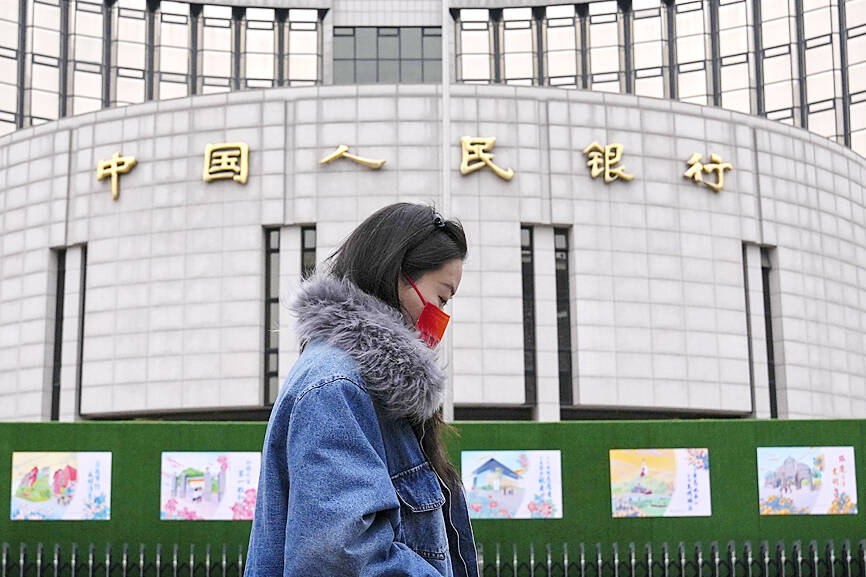
Photo: Andy Wong, AP
The PBOC also cut the interest rate on its purchases of securities from commercial banks through bidding, with a promise to sell them back in the future. The rate on seven-day “reverse repos” was decreased from 1.8 percent to 1.7 percent to help put more cash into the banking system.
The world’s second-largest economy has struggled to regain momentum since the COVID-19 pandemic, and a slump in the property market has been a major hindrance. Economic growth fell to 4.7 percent in the last quarter, but remained at the government’s target rate of about 5 percent for the first half of the year.
The expanded summary of the party’s plenum last week included ambitious targets for accomplishing Chinese President Xi Jinping’s (習近平) goal of making China a “high-standard socialist market economy in all respects” by 2035.
The document promises to increase social welfare such as pensions, improve the tax system and protect private property rights. Rural migrants should have the same access to public services as long-term city dwellers, it says.
It also pledges equal market access and support for private enterprises and state-owned companies, and establishes better “international coordination” of economic policies.
The actual reforms and laws outlined in what amounts to a policy roadmap would come much later.
“We think these measures, if implemented well promptly, should help improve resource allocation, contain financial risks, unleash some growth potential and underpin investors’ confidence, while the actual implementation, and policy clarity and sustainability would be the key,” UBS economists Nina Zhang and Tao Wang said in a report.
Shares of contract chipmaker Taiwan Semiconductor Manufacturing Co (TSMC, 台積電) came under pressure yesterday after a report that Apple Inc is looking to shift some orders from the Taiwanese company to Intel Corp. TSMC shares fell NT$55, or 2.4 percent, to close at NT$2,235 on the local main board, Taiwan Stock Exchange data showed. Despite the losses, TSMC is expected to continue to benefit from sound fundamentals, as it maintains a lead over its peers in high-end process development, analysts said. “The selling was a knee-jerk reaction to an Intel-Apple report over the weekend,” Mega International Investment Services Corp (兆豐國際投顧) analyst Alex Huang
Taiwan Semiconductor Manufacturing Co (TSMC, 台積電) is expected to remain Apple Inc’s primary chip manufacturing partner despite reports that Apple could shift some orders to Intel Corp, industry experts said yesterday. The comments came after The Wall Street Journal reported on Friday that Apple and Intel had reached a preliminary agreement following more than a year of negotiations for Intel to manufacture some chips for Apple devices. Taiwan Institute of Economic Research (台灣經濟研究院) economist Arisa Liu (劉佩真) said TSMC’s advanced packaging technologies, including integrated fan-out and chip-on-wafer-on-substrate, remain critical to the performance of Apple’s A-series and M-series chips. She said Intel and Samsung
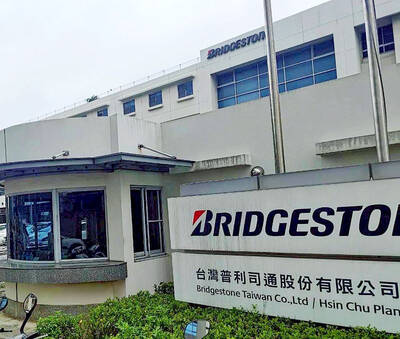
TRANSITION: With the closure, the company would reorganize its Taiwanese unit to a sales and service-focused model, Bridgestone said Bridgestone Corp yesterday announced it would cease manufacturing operations at its tire plant in Hsinchu County’s Hukou Township (湖口), affecting more than 500 workers. Bridgestone Taiwan Co (台灣普利司通) said in a statement that the decision was based on the Tokyo-based tire maker’s adjustments to its global operational strategy and long-term market development considerations. The Taiwanese unit would be reorganized as part of the closure, effective yesterday, and all related production activities would be concluded, the statement said. Under the plan, Bridgestone would continue to deepen its presence in the Taiwanese market, while transitioning to a sales and service-focused business model, it added. The Hsinchu
Taiwan Semiconductor Manufacturing Co (TSMC, 台積電) has approved a capital budget of US$31.28 billion for production expansion to meet long-term development needs during the artificial intelligence (AI) boom. The company’s board meeting yesterday approved the capital appropriation plan for purposes such as the installation of advanced technology capacity and fab construction, the world’s largest contract chipmaker said in a statement. At an earnings conference last month, TSMC forecast that its capital expenditure for this year would be at the higher end of the US$52 billion to US$56 billion range it forecast in January in response to robust demand for 5G, AI and


 RSS
RSS