


The International Monetary Fund (IMF) held its global growth expectations for this year steady in a report yesterday even as it cut forecasts for the US and Japan, while warning of inflation risks and trade tensions ahead.
The IMF expects the world economy to grow 3.2 percent this year, unchanged from its April forecast, according to its World Economic Outlook update.
“Global activity and world trade firmed up at the turn of the year, with trade spurred by strong exports from Asia, particularly in the technology sector,” the fund said.
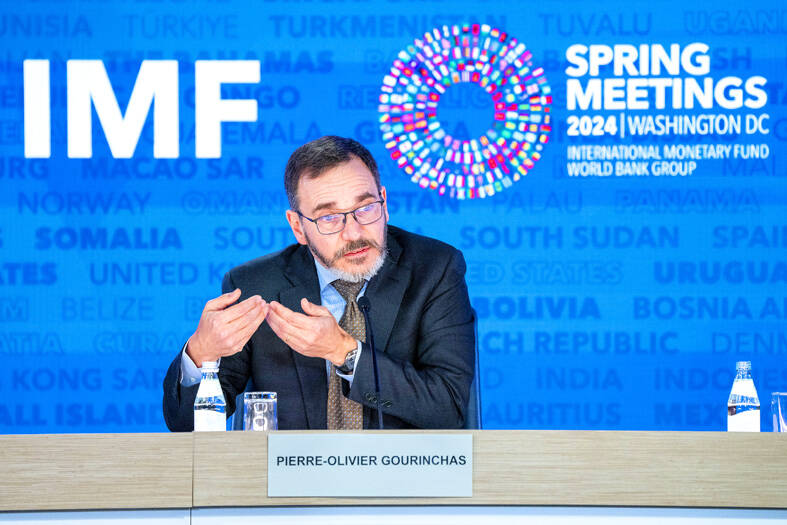
Photo: Jacquelyn Martin, AP
For next year, it expects global growth of 3.3 percent.
But even as many countries saw better growth than anticipated in the first three months this year, the IMF flagged what it called notable surprises in Japan and the US.
The Washington-based lender also cautioned that upside risks to inflation have increased, with services prices holding up disinflation.
This increases the prospect of interest rates staying elevated for longer, “in the context of escalating trade tensions and increased policy uncertainty.”
An area of concern is trade and industrial policy, with countries potentially adopting measures that impact the global economy’s integration, IMF chief economist Pierre-Olivier Gourinchas said.
Asked if risk assessments have shifted after the attempted assassination of former US president Donald Trump, the Republican Party’s nominee in November’s election, Gourinchas noted the fund will consider its implications.
While world growth appears stable, the IMF has lowered projections for the US and Japan.
US growth this year was downgraded to 2.6 percent, 0.1 percentage points below April’s forecast, due to a “slower-than-expected start to the year,” the fund said.
Japan’s economy was seen expanding 0.2 percentage points less than expected, by 0.7 percent this year.
This was mainly thanks to temporary supply disruptions and weak private investment in the first quarter.
The euro area meanwhile is showing signs of recovery, with relatively strong services activity, Gourinchas said, although manufacturing shows weakness.
China and India are expected to power activity in Asia — with China’s forecast revised up to 5 percent this year on a private consumption rebound and strong exports.
India, meanwhile, is set to grow 7 percent, partly on better prospects for consumption.
Gourinchas also flagged risks to China stemming from weak confidence and unresolved property sector problems.
Should domestic demand weaken, China would rely more on the external sector — a situation that countries like the US are pushing back against.
There also remain risks of sticky inflation amid renewed trade or geopolitical tensions, the IMF cautioned, even as it expects inflation to return to target by the end of next year.
Wage growth, if accompanied by weak productivity, could make it tough for firms to ease price increases.
An escalation of trade tensions could also raise near-term inflation risks, by lifting costs of imported goods, IMF said.
Higher inflation could heighten the chances that interest rates stay elevated for longer, increasing financial risks.
The IMF called for careful monetary policy adjustments.
A resurgence of tariffs can also trigger retaliation and a “costly race to the bottom,” the report said.
Another source of uncertainty is the chance of “significant swings in economic policy as a result of elections this year, with negative spillovers to the rest of the world,” it said.

Singapore-based ride-hailing and delivery giant Grab Holdings Ltd has applied for regulatory approval to acquire the Taiwan operations of Germany-based Delivery Hero SE's Foodpanda in a deal valued at about US$600 million. Grab submitted the filing to the Fair Trade Commission on Friday last week, with the transaction subject to regulatory review and approval, the company said in a statement yesterday. Its independent governance structure would help foster a healthy and competitive market in Taiwan if the deal is approved, Grab said. Grab, which is listed on the NASDAQ, said in the filing that US-based Uber Technologies Inc holds about 13 percent of

The domestic unit of the Chinese-owned, Dutch-headquartered chipmaker Nexperia BV will soon be able to produce semiconductors locally within China, according to two company sources. Nexperia is at the center of a global tug-of-war over critical semiconductor technology, with a Dutch court in February ordering a probe into alleged mismanagement at the company. The geopolitical tussle has disrupted supply chains, with some carmakers reportedly forced to cut production due to chip shortages. Local production would allow Nexperia’s domestic arm, Nexperia Semiconductors (China) Ltd (安世半導體中國), to bypass restrictions in place since October on the supply of silicon wafers — etched with tiny components to

Taiwan Semiconductor Manufacturing Co (TSMC, 台積電) yesterday received government approval to deploy its advanced 3-nanometer (3nm) process at its second fab currently under construction in Japan, the Ministry of Economic Affairs said in a news release. The ministry green-lit the plan for the facility in Kumamoto, which is scheduled to start installing equipment and come online in 2028 with a monthly production capacity of 15,000 12-inch wafers, the ministry said. The Department of Investment Review in June 2024 authorized a US$5.26 billion investment for the facility, slated to manufacture 6- to 12nm chips, significantly less advanced than 3nm process. At a meeting with

Taiwan’s food delivery market could undergo a major shift if Singapore-based Grab Holdings Ltd completes its planned acquisition of Delivery Hero SE’s Foodpanda business in Taiwan, industry experts said. Grab on Monday last week announced it would acquire Foodpanda’s Taiwan operations for US$600 million. The deal is expected to be finalized in the second half of this year, with Grab aiming to complete user migration to its platform by the first half of next year. A duopoly between Uber Eats and Foodpanda dominates Taiwan’s delivery market, a structure that has remained intact since the Fair Trade Commission (FTC) blocked Uber Technologies Inc’s


 RSS
RSS