


Manufacturing activity in Europe suffered a setback last month but Asian factories enjoyed solid momentum, offering policymakers some hope the region can weather the hit from soft Chinese demand, surveys showed yesterday.
The downturn in Europe was widespread, with Italy the only big player not to see a fall in its Purchasing Managers’ Index (PMI) despite manufacturers largely cutting prices.
HCOB’s final eurozone manufacturing PMI, compiled by S&P Global, fell to 45.8 last month from May’s 47.3. It has been below the 50 mark separating growth from contraction for two years.
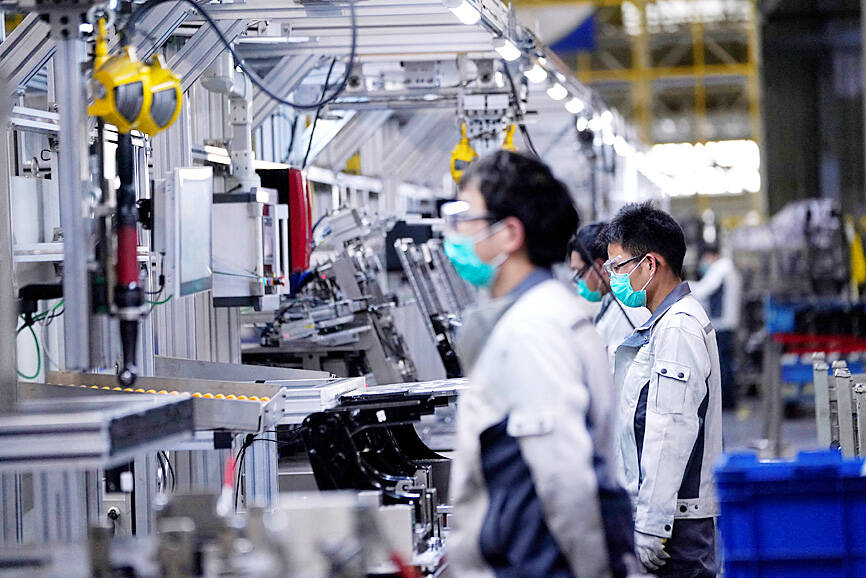
Photo: Aly Song, Reuters
"What looks like the green shoots of recovery seem to be diminishing. We can’t take a recovery for granted," Nomura Holdings Inc economist George Moran said.
Germany’s factory sector, which accounts for about a fifth of Europe’s biggest economy, experienced a retreat, while in France the manufacturing recession deepened.
In Britain, which holds a national election on Thursday, manufacturing growth slipped last month from May’s 22-month high as ongoing disruption to shipping in the Red Sea led to lower demand from overseas customers.
A eurozone index measuring output, which feeds into a composite PMI due on Wednesday that is seen as a good gauge of economic health, sank from May’s 49.3 to a six-month low of 46.1, albeit just ahead of the 46.0 flash estimate.
A new orders index in the currency union dropped to 44.4 from 47.3, despite factories cutting prices charged for a fourteenth month.
But cost pressures weighed on manufacturers in countries like Japan, where a weak yen is boosting the price companies pay for fuel and raw material imports.
China’s Caixin/S&P Global manufacturing PMI rose to 51.8 last month from 51.7. It marked the fastest clip in more than three years and exceeded market forecasts of 51.2.
The private-sector reading followed official PMI data on Sunday showing China’s manufacturing activity fell for a second month last month and services activity slid to a five-month low.
In a sign Asia is benefiting from solid global demand, South Korea’s factory activity growth quickened last month to the fastest in 26 months on surging new orders, its PMI showed.
Factory activity also expanded last month at a faster pace than in May in Vietnam and Taiwan, other surveys showed.
Taiwan’s PMI surged to 53.2 last month, its highest reading since March 2022, while Vietnam’s PMI rose sharply to 54.7 last month from 50.3 in May, rising for a third consecutive month, S&P Global said.
Japan’s factory activity expanded last month, but at a slower pace than in May, as companies struggled with rising costs due to the weak yen.
The final au Jibun Bank Japan manufacturing PMI was 50.0, on the break-even line, after a brief improvement to 50.4 in May.
Meanwhile, activity in India’s manufacturing sector rebounded last month as output increased on robust demand, leading to the fastest rate of hiring in over 19 years.

The domestic unit of the Chinese-owned, Dutch-headquartered chipmaker Nexperia BV will soon be able to produce semiconductors locally within China, according to two company sources. Nexperia is at the center of a global tug-of-war over critical semiconductor technology, with a Dutch court in February ordering a probe into alleged mismanagement at the company. The geopolitical tussle has disrupted supply chains, with some carmakers reportedly forced to cut production due to chip shortages. Local production would allow Nexperia’s domestic arm, Nexperia Semiconductors (China) Ltd (安世半導體中國), to bypass restrictions in place since October on the supply of silicon wafers — etched with tiny components to

Singapore-based ride-hailing and delivery giant Grab Holdings Ltd has applied for regulatory approval to acquire the Taiwan operations of Germany-based Delivery Hero SE's Foodpanda in a deal valued at about US$600 million. Grab submitted the filing to the Fair Trade Commission on Friday last week, with the transaction subject to regulatory review and approval, the company said in a statement yesterday. Its independent governance structure would help foster a healthy and competitive market in Taiwan if the deal is approved, Grab said. Grab, which is listed on the NASDAQ, said in the filing that US-based Uber Technologies Inc holds about 13 percent of
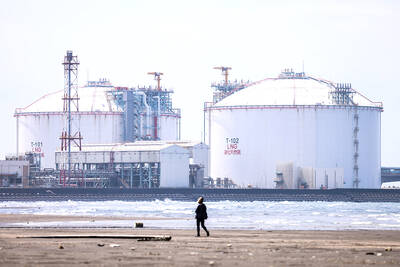
Taiwan is open to joining a global liquefied natural gas (LNG) program if one is created, but on the condition that countries provide delivery even in a scenario where there is a conflict with China, an energy department official said yesterday. While Taiwan’s priority is to have enough LNG at home, the nation is open to exploring potential strategic reserves in other countries such as Japan or South Korea, Energy Administration Deputy Director-General Chen Chung-hsien (陳崇憲) said. While the LNG market does not have a global reserve for emergencies like that of oil, the concept has been raised a few times —

Taiwan Semiconductor Manufacturing Co (TSMC, 台積電) yesterday received government approval to deploy its advanced 3-nanometer (3nm) process at its second fab currently under construction in Japan, the Ministry of Economic Affairs said in a news release. The ministry green-lit the plan for the facility in Kumamoto, which is scheduled to start installing equipment and come online in 2028 with a monthly production capacity of 15,000 12-inch wafers, the ministry said. The Department of Investment Review in June 2024 authorized a US$5.26 billion investment for the facility, slated to manufacture 6- to 12nm chips, significantly less advanced than 3nm process. At a meeting with


 RSS
RSS