


European Union regulators yesterday leveled their first charges under the bloc’s new digital competition rulebook, accusing Apple Inc of preventing app makers from pointing users to cheaper options outside its App Store.
The European Commission said that according to the preliminary findings of its investigation, the restrictions that the iPhone maker imposes on developers using its mobile App Store had breached the 27-nation bloc’s Digital Markets Act (DMA).
The DMA is a sweeping set of regulations aimed at preventing tech “gatekeepers” from cornering digital markets under threat of heavy financial penalties. The commission opened an initial round of investigations after it took effect in March, including a separate ongoing probe into whether Apple is doing enough to allow iPhone users to easily change Web browsers, and other cases involving Google and Meta Platforms Inc.

Photo: Reuters
Under the DMA’s provisions, app developers must be allowed to inform customers of cheaper purchasing options and direct them to those offers.
The commission, the bloc’s executive arm, said App Store rules “prevent app developers from freely steering consumers to alternative channels for offers and content.”
Apple now has a chance to respond to the findings. The commission must make a final decision on Apple’s compliance by March next year. The company could face fines worth up to 10 percent of its global revenue, which could amount to billions of euros, or daily penalties.
The commission kept up the pressure on Apple, simultaneously opening a new investigation into contractual terms that it’s offering app developers.
Regulators zeroed in on a “core technology fee” of 0.5 euros (US$0.54) that Apple is now charging developers for each time their apps are downloaded and installed from outside Apple’s App Store. The DMA’s provisions open the way for alternative app stores to give consumers more choice.
The commission said the the new terms are a “condition to access some of the new features enabled by the DMA.” Rivals had criticized the fee, saying it would deter many existing free apps, which don’t pay any fees, from jumping ship.
“We are concerned Apple’s new business model makes it too hard for app developers to operate as alternative marketplaces & reach their end users on iOS,” EU Commissioner for Competition Margrethe Vestager said on social media.
Apple said over the past several months, it “has made a number of changes to comply with the DMA in response to feedback from developers and the European Commission.”
“We are confident our plan complies with the law, and estimate more than 99 percent of developers would pay the same or less in fees to Apple under the new business terms we created,” the company said in a statement. “All developers doing business in the EU on the App Store have the opportunity to utilize the capabilities that we have introduced, including the ability to direct app users to the web to complete purchases at a very competitive rate.”
The company said it will “continue to listen and engage” with the commission.

Nvidia Corp chief executive officer Jensen Huang (黃仁勳) on Monday introduced the company’s latest supercomputer platform, featuring six new chips made by Taiwan Semiconductor Manufacturing Co (TSMC, 台積電), saying that it is now “in full production.” “If Vera Rubin is going to be in time for this year, it must be in production by now, and so, today I can tell you that Vera Rubin is in full production,” Huang said during his keynote speech at CES in Las Vegas. The rollout of six concurrent chips for Vera Rubin — the company’s next-generation artificial intelligence (AI) computing platform — marks a strategic

REVENUE PERFORMANCE: Cloud and network products, and electronic components saw strong increases, while smart consumer electronics and computing products fell Hon Hai Precision Industry Co (鴻海精密) yesterday posted 26.51 percent quarterly growth in revenue for last quarter to NT$2.6 trillion (US$82.44 billion), the strongest on record for the period and above expectations, but the company forecast a slight revenue dip this quarter due to seasonal factors. On an annual basis, revenue last quarter grew 22.07 percent, the company said. Analysts on average estimated about NT$2.4 trillion increase. Hon Hai, which assembles servers for Nvidia Corp and iPhones for Apple Inc, is expanding its capacity in the US, adding artificial intelligence (AI) server production in Wisconsin and Texas, where it operates established campuses. This
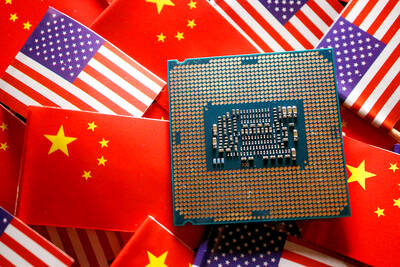
US President Donald Trump on Friday blocked US photonics firm HieFo Corp’s US$3 million acquisition of assets in New Jersey-based aerospace and defense specialist Emcore Corp, citing national security and China-related concerns. In an order released by the White House, Trump said HieFo was “controlled by a citizen of the People’s Republic of China” and that its 2024 acquisition of Emcore’s businesses led the US president to believe that it might “take action that threatens to impair the national security of the United States.” The order did not name the person or detail Trump’s concerns. “The Transaction is hereby prohibited,”

Garment maker Makalot Industrial Co (聚陽) yesterday reported lower-than-expected fourth-quarter revenue of NT$7.93 billion (US$251.44 million), down 9.48 percent from NT$8.76 billion a year earlier. On a quarterly basis, revenue fell 10.83 percent from NT$8.89 billion, company data showed. The figure was also lower than market expectations of NT$8.05 billion, according to data compiled by Yuanta Securities Investment and Consulting Co (元大投顧), which had projected NT$8.22 billion. Makalot’s revenue this quarter would likely increase by a mid-teens percentage as the industry is entering its high season, Yuanta said. Overall, Makalot’s revenue last year totaled NT$34.43 billion, down 3.08 percent from its record NT$35.52


 RSS
RSS