


Export orders last month expanded at a faster-than-expected 7 percent driven by strong demand for chips used in artificial intelligence (AI) applications and high-performance computing (HPC) devices, the Ministry of Economic Affairs said yesterday.
Export orders last month expanded to US$48.89 billion, beating the ministry’s estimate of increasing by 6.2 percent year-on-year to US$48.5 billion.
The ministry expects the growth momentum to extend into this month, rising by an annual rate of between 10.9 percent and 15.4 percent to between US$49 billion and US$51 billion.
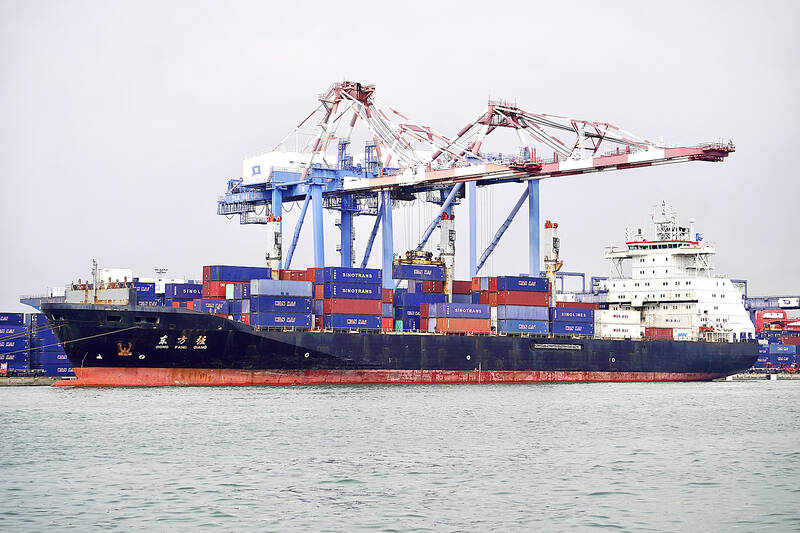
Photo: CNA
That would bring orders this quarter to between US$145 billion and US$147 billion, indicating a yearly expansion of between 9.5 percent and 11.1 percent, the ministry projected.
“Export orders in the second quarter are to ride out of a seven-quarter decline as prolonged inventory corrections are coming to an end for most industries,” Department of Statistics Director Huang Yu-ling (黃于玲) said via telephone. “We expect export orders to grow every quarter in the second half of this year amid normal seasonality.”
In the first five months of the year, export orders rose 2.2 percent to US$229.3 billion, ministry data showed.
It remains to be seen if the growth of export orders swings back to positive territory for the whole year, as major central banks hesitate to cut interest rates and the geopolitical situation remains precarious, Huang said.
Last year, export orders dipped for a second straight year, falling by 15.9 percent year-on-year amid supply chain inventory adjustments and sagging end-market demand, ministry data showed.
Orders for electronic products rose 9.2 percent year-on-year to US$16.89 billion last month, primarily fueled by demand for foundry services and chip distributors for AI applications and HPC devices, the ministry said.
Orders for information and communication technology (ICT) products last month rose 11.4 percent to US$14.06 billion, aided by demand for AI applications, cloud devices and servers. That marked the best May performance for ICT goods, it said.
Orders from Southeast Asian countries showed the strongest growth in ICT products as the region has become the new server manufacturing hub for local manufacturers including Quanta Computer Inc (廣達), Hon Hai Precision Industry Co (鴻海) and Wiwynn Corp (緯穎).
Orders of optoelectronics products expanded 7 percent to US$1.77 billion last month, thanks to price increases for large TV panels and better orders of optoelectronic cameras, it said.
Orders for base metals dropped 1.5 percent to US$2.21 billion last month as steel demand slowed, and those for machinery products shrank 0.5 percent to US$1.66 billion as businesses were still conservative about investing in new manufacturing equipment, the ministry said.
However, orders for plastic products increased 8.5 percent to US$1.72 billion due to restocking demand and higher selling prices, it said.
Petrochemical products orders also surged 17.1 percent to US$1.69 billion, thanks to price increases amid higher global crude oil prices, the ministry said.

The domestic unit of the Chinese-owned, Dutch-headquartered chipmaker Nexperia BV will soon be able to produce semiconductors locally within China, according to two company sources. Nexperia is at the center of a global tug-of-war over critical semiconductor technology, with a Dutch court in February ordering a probe into alleged mismanagement at the company. The geopolitical tussle has disrupted supply chains, with some carmakers reportedly forced to cut production due to chip shortages. Local production would allow Nexperia’s domestic arm, Nexperia Semiconductors (China) Ltd (安世半導體中國), to bypass restrictions in place since October on the supply of silicon wafers — etched with tiny components to

Singapore-based ride-hailing and delivery giant Grab Holdings Ltd has applied for regulatory approval to acquire the Taiwan operations of Germany-based Delivery Hero SE's Foodpanda in a deal valued at about US$600 million. Grab submitted the filing to the Fair Trade Commission on Friday last week, with the transaction subject to regulatory review and approval, the company said in a statement yesterday. Its independent governance structure would help foster a healthy and competitive market in Taiwan if the deal is approved, Grab said. Grab, which is listed on the NASDAQ, said in the filing that US-based Uber Technologies Inc holds about 13 percent of

Taiwan Semiconductor Manufacturing Co (TSMC, 台積電) yesterday received government approval to deploy its advanced 3-nanometer (3nm) process at its second fab currently under construction in Japan, the Ministry of Economic Affairs said in a news release. The ministry green-lit the plan for the facility in Kumamoto, which is scheduled to start installing equipment and come online in 2028 with a monthly production capacity of 15,000 12-inch wafers, the ministry said. The Department of Investment Review in June 2024 authorized a US$5.26 billion investment for the facility, slated to manufacture 6- to 12nm chips, significantly less advanced than 3nm process. At a meeting with

Taiwan’s food delivery market could undergo a major shift if Singapore-based Grab Holdings Ltd completes its planned acquisition of Delivery Hero SE’s Foodpanda business in Taiwan, industry experts said. Grab on Monday last week announced it would acquire Foodpanda’s Taiwan operations for US$600 million. The deal is expected to be finalized in the second half of this year, with Grab aiming to complete user migration to its platform by the first half of next year. A duopoly between Uber Eats and Foodpanda dominates Taiwan’s delivery market, a structure that has remained intact since the Fair Trade Commission (FTC) blocked Uber Technologies Inc’s


 RSS
RSS