


Cathay Financial Holding Co (國泰金控) yesterday said it booked net income of NT$7.88 billion (US$244.34 million) last month, or earnings per share of NT$4.07.
Its main subsidiary, Cathay Life Insurance Co (國泰人壽), accounted for 53 percent of the company’s total net income, or NT$4.18 billion, as it booked a profit after global financial markets responded favorably to the US Federal Reserve’s extended pause in interest rate adjustments.
Capital gains more than offset hedging losses induced by a softening US dollar, it added.
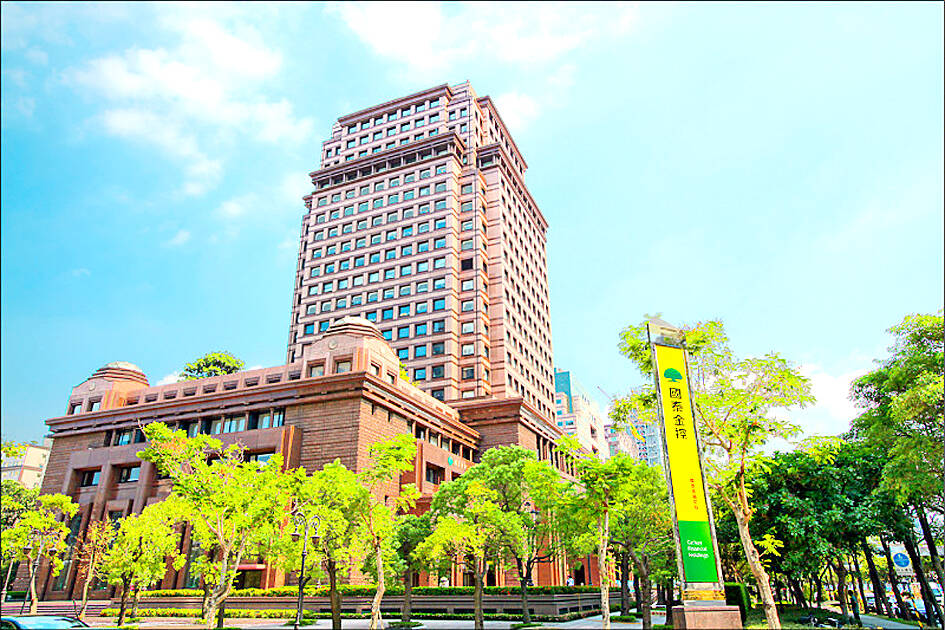
Photo courtesy of Cathay Financial Holding Co
Cathay United Bank (國泰世華銀行), the company’s banking unit, generated NT$3.3 billion in net income last month, aided by robust lending, wealth management and credit card businesses.
The central bank’s interest rate hike in March also boosted interest income, the conglomerate said.
Cathay Securities Investment Trust Co (國泰投信) posted a net income of NT$190 million last month, or a 43 percent pickup from a year earlier, with its assets under management rising to NT$1.85 trillion thanks to its exchange-traded funds (ETFs) on the local bourse.
The three funds’ quarterly distribution of cash dividends grew to NT$284.4 billion, NT$150 billion and NT$100 billion last month, as Taiwanese investors displayed keen interest in ETFs targeting local shares and US bonds.
Fubon Financial Holding Co (富邦金控) meanwhile yesterday reported a record net income of NT$16.02 billion for last month.
The company attributed the results to soaring net income in its life insurance, banking and securities arms from a year earlier.
The figures translated into earnings per share of NT$4.57, enabling Fubon Financial to retain the title of “the most profitable conglomerate” among its peers in Taiwan last month.
Profit at Fubon Life Insurance Co (富邦人壽) spiked 726 percent year-on-year to a new high of NT$11.35 billion last month, primarily on the back of capital gains and interest income, the conglomerate said.
Fubon Life raked in hefty profits from its fund and stock investments and realized partial gains, it said, adding that its portfolio still maintained large unrealized gains as a result of global financial market rallies.
At the same time, Fubon Life increased its holdings of US bonds and incurred some foreign exchange losses due to the greenback’s 0.37 percent depreciation, it said.
Taipei Fubon Commercial Bank (台北富邦銀行) generated NT$2.53 billion of net income in the month, indicating 30 percent growth from a year earlier, helped by double-digit percentage advances in lending, and credit card and wealth management operations.
Fubon Securities Co (富邦證券) contributed NT$750 million of profit, a 60 percent rise from a year earlier, the conglomerate said.
The impressive showings came as little surprise given the TAIEX repeatedly hit record highs last month and received sizeable support from global fund inflows, the conglomerate added.


Taiwanese firms have increased investment in the Philippines in recent years as Manila’s ties with Washington deepen and global supply chains continue to shift away from China, an expert at the Chung-Hua Institution for Economic Research (CIER, 中華經濟研究院) said yesterday. The Philippines had not been among Taiwanese investors’ top choices in Southeast Asia, CIER Taiwan ASEAN Studies Center director Kristy Hsu (徐遵慈) said at a seminar in Taipei. However, Taiwan’s investment in the country has grown significantly since the COVID-19 pandemic, reaching US $257 million last year, a high in recent years, she said. Although Taiwan’s total investment in the Philippines still lags

Intel Corp regards Taiwan Semiconductor Manufacturing Co (TSMC, 台積電) as a longstanding partner, as the US chipmaker would continue outsourcing production of advanced chips to TSMC, Intel chief executive officer Lip-Bu Tan (陳立武) said yesterday. “I don’t look at people as competitors. I look at the collaboration... Nvidia is also, you know, a good friend,” Tan told a news conference following his keynote speech at the Computex trade show in Taipei. “It’s a very trusted partnership for us... We are a big, top customer for them, and we’re going to continue doing that,” he said, referring to TSMC, the world’s largest foundry

Hon Hai Precision Industry Co (鴻海精密) yesterday said it would work with US chipmaker Intel Corp to jointly develop and deploy next-generation artificial intelligence (AI) infrastructure and intelligent computing platforms in a move to capture booming demand for AI computing systems. Hon Hai, also known as Foxconn Technology Group (富士康), said in a statement that the partnership would combine its global manufacturing scale, system integration expertise and AI data center deployment capabilities with Intel’s strengths in processor architecture, silicon technologies and software ecosystem. The companies said they plan to work on equipment used in AI data centers, including server racks powered by

Artificial intelligence (AI) agents would supplant smartphones as the center of people’s digital lives, fundamentally reshaping personal devices and driving a major computing upgrade cycle, Qualcomm Inc CEO Cristiano Amon said yesterday. In his keynote speech for this year’s Computex trade show in Taipei, Amon said that the rise of "agentic AI" — AI systems capable of reasoning, planning and carrying out tasks autonomously — would transform how people interact with technology across phones, PCs, vehicles and wearable devices. Describing the technology as the next major evolution in computing, Amon said that "2026 is the year of agents.” For decades, smartphones have sat


 RSS
RSS