


Foreign funds snapped a two-month selling streak of Taiwanese equities last month amid renewed optimism around artificial intelligence (AI).
Overseas investors bought US$2.7 billion of Taiwanese shares, according to Bloomberg-compiled data.
That is a turnaround from when they sold stocks in March and April as Taiwan Semiconductor Manufacturing Co (TSMC, 台積電) cautioned over persistent weakness in consumer markets and funds rotated to rival South Korea.
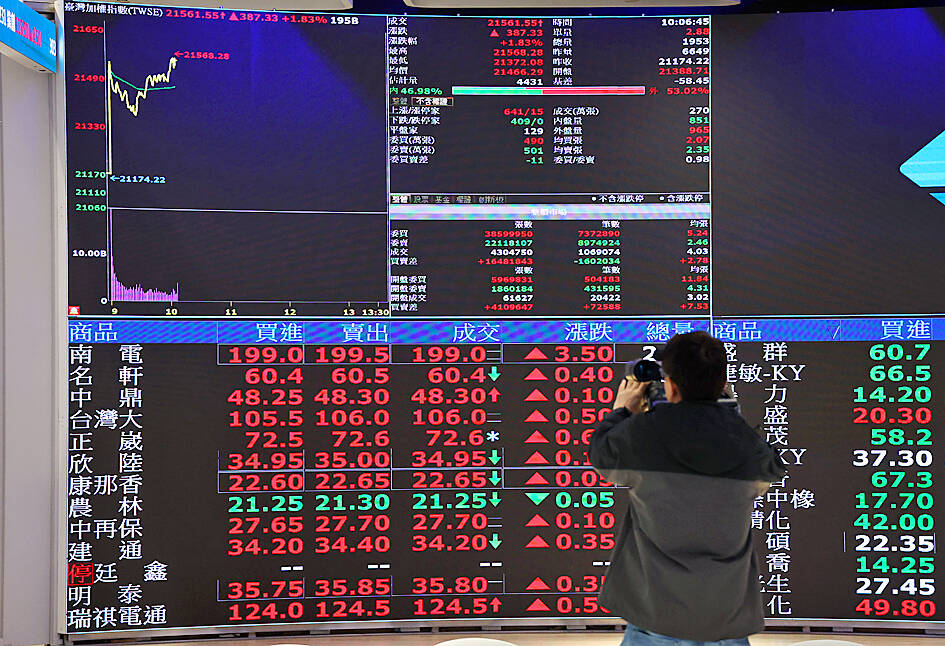
Photo: CNA
Sentiment in chip stocks has recovered globally following another bullish forecast from AI chipmaker Nvidia Corp. Taiwan’s dominant position in the AI value chain would get another boost this week as tech giants gather for the nation’s annual electronics showcase event, Computex Taipei.
“Alongside Nvidia’s optimism, there was some cautious positioning on Taiwan earlier in the year which has eased,” Bloomberg Intelligence strategist Marvin Chen (陳明康) said. “While valuations are getting stretched, Taiwan is still Asia’s best proxy for the AI boom.”
Taiwan was the biggest recipient of foreign inflows last month among emerging Asian countries excluding China. That helped fuel a rally in TAIEX to a record high late last month and pushed the benchmark index to become one of the best performers in Asia this year.
Yesterday, the TAIEX moved sharply higher amid enthusiasm over AI development after a speech by Nvidia CEO Jensen Huang (黃仁勳) in Taipei a day earlier. The index closed up 362.54 points, or 1.71 percent, at 21,536.76.
TSMC, which is believed to provide advanced chips for Nvidia’s graphics processing units, led the gains throughout the session and closed 3.05 percent higher at NT$846.
Turnover on the main board totaled NT$433.32 billion (US$13.38 billion) yesterday, with foreign institutional investors buying a net NT$2.9 billion in shares, Taiwan Stock Exchange data showed.
There is still scope for global funds to keep buying given that foreign ownership of TSMC — the largest stock on the index with a weighting of 32 percent — is below the record 80 percent level seen in 2017.
A strong earnings outlook for Taiwanese firms also bodes well for foreign flows into the market. The 12-month forward profit estimate for the TAIEX has risen by more than 8 percent this year compared with little change on the MSCI Asia Pacific Index, data compiled by Bloomberg showed.
A delay in the US Federal Reserve’s rate cuts might still dent the tech rally, while any escalation in cross-strait tensions might deter foreign interest in Taiwan’s stock market.
“Strength of Nvidia and the underlying AI/server theme continue to support associated stocks in Taiwan,” Robeco Hong Kong Ltd Asia Pacific equities head Joshua Crabb said.
Stocks also remain attractive to foreign investors as they “are a lot cheaper than US counterparts,” he added.
Additional reporting by CNA

Cairo’s new monorail slices across the city skyline, running above the familiar chaos of blaring horns and aging buses’ exhaust fumes that mark rush hour below. The US$4.5 billion monorail, opened this month, is among Egypt’s most prominent new transport projects, part of a debt-funded infrastructure drive criticized for sapping state finances while bringing limited benefits to most of the country’s 109 million people. “It feels like you’re in a different country,” said Ramy Sayed, a restaurant manager, aboard a driverless Innovia 300 train. “No noise, no traffic, we’re not used to this.” The eastern line runs 56km from the bustling middle-class

Taiwanese firms have increased investment in the Philippines in recent years as Manila’s ties with Washington deepen and global supply chains continue to shift away from China, an expert at the Chung-Hua Institution for Economic Research (CIER, 中華經濟研究院) said yesterday. The Philippines had not been among Taiwanese investors’ top choices in Southeast Asia, CIER Taiwan ASEAN Studies Center director Kristy Hsu (徐遵慈) said at a seminar in Taipei. However, Taiwan’s investment in the country has grown significantly since the COVID-19 pandemic, reaching US $257 million last year, a high in recent years, she said. Although Taiwan’s total investment in the Philippines still lags

Intel Corp regards Taiwan Semiconductor Manufacturing Co (TSMC, 台積電) as a longstanding partner, as the US chipmaker would continue outsourcing production of advanced chips to TSMC, Intel chief executive officer Lip-Bu Tan (陳立武) said yesterday. “I don’t look at people as competitors. I look at the collaboration... Nvidia is also, you know, a good friend,” Tan told a news conference following his keynote speech at the Computex trade show in Taipei. “It’s a very trusted partnership for us... We are a big, top customer for them, and we’re going to continue doing that,” he said, referring to TSMC, the world’s largest foundry

Artificial intelligence (AI) agents would supplant smartphones as the center of people’s digital lives, fundamentally reshaping personal devices and driving a major computing upgrade cycle, Qualcomm Inc CEO Cristiano Amon said yesterday. In his keynote speech for this year’s Computex trade show in Taipei, Amon said that the rise of "agentic AI" — AI systems capable of reasoning, planning and carrying out tasks autonomously — would transform how people interact with technology across phones, PCs, vehicles and wearable devices. Describing the technology as the next major evolution in computing, Amon said that "2026 is the year of agents.” For decades, smartphones have sat


 RSS
RSS