


Owners of laptops built on Qualcomm Inc’s new chips would be able to use the computers as much as they want without having to worry about the battery dying, the San Diego, California-based company said yesterday.
Qualcomm is providing the semiconductors underpinning Microsoft Corp’s new breed of Copilot+ PCs that feature the software maker’s latest and best artificial intelligence (AI) enhancements.
“We’re really making history together and the industry is starting to take notice,” Qualcomm chief executive officer Cristiano Amon said in a keynote address at Computex Taipei. “I believe it’s as significant as Windows 95.”
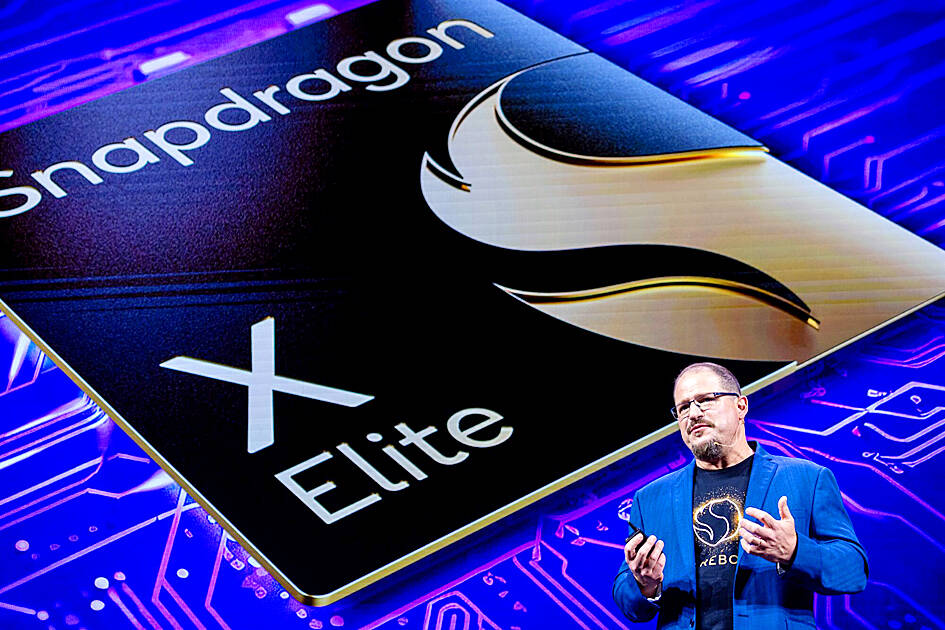
Photo: Bloomberg, Annabelle Chih
Qualcomm and some of its peers have spent more than a decade trying to loosen the dependency of the PC industry on Intel Corp and provide a fresh set of key components using the Arm Holdings PLC technology that is dominant in the smartphone industry.
Windows laptops based on Qualcomm’s Snapdragon X Elite systems would have as much as twice the battery life of traditional counterparts, and when it comes to running some AI features, the power efficiency would be more than 100 times greater, Amon said said.
“The PC is truly reborn. It’s a new era for the PC, and that is happening with a combination of Snapdragon X Elite and Copilot+,” Amon said.
The CEO’s bullishness about the new devices is part of his attempt to diversify Qualcomm’s sources of revenue — the company’s mobile chips are ubiquitous across the smartphone industry, but it trails rivals in other segments.
The greater efficiency and connectivity offered by Qualcomm’s products would help it win share in a number of new markets, including automotive and computing, Amon has said.
Last month, Microsoft unveiled its Copilot+ computers infused with AI features.
The machines from Microsoft’s Surface line — all based on Qualcomm chips — and manufacturing partners would offer more power and be faster than Apple Inc’s top-of-the-line MacBook Air, Microsoft said.
Lenovo Group Ltd (聯想), Dell Technologies Inc, HP Inc, Asustek Computer Inc (華碩) and Acer Inc (宏碁) are among the partners who have announced they would release Snapdragon-powered Copilot+ laptops.
“Qualcomm is now in this neighborhood to stay, we’re not going anywhere, and we’re very happy to be working with our partners,” Amon said, wearing a pair of white sneakers with the Copilot logo printed on them.
Microsoft corporate vice president and head of Windows and devices Pavan Davuluri joined Amon on stage and the two men hugged to underscore the warmth of their business partnership.
Amon ended his speech with an apparent dig at Apple — whose high-end Mac computers have long competed with premium PCs — showing the audience a short video of the actor Justin Long trying to order a Snapdragon PC after being bombarded by notifications on his Mac laptop.
Long was featured in the popular Apple ads from the 2000s in which he played a hip character representing Macs opposite John Hodgman as a stuffy and boring PC.
“What?” Long said while looking at the camera in the Qualcomm video. “Things change.”
Additional reporting by AFP

Cairo’s new monorail slices across the city skyline, running above the familiar chaos of blaring horns and aging buses’ exhaust fumes that mark rush hour below. The US$4.5 billion monorail, opened this month, is among Egypt’s most prominent new transport projects, part of a debt-funded infrastructure drive criticized for sapping state finances while bringing limited benefits to most of the country’s 109 million people. “It feels like you’re in a different country,” said Ramy Sayed, a restaurant manager, aboard a driverless Innovia 300 train. “No noise, no traffic, we’re not used to this.” The eastern line runs 56km from the bustling middle-class

Taiwanese firms have increased investment in the Philippines in recent years as Manila’s ties with Washington deepen and global supply chains continue to shift away from China, an expert at the Chung-Hua Institution for Economic Research (CIER, 中華經濟研究院) said yesterday. The Philippines had not been among Taiwanese investors’ top choices in Southeast Asia, CIER Taiwan ASEAN Studies Center director Kristy Hsu (徐遵慈) said at a seminar in Taipei. However, Taiwan’s investment in the country has grown significantly since the COVID-19 pandemic, reaching US $257 million last year, a high in recent years, she said. Although Taiwan’s total investment in the Philippines still lags

Intel Corp regards Taiwan Semiconductor Manufacturing Co (TSMC, 台積電) as a longstanding partner, as the US chipmaker would continue outsourcing production of advanced chips to TSMC, Intel chief executive officer Lip-Bu Tan (陳立武) said yesterday. “I don’t look at people as competitors. I look at the collaboration... Nvidia is also, you know, a good friend,” Tan told a news conference following his keynote speech at the Computex trade show in Taipei. “It’s a very trusted partnership for us... We are a big, top customer for them, and we’re going to continue doing that,” he said, referring to TSMC, the world’s largest foundry

Artificial intelligence (AI) agents would supplant smartphones as the center of people’s digital lives, fundamentally reshaping personal devices and driving a major computing upgrade cycle, Qualcomm Inc CEO Cristiano Amon said yesterday. In his keynote speech for this year’s Computex trade show in Taipei, Amon said that the rise of "agentic AI" — AI systems capable of reasoning, planning and carrying out tasks autonomously — would transform how people interact with technology across phones, PCs, vehicles and wearable devices. Describing the technology as the next major evolution in computing, Amon said that "2026 is the year of agents.” For decades, smartphones have sat


 RSS
RSS