


Japan’s central bank yesterday raised its benchmark interest rate for the first time in 17 years, ending a longstanding policy of negative rates meant to boost the economy.
The Bank of Japan’s lending rate for overnight borrowing by banks was raised to a range of 0 to 0.1 percent from minus-0.1 percent at a policy meeting that confirmed expectations of a shift away from ultra-lax monetary policy.
It was the first rate hike since February 2007. The negative interest rate policy, combined with other measures to inject money into the economy and keep borrowing costs low, “have fulfilled their roles,” Bank of Japan Governor Kazuo Ueda told reporters.
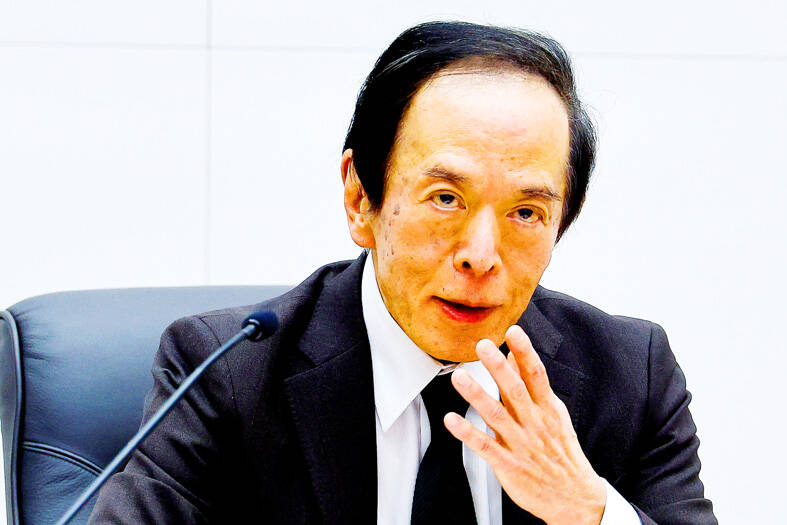
Photo: Reuters
The central bank has an inflation target of 2 percent that it used as a benchmark for whether Japan had finally escaped deflationary tendencies. There was “a positive cycle” of a gradual rise in wages and prices, Ueda said, adding that that monetary policy would remain easy for some time.
Although private-sector banks and other financial organizations will make their own decisions about rates, Ueda said he did not foresee any drastic rises.
The central bank would watch for any big moves in rates, which would cause confusion, he said.
“We made the decision because we foresaw stable and continuous 2 percent inflation,” he said.
Another factor supporting the shift: Japanese companies have announced relatively robust wage hikes for this year’s round of negotiations with trade unions.
Wages and profits at companies were improving, the bank said, in releasing its latest decision, referring to “anecdotal” accounts as well as data it had gathered lately.
“Japan’s economy has recovered moderately,” it said.
Market reaction was muted as the decision had been anticipated after Japanese media reports earlier this week. Tokyo’s benchmark Nikkei 225 index gained about 0.7 percent yesterday, while the US dollar was steady at about ¥150.
Bank officials said they want to make sure inflation is based on domestic factors that can sustain higher wages, not external ones.
The bank likely would not rush to change its overall easy lending framework and would closely monitor prices, analysts said.
The ultra-lax monetary policy also included huge injections of money into the economy through purchases of Japanese government bonds and other assets. The bank would continue with those government bond purchases at a rate of about ¥6 trillion and adjust quickly depending on economic trends, it said.
However, the bank called an end to other unorthodox policies including its yield curve control program, which allows bonds to move in a tight band, and the purchase of exchange-traded funds because they had “fulfilled their roles,” it said.
In its assessment of the economy that the current recovery was based partly on a “materialization of pent-up demand” even as global demand has weakened, the Bank of Japan said.
However, it said that industrial production was stagnant, partly due to cutbacks by vehicle manufacturers.
Housing investment was relatively weak and government spending was “more or less flat,” it said.
Ueda characterized the situation as “less than perfect.”
“Concerning risks to the outlook, there are extremely high uncertainties surrounding Japan’s economic activity and prices,” the bank said.

Taichung reported the steepest fall in completed home prices among the six special municipalities in the first quarter of this year, data compiled by Taiwan Realty Co (台灣房屋) showed yesterday. From January through last month, the average transaction price for completed homes in Taichung fell 8 percent from a year earlier to NT$299,000 (US$9,483) per ping (3.3m²), said Taiwan Realty, which compiled the data based on the government’s price registration platform. The decline could be attributed to many home buyers choosing relatively affordable used homes to live in themselves, instead of newly built homes in the city’s prime property market, Taiwan Realty
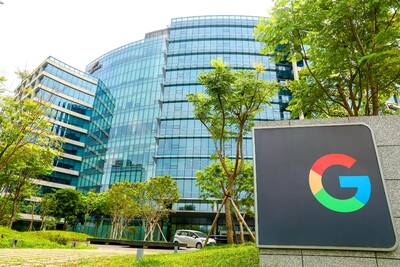
The government yesterday approved applications by Alphabet Inc’s Google to invest NT$27.08 billion (US$859.98 million) in Taiwan, the Ministry of Economic Affairs said in a statement. The Department of Investment Review approved two investments proposed by Google, with much of the funds to be used for data processing and electronic information supply services, as well as inventory procurement businesses in the semiconductor field, the ministry said. It marks the second consecutive year that Google has applied to increase its investment in Taiwan. Google plans to infuse NT$25.34 billion into Charter Investments Ltd (特許投資顧問) through its Singapore-based subsidiary Fructan Holdings Singapore Pte Ltd, and

Micron Technology Inc is a driving force pushing the US Congress to pass legislation that would put new export restrictions on equipment its Chinese competitors use to make their chips, according to people familiar with the matter. A US House of Representatives panel yesterday was to vote on the “MATCH Act,” a bill designed to close gaps in restrictions on chipmaking equipment. It would also pressure foreign companies that sell equipment to Chinese chipmaking facilities to align with export curbs on US companies like Lam Research Corp and Applied Materials Inc. The bill targets facilities operated by China’s ChangXin Memory Technologies Inc

Singapore-based ride-hailing and delivery giant Grab Holdings’ planned acquisition of Foodpanda’s Taiwan operations has yet to enter the formal review stage, as regulators await supplementary documents, the Fair Trade Commission (FTC) said yesterday. Acting FTC Chairman Chen Chih-min (陳志民) told the legislature’s Economics Committee that although Grab submitted its application on March 27, the case has not been officially accepted because required materials remain incomplete. Once the filing is finalized, the FTC would launch a formal probe into the deal, focusing on issues such as cross-shareholding and potential restrictions on market competition, Chen told lawmakers. Grab last month announced that it would acquire


 RSS
RSS